
What Is Agentic Trading? The Complete Guide
Agentic trading means AI that perceives markets, reasons, and acts under your guardrails. What it is, what it is not, and how to start with discipline.
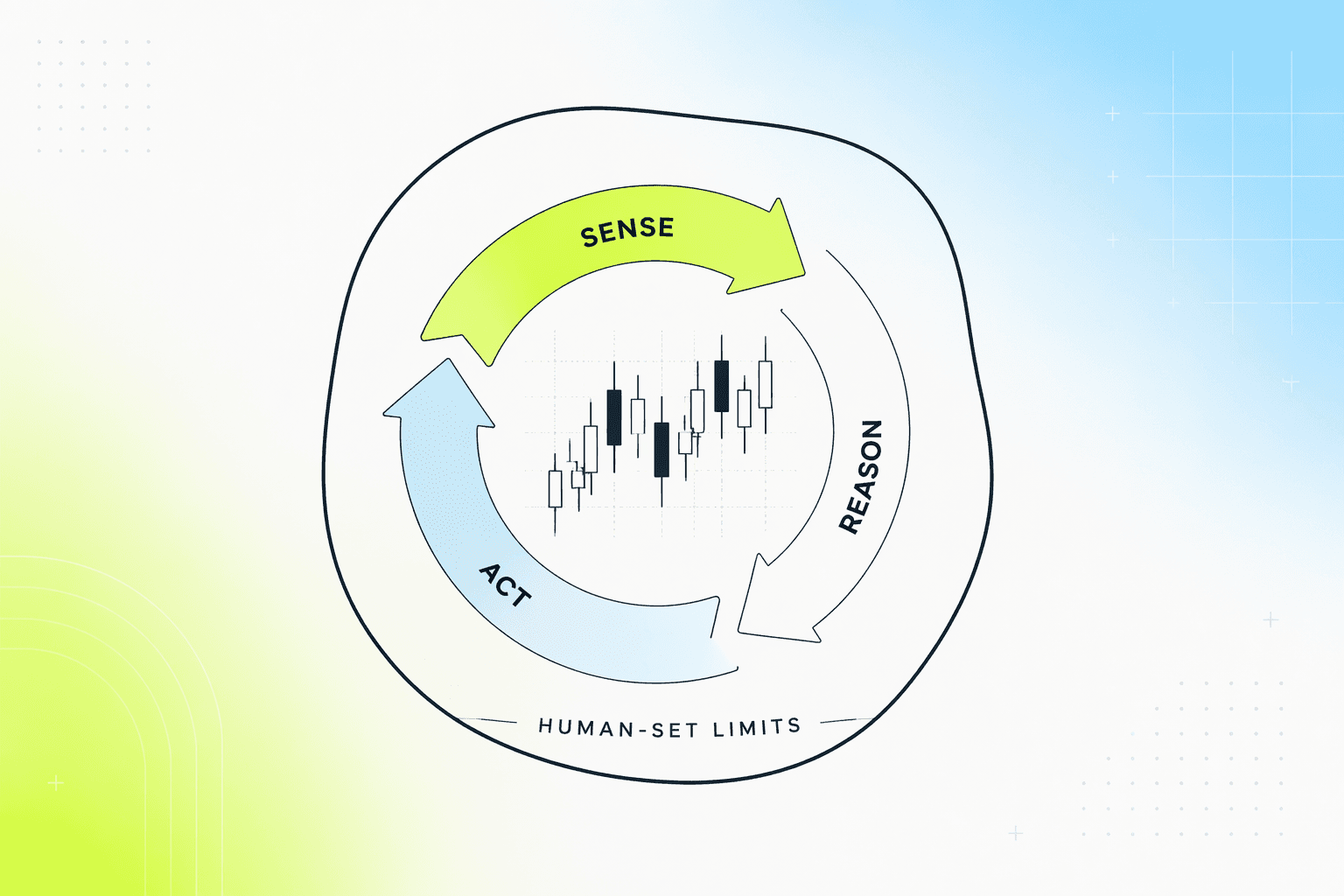
Agentic trading is the point where AI stops commenting on markets and starts acting in them: software that watches prices, indicators, and news around the clock, reasons about what it sees, and places orders, alerts, or rebalances inside limits you set in advance. That last clause carries all the weight.
This guide defines the term precisely, separates real agents from chatbots and classic bots, walks through the perceive-reason-act loop, and lays out the backtest-paper-live discipline that keeps autonomy useful rather than dangerous. It also states plainly what today's agents cannot do.
What agentic trading actually means
Strip the marketing away and an agentic trading system does three things in a loop. It perceives market state: prices, technical indicators, news flow, volatility, the current shape of your portfolio. It reasons about whether that state matches the strategy you gave it. And it acts on the conclusion, by submitting an order, firing an alert, or rebalancing a position. Every action happens inside guardrails you fixed before the agent ever ran: position sizes, stop levels, drawdown caps, the venues it may touch.
The definition earns its keep because two neighboring products get sold under the same label. A chatbot only talks. Ask a general assistant about RSI divergence and you get a fluent paragraph, no view of your account, and no ability to do anything about it. A classic bot only acts. It executes a fixed if-then rule, "buy when price crosses above the 50-day average," exactly as written, forever, whether or not the market that made the rule sensible still exists.
An agent combines perception, reasoning, and action, then adds the part that makes the combination tolerable: explicit, machine-enforced constraints. That is what "agentic" means when the word is used honestly.
One more boundary worth drawing. The strategy is yours. A well-built agent never decides what you should believe about a market; it executes what you already believe, faster and more consistently than you can. Anything promising to invent a winning strategy for you belongs in a different, far more suspicious category.
The perceive-reason-act loop, one cycle at a time
Watch a single cycle run. Suppose you gave an agent this brief: accumulate BTC on weakness, never during bad news, never beyond 10% of the portfolio.
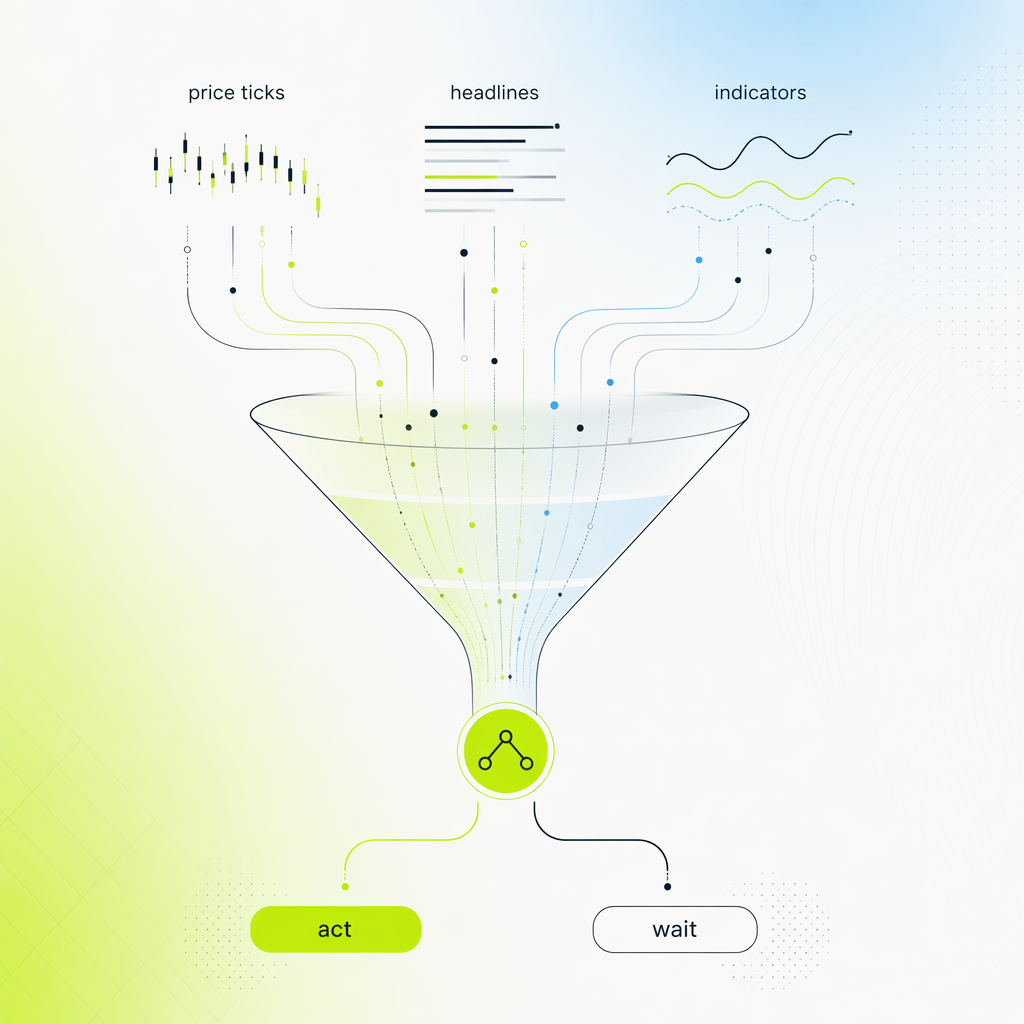
Perception. The agent ingests 4-hour candles, computes RSI(14), tracks headline severity on BTC, and reads your current exposure. This is data plumbing, not intelligence, and it runs continuously.
Reasoning. A trigger fires: RSI has dropped below 30. The agent evaluates the rest of the brief. Any high-severity negative headline in the last 12 hours? No. Would a new buy push BTC exposure past 10%? No. Conditions met.
Action. It submits a limit order sized to your rule, attaches a trailing stop, records what it saw and why it acted, and goes back to watching.
The reasoning layer is where implementations differ most. Some agents are pure rules. Some put a language model in the loop to interpret fuzzy conditions like "bad news." The sturdiest designs use the model for interpretation and leave arithmetic, prices, and order handling to deterministic code, because language models are unreliable at exactly the things order execution cannot get wrong. The full anatomy (inputs, tools, memory, the guardrail layer) deserves its own piece, and how AI trading agents actually work walks through it end to end.
Chatbot, bot, or agent: which machine are you buying?
The vocabulary confusion is not an accident; "AI-powered" sells. Here is the sober comparison:
| Chatbot | Classic bot | Trading agent | |
|---|---|---|---|
| Sees market state | No | Only its one rule's inputs | Prices, indicators, news, your portfolio |
| Reasons about context | In text only | No | Yes, within your strategy |
| Takes action | Never | Rigidly | Inside guardrails |
| Typical failure | Confident nonsense | Keeps firing after the regime shifts | Does what you said, not what you meant |
None of the three is universally better. If your strategy is "buy $100 of one asset every Friday," a plain bot is cheaper, simpler, and easier to audit than any agent, and deterministic tools deserve more respect than agent marketing gives them. Agents earn their complexity when conditions are contextual: add on dips, but not during a news storm, and shrink size when volatility doubles. The decision framework, including the cases where each option wins, is mapped in AI agent vs. trading bot.
The failure column rewards a second look. A chatbot's failure is visible: you read the nonsense. A bot's failure is silent: the rule keeps executing in a market it no longer fits. An agent's characteristic failure is subtler, a gap between your intent and its interpretation, which is exactly why serious platforms restate what they understood and wait for your approval before anything runs.
What's real in 2026 (and what's still marketing)
The institutional shift is real. In the Cambridge CCAF and World Economic Forum's 2026 Global AI in Financial Services Report (May 2026), 23% of financial-industry respondents describe their agentic AI work as scaling or transforming, and another 29% are piloting; the same report flags the adequacy of human oversight as a key risk as agentic AI spreads. Governance attention at that level usually means a technology has left the demo stage.
The performance claims mostly are not. A 2026 audit of 77 studies on LLM trading agents ("Agentic Trading: When LLM Agents Meet Financial Markets," arXiv:2605.19337, 2026) found the evidence for durable alpha thin, locating the practical value in disciplined execution, monitoring, and research assistance instead. Many impressive agent backtests also lean on a quiet flaw: a language model tested on a period inside its own training data can simply remember what happened.
So the honest pitch for agentic trading is not "the AI will out-trade you." It is narrower and more useful: the agent will execute your strategy at 3am, without hesitation, without revenge trades, with the same sizing discipline on trade two hundred as on trade one. Consistency is a smaller promise than alpha. It is also one that machines demonstrably keep.
Backtest, paper trade, go live: the discipline that makes it safe
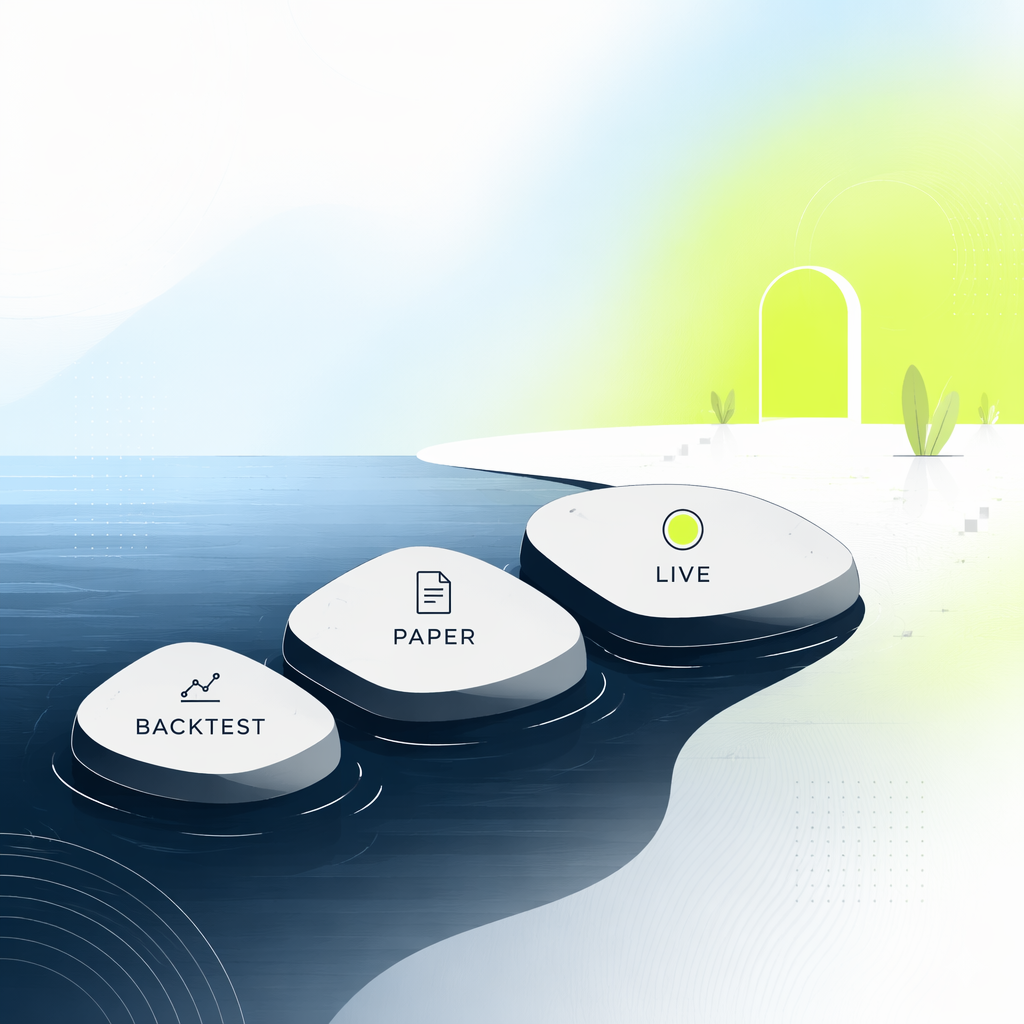
Autonomy should be earned in stages, by evidence. The sequence is the same on any serious platform.
Backtest first. Replay the exact agent definition against years of history, across different regimes, with slippage and fees included. You are not looking for a beautiful equity curve. You are looking for the max drawdown you would have had to sit through, and asking whether you honestly would have sat through it.
Paper trade next. Run the same agent on live market data with no real orders. The backtest validated the strategy; the paper run validates the translation — did the agent trigger when you expected, size correctly, behave through a weekend gap? Two to four weeks, or twenty-plus signals, is a reasonable bar.
Then go live, small, with hard limits. Guardrails like per-position caps and a drawdown circuit breaker are what let you sleep through this phase.
Here is the sequence on Obside, the platform we build. You type: "DCA $200 into an S&P 500 ETF every Monday, skip the buy if RSI(14) on the daily is above 75, pause everything if the portfolio drops 10% in a month." The copilot restates that as monitored conditions, an order size, and a risk rule, and you approve the restated version rather than your loose phrasing. The backtesting engine replays it over years of data in minutes. One click starts it as a paper agent on live prices; once the paper run matches your expectations, the same definition goes live against your connected broker or exchange, with the risk caps enforced at execution time. For the step-by-step version of this path, see how to create an AI trading agent.
Who agentic trading is for (and who should skip it)
The best fit is a specific person: you already have rules, and you fail to follow them. You know you should rebalance when allocations drift five points, and you postpone it. You planned to buy the dip, then froze when it arrived. You hold crypto, which trades while you sleep. For that person, an agent closes the gap between the plan and the execution, which is where most retail losses actually live.
It is a poor fit in three cases. If you have no strategy, an agent gives you nothing to automate; no reasoning layer will conjure an edge on your behalf. If you will not backtest or paper trade, you are handing live capital to an unverified translation of your own words. And if what you really want is to hand over judgment entirely, you want a robo-advisor or an index fund, not an agent. Full autonomy without human review is precisely the configuration serious practitioners refuse to run.
Where to go from here
Defined honestly, agentic trading is a smaller and better idea than the hype version: machines that perceive, reason, and act on your strategy, inside your limits, with autonomy granted in stages as the evidence accumulates. Chatbots talk. Bots repeat. Agents execute your logic under constraints, and the backtest-paper-live sequence is what separates a tool from a gamble.
If you would rather feel the loop than read about it, describe one rule you already believe in to Obside and let it run as a paper agent this week. Conviction about agentic trading comes from watching your own logic execute without you.
Educational content only. This is not investment advice. Trading involves risk, including possible loss of capital.
FAQ
No. Algorithmic trading is the established discipline of systematic rules, backtesting, and automated execution. Agentic trading adds a reasoning layer and a natural-language interface on top: the agent can weigh context and unstructured inputs like news instead of only evaluating fixed formulas. The validation discipline carries over unchanged, though. Agents still need backtests, paper runs, and hard risk limits, exactly like any algorithm you would trust with money.