
Automated Dollar-Cost Averaging, With an Agent's Discipline
DCA works because it removes decisions. Automation removes the skipped buys too. Set up condition-aware DCA honestly, including why lump-sum investing usually wins on paper.
Dollar-cost averaging is the simplest automation in investing: buy a fixed amount of an asset on a fixed schedule, whatever the price. Simple to describe, and yet most people who DCA by hand eventually break the schedule, usually at the worst possible moment. That gap between the plan and the execution is the whole case for automated dollar-cost averaging. This article covers what DCA genuinely does, what automation adds, the condition-aware variants an agent makes possible, and the honest math the sales pages skip: on average, lump-sum investing beats DCA. The point of DCA is discipline, not alpha.
What DCA does, and what it does not
The mechanics first. Committing a fixed currency amount at fixed intervals means you buy more units when prices are low and fewer when prices are high. Put €300 into an asset monthly: at €30 per unit you get 10 units, at €20 you get 15. Over time your average cost per unit lands below the average of the prices you paid, a small arithmetical courtesy known as the cost-averaging effect.
What DCA does not do is protect you from a falling market. If the asset grinds down for two years, a DCA schedule loses money for two years, just more slowly than a single early purchase would have. Nor does it identify good assets: averaging into something that goes to zero produces a beautifully smooth ride to zero. The choice of what to accumulate is a judgment DCA cannot make for you, and this article will not make it either.
What DCA actually buys you is decision removal. There is no "is now a good time?" question, ever. That sounds like a small thing until you have watched yourself hesitate through a red week with cash in hand. The schedule answers the timing question in advance, once, while you are calm.
What automated dollar-cost averaging adds
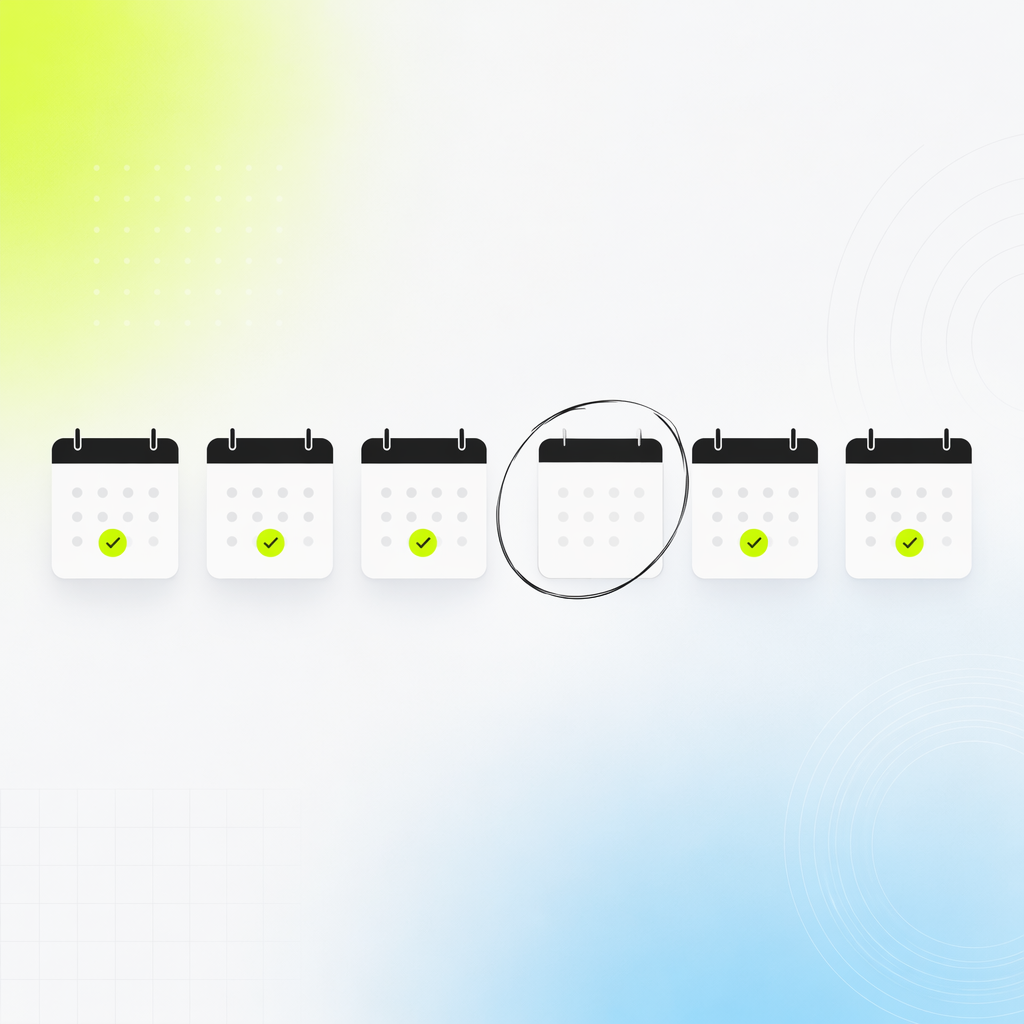
If the schedule is the strategy, then keeping the schedule is the performance. Manual DCA fails in predictable ways, and each failure has a name worth knowing.
The skipped buy. Markets fall 15% in a week, headlines turn apocalyptic, and this month's purchase suddenly feels optional. The irony is brutal: the buy you skip in a selloff is precisely the one your future average cost needed most. People do not skip buys at all-time highs; they skip them in exactly the conditions DCA exists for.
The upgrade itch. After a few winning months, a fixed schedule feels naive. You start "improving" it: doubling here, pausing there, waiting for a dip that never comes. Each improvisation converts a rule back into a feeling.
Plain forgetting. Life happens. A missed transfer, a holiday, a broker app you stopped opening. Streaks die quietly.
Automation deletes all three failure modes at once. An agent placing the order every Monday at 09:00 does not read headlines, does not feel clever after a win, and does not forget. Execution becomes a property of the system instead of a test of character, week after week. That is the entire value proposition, and it is worth more than any optimization of the schedule itself. The same logic extends across a whole portfolio of hands-off rules, which is the territory of the autopilot investment app approach.
One honest caveat: automation also automates mistakes. A schedule too large for your cash flow will bounce transfers mechanically. Size the recurring amount so that you never need to pause it, because a paused automation is a manual process again.
Smart variants an agent makes possible
A calendar with an order attached needs no intelligence. Where an agent earns its keep is conditional DCA, schedules that read market state before acting. Three patterns are worth knowing.
Condition-aware skips. Add a filter to the schedule: buy every Monday, unless the daily RSI(14) is above 75. The idea is to avoid mechanically adding at momentum extremes. Note what this really is: a small, explicit timing bet layered on a no-timing strategy. Sometimes it helps, sometimes the "overheated" market keeps climbing and your filter just means fewer units. If you add a skip rule, backtest it against plain DCA before believing in it.
Drawdown boosts. The mirror image: double the scheduled buy after the asset has fallen a set percentage from its recent high, say 20%. This hard-codes the "be greedy when others are fearful" instinct people claim to have and rarely execute. A cap matters here, for instance no more than two boosted buys per month, so a long bear market cannot drain your cash reserve ahead of plan.
Multi-asset DCA and DCA-out. A single schedule can split each contribution across several assets by weight you define, 70/30 between two holdings, for example, keeping proportions steady without a separate rebalancing pass for new money. The same machinery also runs in reverse: selling a fixed amount on a schedule, sometimes called DCA-out, turns "I should trim this position someday" into an exit that actually happens, spread across prices instead of dumped on one emotional day.
Every added condition moves you further from pure DCA and closer to a strategy that needs validation. Two conditions is a reasonable ceiling. Ten conditions is a trading system wearing a DCA costume.
The honest part: lump sum usually wins on paper
Now the section this article owes you. If you have a lump of cash today, the historical record is consistent: investing it all immediately has beaten spreading it out over months in most periods, for the unglamorous reason that markets rise more often than they fall. Every month your cash waits on the sidelines is, on average, a month of missed exposure. DCA-ing a windfall is, statistically, a drag on expected return.
So why does DCA survive contact with that fact? Two reasons, both legitimate.
First, most DCA is not a choice against lump sum at all. If you invest from salary, the money arrives in monthly pieces; investing each piece when it arrives simply is lump-sum investing, done repeatedly. Automation makes sure it happens. There is no timing decision to optimize, only a discipline to keep.
Second, for an actual windfall, the comparison is not between two spreadsheets but between two humans. The spreadsheet lump-sum investor never panics. The real one, having invested everything the week before a 25% drawdown, sometimes sells the bottom and leaves the market for years. DCA is regret insurance: you pay a modest expected-return premium for a dramatically lower chance of a catastrophic behavioral response. For some investors that premium is worth every basis point; for others with steadier nerves it is money left on the table. Knowing which investor you are matters more than the average.
What DCA is not, on any reading of the evidence, is free alpha. Anyone selling it as a return-enhancing trick is selling something.

From sentence to schedule: setting it up
On Obside, the setup for everything above is one message to the copilot. You type: "DCA $200 into BTC every Monday, skip the buy if RSI(14) on the daily is above 75." The copilot restates what it understood, the asset, the amount, the schedule, the skip condition, as explicit monitored rules, and nothing runs until you approve that restatement. The restating step is your defense against the gap between what you said and what you meant, and getting the phrasing right the first time is a skill worth ten minutes of study; there is a full pattern library in trading prompts that work.
The disciplined path from there mirrors any automation worth trusting. Run the schedule as a paper agent first: same live prices, no real orders, so you can watch a few Mondays resolve and confirm the skip condition fires when you expected. Then go live with the risk limits you chose, such as a monthly spending cap the agent cannot exceed. If you later add a drawdown boost or a second asset, the same restate-approve-paper loop applies to the change.
Two neighboring automations complete the picture. Contributions concentrate whatever you keep buying, so weights drift; pairing the schedule with AI portfolio rebalancing keeps the accumulation aligned with your targets. And if your horizon is measured in decades, DCA is just one instrument in a broader policy of calm, written rules, the subject of AI for long-term investing.
A schedule you will actually keep
The best DCA plan is the one that survives your worst week, and that is an argument about execution, not spreadsheets. Keep the core schedule dumb, add at most one or two conditions you have backtested, be honest that lump sum wins on average when you genuinely hold a lump, and let a machine keep the streak so your character never has to. If you want that machine to be one sentence away, Obside turns the sentence into a running agent, paper first, limits enforced.
Educational content only. This is not investment advice. Trading involves risk, including possible loss of capital.
FAQ
The strategy is identical; the execution is not. Manual DCA depends on you placing every scheduled buy, including the ones that fall in frightening weeks, and skipped buys during selloffs are the most common and most costly failure. Automation makes execution unconditional: the order goes in regardless of headlines, mood, or forgetfulness. Since DCA's entire value is consistency, removing the human from the repetition is the single biggest upgrade available.