
Backtest Overfitting: When Great Results Are a Trap
Curve-fitting, survivorship, lookahead, and the new one: LLMs that memorized the test period. How to spot inflated results and validate strategies that survive live markets.

The most dangerous thing a backtest can do is succeed. Backtest overfitting is what happens when a strategy learns the noise of one specific slice of history instead of anything real about markets, producing a gorgeous equity curve that predicts exactly nothing. The quant world has fought this for decades. The agent era adds a new twist: language models that may have already read the history you are testing them on. This article covers the classic mechanics, the old biases that still catch people, the new LLM memorization failure mode, and the defenses that separate trustworthy results from flattering ones.
Why backtest overfitting happens: degrees of freedom
Every adjustable choice in a strategy is a degree of freedom, and degrees of freedom are how noise gets fitted. Watch it compound. A moving-average crossover starts with two parameters: the fast and slow lengths. Add an RSI filter, and you have four: period plus threshold. Add a time-of-day window, a stop distance, and a profit target, and you are at seven or eight. Test ten plausible values for each and the space holds tens of millions of combinations. Somewhere in there, a configuration fits your test period beautifully by pure accident. An optimizer will find it for you.
The intuition is the coin-flipping contest. Put ten thousand people in a room flipping coins, and after ten rounds roughly ten of them have flipped heads every time. They look like geniuses. They are lottery winners. Parameter searches run the same contest with strategy variants as contestants, and the winner of a large enough search is nearly guaranteed to be a fluke. The uncomfortable rule that follows: the more configurations you tried, the less the best one's performance means. A Sharpe ratio of 2.0 from testing three ideas is interesting. The same number from a sweep of fifty thousand is mostly a measurement of how big the sweep was.
The classic biases: survivorship and lookahead
Two older sins inflate backtests without any optimizer involved.
Survivorship bias means testing on today's winners. Run a strategy across the current constituents of a stock index and you have quietly excluded every company that was delisted, acquired at a discount, or went bankrupt along the way; the losers your strategy would have held are missing from the data. Crypto is worse: thousands of dead tokens simply vanish from most datasets, so a "buy the top 50 by market cap" backtest built on surviving coins tests a portfolio no one could have known to hold. The fix is point-in-time data reflecting what was actually tradable on each date, and skepticism whenever such data is not available.
Lookahead bias means acting on information before it existed. The blunt version: trading a candle using that candle's close. Subtler versions sneak in everywhere: economic data as later revised rather than as first printed, indicators computed over a full-sample window, or fundamentals stamped with the fiscal period's date instead of the later date they were published. Any of these leaks tomorrow's newspaper into today's decision, and the backtest rewards the leak.

The new failure mode: your LLM already read the answers
Agentic strategies introduce a version of lookahead that no data-hygiene checklist catches, because the leak is inside the model. A large language model trained on data through, say, 2024 has ingested financial news, price commentary, and post-mortems covering every dramatic market move before its cutoff. Ask it to "decide" what to trade in March 2020 and it is not forecasting. It is remembering.
The research here is blunt. "Can LLM-based Financial Investing Strategies Outperform the Market?" (arXiv:2505.07078, 2025) showed that LLM-strategy backtests are inflated by memorization and lookahead: models whose training data overlaps the test window can recall tickers, dates, and price moves, and performance often degrades once evaluation moves out-of-sample. A follow-up memory-controlled benchmark (arXiv:2605.28359, 2026) reached the same verdict from the other direction, finding that long backtests overlapping a model's knowledge cutoff let memorized market history leak into its "predictions," and that controlling for memory sharply reduces the apparent skill. An agent that looks brilliant on 2020–2023 may simply be a very expensive index of what happened in 2020–2023.
The practical consequences are simple to state. If an LLM makes decisions anywhere in your loop, treat any backtest window before that model's training cutoff as contaminated and weight evidence from after the cutoff. Better, keep the LLM out of the prediction path entirely: use it to translate your intent into explicit rules, then replay those deterministic rules against history, where memorization has nothing to touch. The broader division of labor between language models and deterministic engines is covered in LLMs in trading.
Defenses that actually work
None of the defenses are exotic. Their power is in being applied before you fall in love with a result.
Hold out data, and respect the holdout. Split history and tune only on the earlier part, keeping the recent segment untouched until the design is frozen. One look at the holdout per strategy. Peek repeatedly and adjust each time, and the holdout has silently become training data.
Walk-forward testing. Instead of one static split, optimize on a window, test on the next slice, roll forward, and repeat. The stitched-together out-of-sample segments show how the strategy behaves when it must keep working on data it never saw, which is the actual job description.
Regime coverage. A test window is an argument, and a narrow one is weak. Span the 2018 crypto bear, the March 2020 crash, the 2021 melt-up, and the 2022 grind, and you learn whether the edge is a market property or a regime costume. A survey of LLM trading agents (arXiv:2408.06361, 2024) flagged short test windows and small universes as endemic weaknesses across the field, and retail backtests are rarely better.
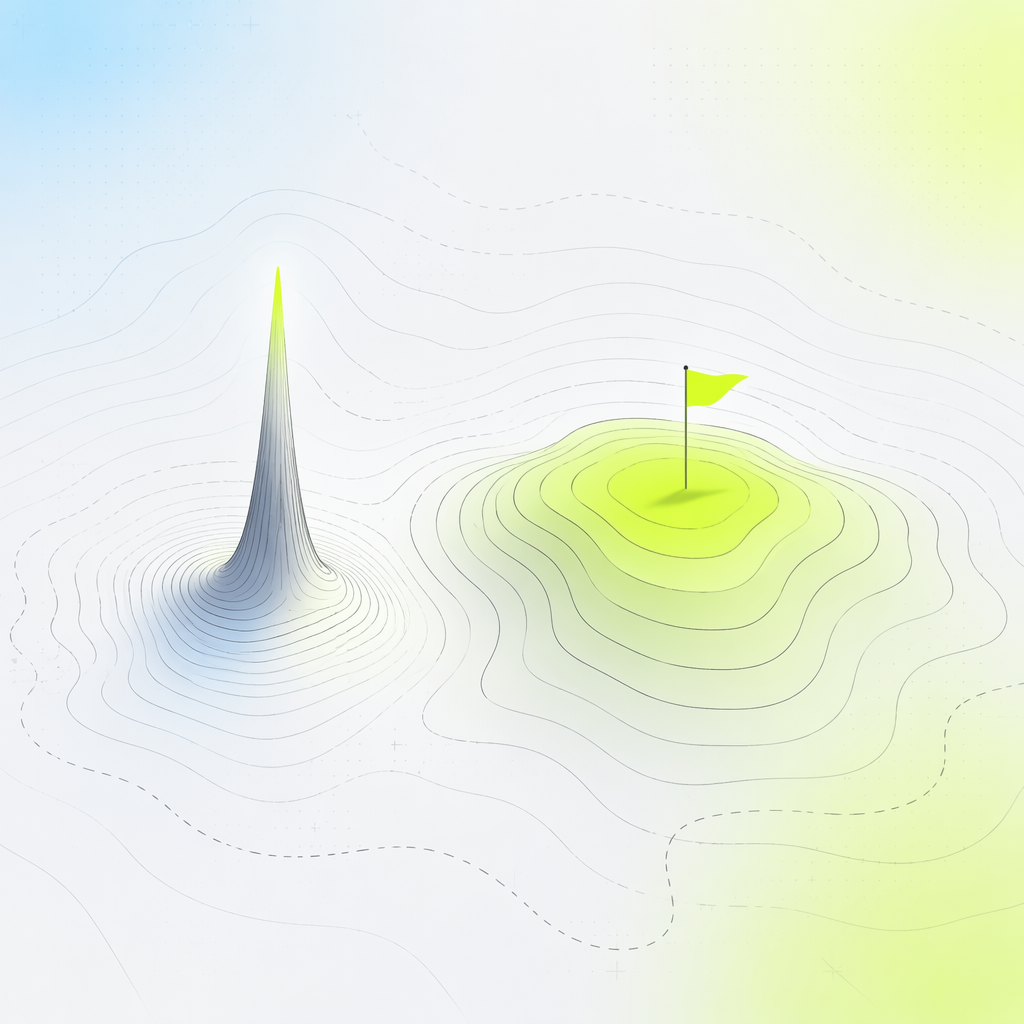
Parameter plateaus over peaks. Vary each parameter around its chosen value and watch what happens. Suppose an RSI entry threshold of 30 backtests at a Sharpe of 1.4, but 25 gives 0.3 and 35 gives 0.4: that needle-thin spike is the signature of fitted noise, because real market effects are not that precise. If everything from 25 to 40 lands between 0.9 and 1.2, you are standing on a plateau, and plateaus travel to live trading far more often than peaks do. Pick the middle of a broad plateau over the top of a sharp spike, even when the spike's number is prettier.
This is also where tooling either helps or quietly hurts, so choose backtesting software that makes honesty convenient. On Obside, a backtest replays years of history in minutes with slippage assumptions built in, which makes the cheap, disciplined move, testing across regimes with realistic costs before trusting anything, the path of least resistance rather than a chore. The agent-specific workflow is walked through in how to backtest an AI trading agent.
Simplicity as a prior, and paper trading as the final exam
When two strategies backtest similarly, prefer the one with fewer moving parts, and hold that preference before seeing any results. Each added rule or parameter must pay rent by surviving out-of-sample, not merely by improving the in-sample curve, which added complexity almost always does for free. A two-rule strategy with a Sharpe of 0.9 across four regimes deserves more trust than a nine-parameter construction showing 1.8 on a single bull run. Complexity is not sophistication. In backtesting, it is mostly surface area for noise to grip.
Then comes the one test nothing can contaminate: the future. Paper trading runs your exact agent against live markets with no capital at risk, on data that did not exist when you designed the strategy. No optimizer has seen it, and no language model has memorized it. One thing matters most about this graduation: nothing about the agent changes on the way. On Obside, the same agent definition that was backtested moves to paper mode unchanged, with identical conditions and risk controls, so the paper run tests the strategy you validated rather than a hand-copied approximation of it. Three or four weeks of paper results that rhyme with the backtest is the strongest evidence retail validation can produce.
Where to go from here
Treat every beautiful backtest as a claim requiring hostile review, and audit in this order: how many configurations were searched, whether the data is survivorship-free and point-in-time, whether any LLM in the loop could have memorized the window, whether the result rests on a plateau or a spike, and whether it survived data you held out. Then let paper trading deliver the verdict. If you want this discipline built into the workflow rather than bolted on, Obside runs the whole ladder, regime-spanning backtests with slippage baked in, then paper, then live, on one unchanged agent definition.
Educational content only. This is not investment advice. Trading involves risk, including possible loss of capital.
FAQ
It is when a strategy is tuned, deliberately or accidentally, until it fits the random noise of one historical period instead of a repeatable market behavior. The backtest looks excellent because the strategy has effectively memorized that slice of history. Live markets produce new noise, the memorized patterns fail to repeat, and performance collapses. The telltale symptom is a strategy that looks far better in testing than any plain economic logic would justify.