
Natural Language Trading: From Prompt to Portfolio
Describing a strategy in a sentence changes who can automate. How the translation from human phrasing to machine-precise rules works, and where it breaks.

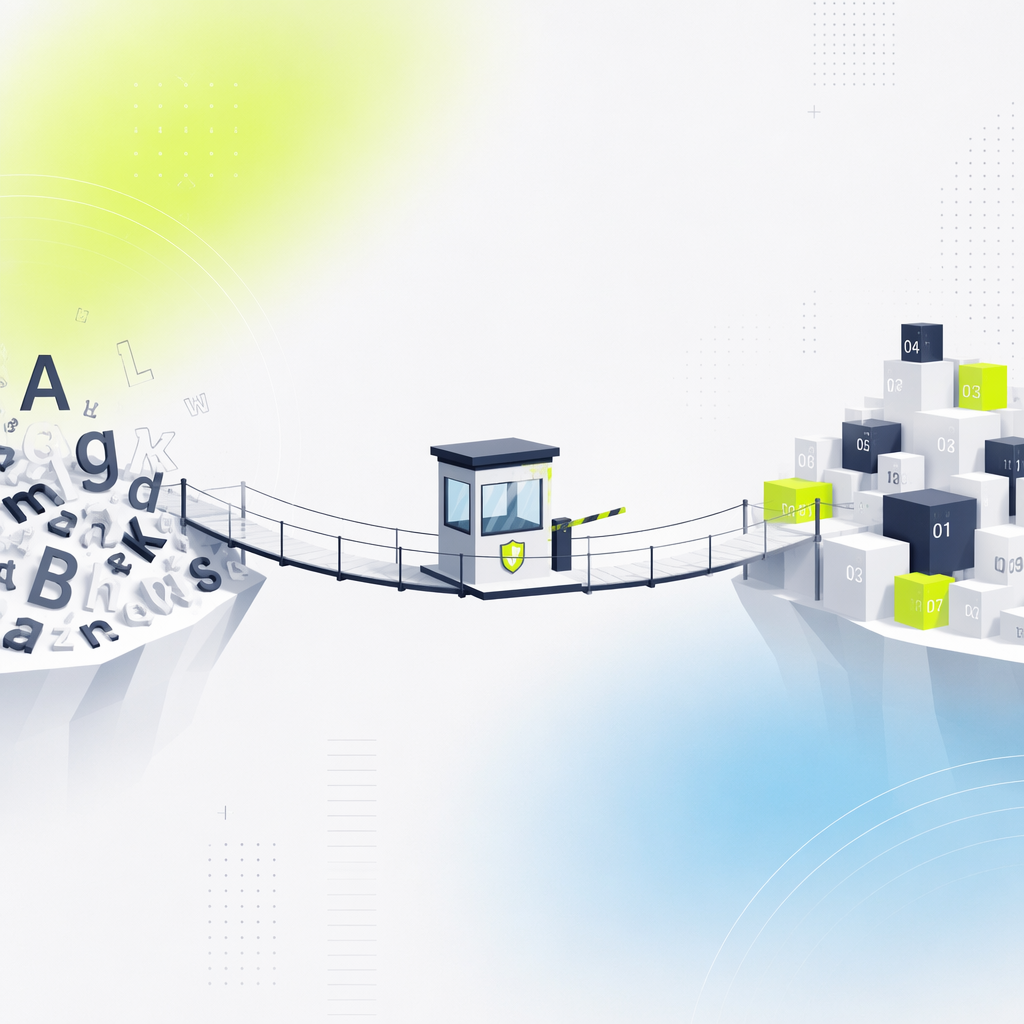
For twenty years, automating a trade meant one of two things: learn to code, or wrestle a form with forty dropdown fields. Both filters removed most investors before their first rule ever ran. Natural language trading removes the filter. You describe what you want in a sentence, and a system turns it into monitored conditions and executable orders. The hard part is hiding in the middle of that sentence: human phrasing is ambiguous, markets are not, and the translation between them is where these systems succeed or quietly fail. This article explains how that translation works and how to judge it.
The interface was the barrier, not the idea
Most retail investors have automation-shaped ideas. Buy a fixed amount every week. Take profits after a big run. Stop adding to a position that keeps falling. None of this is exotic; it is policy, the kind of rule anyone can state out loud.
What stood between the idea and a running system was expression. Coding a bot means Python, API documentation, server uptime, and error handling at 3 a.m. Form-based builders are gentler but still force your idea through their vocabulary: if the dropdown has no field for "skip the buy after a bad week," your rule loses that clause. Either way, the tool shaped the strategy instead of the strategy shaping the tool.
A language interface inverts that. The system adapts to your phrasing rather than you adapting to its schema. That matters less for professional quants, who were never blocked, and enormously for everyone else: the investor with a clear policy and no interest in becoming a programmer. It is the interface layer of a bigger shift toward agentic trading, where software executes your logic under your constraints, and it slots into the same pipeline any serious trading automation follows: define, test, then run.
"Buy the dip" has no definition
Here is the core problem, visible in one instruction: "Buy the dip on Bitcoin."
A human colleague would know roughly what you mean. A market does not deal in roughly. Unpacked, that sentence hides at least five open parameters:
| Ambiguity | The question a machine must answer |
|---|---|
| What is a dip? | Down 3%? 10%? From yesterday's close, the 7-day high, or your last buy price? |
| Buy how much? | Fixed amount, percentage of cash, scaled to dip size? |
| How often? | Once per dip? What stops it from buying every hour of a crash? |
| When does a dip become a crash? | Is minus 40% still a dip you want to buy? |
| When is this wrong? | What result would make you switch the rule off? |
Every one of those blanks must be filled before the rule can run. The only question is who fills it: you, explicitly, or the system, silently. A system that guesses is dangerous precisely because it will run, and it will do something, and the something may not be what you meant. "Buy the dip" interpreted as "buy 5% of cash on every 3% drop, unlimited frequency" empties an account into a falling market with perfect obedience.
The same trap sits inside gentler phrases. "Every week" (which day, which hour, which timezone?). "Take profits when it's up a lot" (up from where, sell how much?). "If things get bad, stop" (measured by what?). Human language leans on shared context; execution systems have none. Translation is therefore not a convenience feature of natural language trading. It is the entire product.

How good natural language trading systems resolve ambiguity
Well-designed systems refuse to guess silently. Three mechanisms separate the trustworthy ones from the rest.
Restating intent. Before anything runs, the system plays your instruction back in precise terms: asset, trigger conditions, order size, schedule, exit, invalidation. The restatement is the contract. If it says "buy on any 3% daily drop" and you meant weekly, the mistranslation dies at the review stage instead of in your account. When you evaluate a platform, this is the first thing to test: give it a vague instruction and see whether it exposes its assumptions or buries them.
Asking, not assuming. When a parameter genuinely cannot be inferred, the right behavior is a clarifying question. "You said buy the dip: from what reference, and how much per buy?" A system that never asks questions is not smarter than one that does; it is guessing with better manners.
Showing the parsed rule, permanently. After approval, the exact machine-readable conditions should stay visible: not the poetic sentence you typed, but the thresholds and sizes actually being monitored. You should be able to audit at any time what the agent believes its instructions are, because that, and not your memory of the conversation, is what will execute.
Notice what all three mechanisms have in common: they move the ambiguity resolution before the money. The cost of a mistranslation caught at review is ten seconds of editing. The cost of one caught in a live account is whatever the market decided it was.
From sentence to running agent: a worked example
Here is what the full path looks like on Obside, sentence included.
You type into the copilot: "Every Friday, put €150 into an S&P 500 ETF, but skip that week if the index closed down more than 3% the day before, and pause everything if the position is down 20% overall."
The copilot restates it as a rule: buy order of €150 in your chosen S&P 500 ETF, scheduled every Friday; a skip condition that checks Thursday's close against the prior close and cancels the week's buy on a drop greater than 3%; and an invalidation clause that pauses the automation entirely if unrealized loss on the position reaches 20%, with a notification to you. Ambiguities it could not infer come back as questions: which ETF at which broker, and at what time on Friday.
You review the restated conditions and approve. The agent then runs in paper mode first: same schedule, same conditions, live market data, no real orders. After a few Fridays you can check the log: did it buy when it should have, did the skip clause fire on the week it was supposed to? Only then do you switch it live, and the same conditions execute with real orders through your connected broker account.
The sentence was the interface. The restatement was the safety net. The paper run was the exam. That sequence, rather than any single feature, is what makes the plain-language approach trustworthy, and it mirrors the full workflow we walk through in how to create an AI trading agent.
What a sentence cannot do
The interface deserves honest limits, because removing the coding barrier removes none of the thinking.
A clearer sentence does not make a bad strategy good. "Buy every dip with all my cash" translates perfectly and fails perfectly. The translation layer guarantees fidelity to your intent, not quality of your intent. Backtesting and paper trading exist to test the idea itself, and no interface replaces them.
Precision still has to come from somewhere. Systems can ask clarifying questions, but you have to hold answers: what invalidates the rule, how much per position, what loss ends the experiment. Investors who cannot answer those questions in any interface are not ready to automate in this one. Writing instructions that carry their own precision is a learnable skill with known patterns, and we keep a library of them in trading prompts that work.
Some strategies do not fit sentences. Genuinely quantitative logic, a portfolio optimization, a signal built from custom data, wants a formal specification, not prose. If you find yourself typing a paragraph with twelve nested clauses, the language interface has stopped helping.
And the responsibility never transfers. The agent executes what you approved; the approval was yours. Plain language lowers the barrier to entry, not the bar for judgment.
Where to go from here
Natural language trading is best understood as a translation contract: you supply intent, the system supplies precision, and the visible restatement is where the two meet. Judge any platform by that contract. Does it expose its assumptions, ask when it cannot infer, show the parsed rule, and make you rehearse on paper before going live?
If you want to test the loop end to end, Obside lets you type a strategy in your own words, shows you exactly what it understood before anything runs, and walks the result through backtest and paper trading before a single real order.
Educational content only. This is not investment advice. Trading involves risk, including possible loss of capital.
FAQ
Natural language trading means describing a trading or investing rule in ordinary language, "buy €150 of an S&P 500 ETF every Friday unless the index just fell 3%", and having a system translate it into precise, machine-executable conditions. The translation layer defines the quality of the experience: good systems restate what they understood and ask about ambiguities before any order can be placed.