
News-Based Trading With AI: React in Seconds, Not Hours
What an AI news pipeline actually does, the two design patterns that survive contact with real headlines, and the failure modes nobody advertises.

A headline breaks at 14:31. By 14:32 the stock is down 4%. You see the story at 15:10, between meetings, and now you are deciding what to do 39 minutes after the market already decided. That gap is the problem news-based trading AI exists to solve — not predicting headlines, but compressing the distance between an event and your pre-written rules responding to it.
This article walks through what an AI news pipeline actually does, the two design patterns that hold up in live conditions, and the failure modes that turn fast reactions into fast losses.
Why you are structurally late to every headline
Institutional systems parse wire feeds in milliseconds. Market makers adjust quotes before most journalists finish their second sentence. By the time a story reaches the app where you read news, the first price move is over. Racing that machinery is not a strategy available to you, and any product implying otherwise is selling latency it does not have.
What you can change is everything after the first move. Most retail damage from news doesn't come from being seconds late; it comes from being hours late, or from reacting emotionally once you finally see the story. A holding gaps down on a regulatory headline at 3am your time; you wake up, panic, and sell the bottom. Crypto makes this worse: the market trades through every weekend and every night, and no human watches all of it.
An agent doesn't sleep, doesn't panic, and doesn't improvise. It applies the rule you wrote in a calm moment to the event you couldn't have watched for. That is the honest value proposition: consistent reaction in seconds, not clairvoyant reaction in microseconds.
What a news-based trading AI pipeline actually does
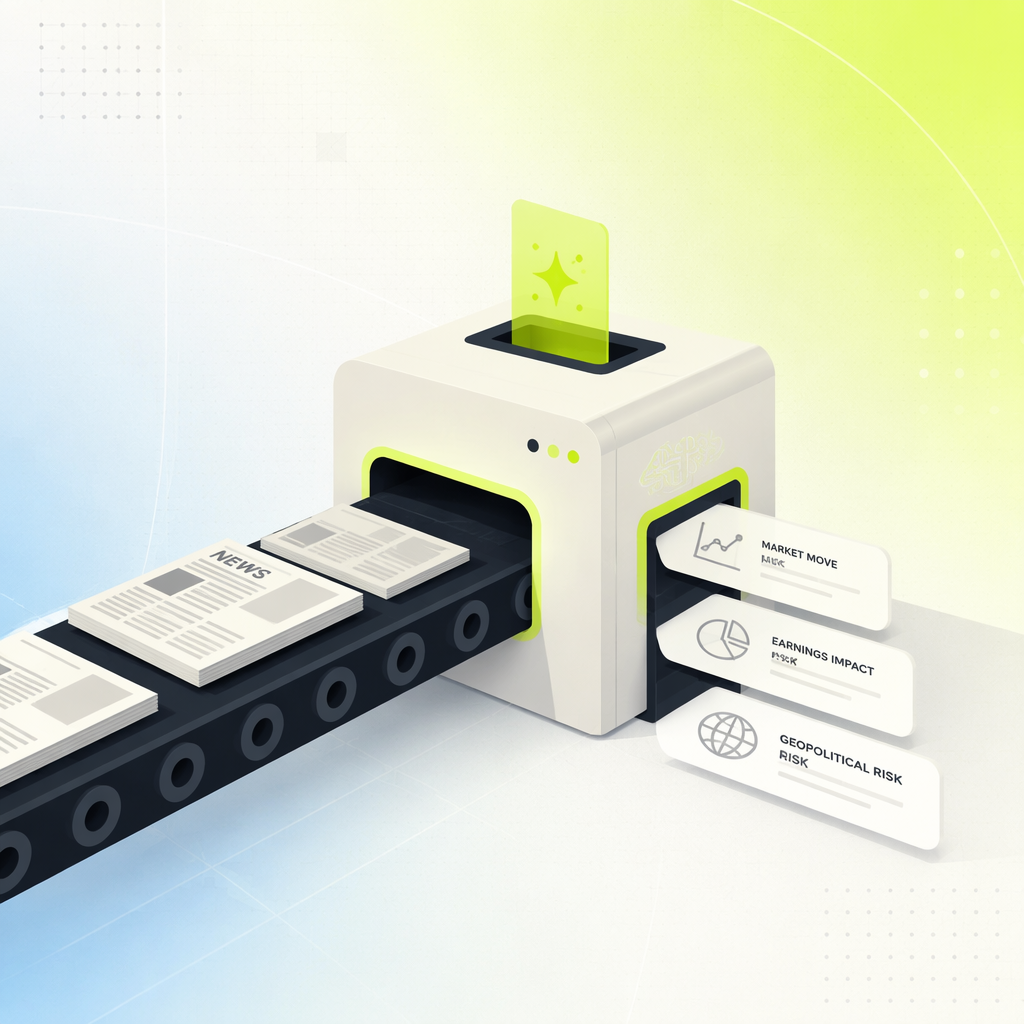
Strip away the marketing and every serious system runs the same five stages.
Ingest. Pull headlines and articles from wire services, exchange notices, regulatory filings, and social sources. Volume is brutal: thousands of items per hour across global markets, most of them irrelevant to you.
Deduplicate and cluster. One event generates dozens of rewrites. A recall announced once becomes forty headlines across outlets over six hours. Good pipelines collapse them into a single event; naive ones count each rewrite as fresh information.
Classify relevance. Does this item concern an asset you hold or watch? Entity matching sounds trivial until "Apple" appears in a story about orchards. Large language models raised the ceiling here dramatically, because they read context rather than just keywords.
Score severity and tone. How bad, how good, how big? A CEO resignation scores differently from a product delay. The scoring internals (tone models, source weighting, extremes detection) are a discipline of their own, covered in our piece on sentiment analysis in trading.
Match and act. The scored event meets your watchlist and your rules, and produces either an alert or an action. Everything upstream exists to make this step trustworthy.
One caution belongs here: language models grade essays better than they do arithmetic, and they fabricate. Studies of LLMs on finance questions have measured hallucination rates up to roughly 41% without safeguards (FailSafeQA and related benchmarks, 2024). A pipeline that lets a raw model both interpret the story and pull the trigger has no floor under it. The fix is architectural: models classify, deterministic rules decide.
News as a filter: the defensive pattern
The most reliable use of news in automation is not acting on headlines. It is refusing to act during them.
Consider a simple weekly buy program. Left alone, it will cheerfully buy a company the morning after fraud allegations surface, because price and calendar conditions know nothing about the story. A news filter fixes that with one rule: block or pause buying on any asset with a high-severity headline in the last 24 hours, and resume only after 12 consecutive quiet hours.
Notice what this rule does not require. It doesn't need the news interpreted correctly, doesn't need direction predicted, doesn't need speed measured in milliseconds. It only needs to know that something loud is happening, and "loud" is the one thing news pipelines measure well. Filters are robust precisely because they demand so little intelligence from the system.
This is where a platform example makes the mechanics concrete. Obside's composite market signals include news flow as a first-class input, so a filter like this is a sentence, not a project. You hold twelve stocks and tell the copilot: "pause every buy agent on any holding when news severity spikes on that ticker; resume after 24 quiet hours." The assistant restates the conditions, you approve them, and the filter runs across the portfolio: reaction without doomscrolling, and no feed parser to build.
Other filter variants worth stealing: block new entries portfolio-wide when severity spikes on a market-level story; widen stop distances during a news storm so ordinary whipsaw doesn't shake you out; require a quiet news window before any automated entry fires.
News as a trigger: the offensive pattern
Acting on news is harder than pausing because of news, and the difference is definitional discipline. "React to bad news" is not a rule. "If a portfolio holding announces a dividend cut, sell half the position and alert me about the rest" is a rule: the event class is precise, the action is pre-committed, and the size is capped.
Trigger patterns that survive share three properties:
- A narrow event class. Dividend cuts, guidance withdrawals, regulatory enforcement actions, delisting notices. Events with unambiguous definitions, not vibes like "negative coverage."
- A price-confirmation leg. Require the market to agree before acting: news event and price down more than 2% from the pre-news level. This one AND-condition eliminates most fake-headline damage, and it's the gateway into multi-condition automations generally.
- A hard size cap. The trigger can trim or hedge; it cannot bet the account. First responses to news are wrong often enough that no single one should be allowed to matter much.
A worked example: you hold a mid-cap at 8% of your portfolio. Rule: "if the company withdraws guidance AND the price is down more than 3% within an hour of that headline, reduce the position to 4% and notify me." The agent executes the mechanical half in seconds; the judgment half, whether to exit fully, waits for you, with the story attached.
One boundary worth drawing: scheduled macro releases are a different discipline entirely. CPI, Fed decisions and jobs reports arrive on a known calendar with known consensus figures, which changes the whole design space. That playbook lives in trading macro events with agents.
Where news pipelines break
Every failure mode below has cost real traders real money. Design against all four.
Headline fake-outs. First reports are frequently wrong, exaggerated, or missing the one qualifier that changes everything. A "regulator investigates company" headline that later resolves to a routine inquiry can round-trip a stock in ninety minutes. A trigger without price confirmation sells the low and watches the recovery from the sidelines. Mitigation: the confirmation leg above, plus a bias toward alerts over actions for ambiguous event classes.
Corrections and revisions. The number in the first print is not always the number an hour later. Restated figures, corrected headlines, and walked-back statements mean any system acting on initial reports needs either a delay window or a size small enough to absorb being wrong.
Dupe storms. Forty rewrites of one story can read as escalating crisis to a counter of headlines. If severity scoring doesn't cluster events, repetition masquerades as deterioration and your filter never un-pauses. Ask any vendor directly how they deduplicate; a hand-wavy answer is disqualifying.
Speed without a rule. The subtle one. A pipeline that surfaces news faster, attached to a human with no pre-committed response, produces exactly one thing: faster panic. You've upgraded the stimulus and left the behavior unchanged. If you haven't written down what you'll do when the alert fires, the alert is a stress generator. The broader craft of deciding what headlines should mean to you is covered in Trading News: Turn Headlines Into Confident Decisions.
Where to go from here
Sequence the ambition. Start with alerts only: let the pipeline prove it surfaces what matters for your actual holdings, and note how often the third headline corrected the first. Then add the filter pattern, because pausing is cheap insurance with almost no downside. Only then, if a narrow event class keeps recurring in your portfolio, graduate to a confirmed trigger with a size cap, and run it on paper before it touches money.
News will keep breaking while you sleep. The realistic edge is not reading it first; it's having already decided what it means. If you want to express those rules in plain language and let composite news signals do the watching, Obside turns a sentence into a running agent — alerts first, actions when you've earned the trust.
Educational content only. This is not investment advice. Trading involves risk, including possible loss of capital.
FAQ
Yes, but not faster than the institutional systems that move prices first. AI news pipelines react in seconds where humans take minutes to hours, which is valuable for defense and discipline: pausing buys, tightening stops, executing pre-committed trims. The milliseconds race against market makers is lost before it starts, and honest tools don't pretend otherwise.