
Day Trading Crypto: A Practical Intraday Playbook
Crypto doesn't sleep, and neither does the temptation to overtrade. The traders who consistently make money intraday in crypto aren't the ones glued to charts at 3 AM — they're the ones running rule-based playbooks during defined sessions, with automation handling the rest.
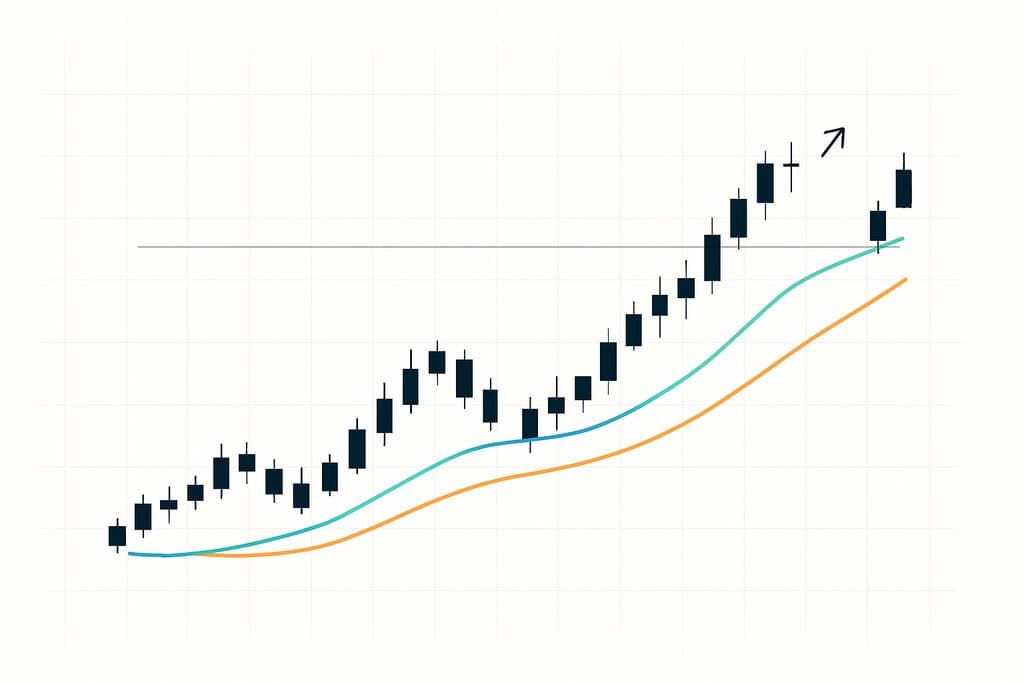
Crypto doesn't sleep, and neither does the temptation to overtrade. The traders who consistently make money intraday in crypto aren't the ones glued to charts at 3 AM — they're the ones running rule-based playbooks during defined sessions, with automation handling the rest.
This guide gives you a tight set of intraday strategies tuned for crypto's specific quirks: 24/7 liquidity asymmetries, funding rate dynamics, weekend gaps, and macro overlap with traditional markets.
What's different about day trading crypto
Day trading crypto means opening and closing positions within 24 hours — usually within hours. Compared to equities, four things change:
- 24/7 markets: no opening bell, no closing auction. Liquidity peaks during US/EU overlap, troughs during Asian overnight.
- Higher volatility: ATR on BTC is typically 2–4× SPY in percentage terms. Stops and targets must scale.
- Funding rate dynamics: on perpetual futures, positive funding pressures longs to close, negative funding pressures shorts. Funding flips can move spot price.
- Liquidation cascades: leveraged positions liquidating produce rapid moves that "shouldn't" happen on charts. Plan for them.
If you bring an equity day trading mindset to crypto without these adjustments, you'll bleed slowly until a cascade takes you out fast.
The right instruments for intraday
Liquidity isn't optional. Stick to:
- BTC, ETH — deep books, tight spreads, reliable patterns
- Top 5–10 majors (SOL, XRP, BNB, etc.) — good liquidity during US hours
- Top altcoin perpetuals (the ones with $100M+ daily volume) — for traders who know what they're doing
Avoid:
- Altcoins below top 50 — spreads widen brutally, slippage destroys edge
- Anything with funding rate above ±0.05% — squeeze risk
- New listings without 30+ days of trading history
The universe is narrow. That's the point.
Five intraday crypto setups
1. Opening range breakout (UTC anchor)
Crypto has no official "open," so pick a UTC time when liquidity is high — 09:00 UTC aligns with the European open. Mark the 15-minute high and low.
- Trigger: 5-min close above the range high with volume > 1.5× 20-bar average
- Stop: below the range midpoint
- Target: range height projected upward, then trail
- Skip: if 24h volume is below 50% of the 30-day average
2. VWAP pullback in trend
Anchor VWAP to the start of the US session (13:30 UTC). Once price is meaningfully above VWAP, wait for a pullback to it.
- Setup: price above VWAP, higher highs/higher lows on 5-min
- Trigger: pullback touches VWAP, then a bullish reversal candle closes back above
- Stop: 1×ATR below entry or the pullback low, whichever is wider
- Target: prior session high or +2R, then trail under each higher low
3. Mean reversion on overstretched moves
Crypto routinely overextends. The RSI(2) setup adapts well:
- Long BTC when RSI(2) < 5 and price > 4h 50 EMA
- Exit when RSI(2) > 60 or after 6 hours
- Conservative sizing: 0.25% per trade. Mean reversion blows up in trends.
4. Range trading in compressed volatility
Bollinger Band squeeze on 1h or 4h. Trade the edges, target the middle.
- Long at the lower band with bullish reversal candle, short at the upper band with bearish reversal
- Stop just outside the structure
- Skip if BB bandwidth is in its top quartile (volatility too high for ranges)
5. Funding-driven contrarian
When perpetual funding stays elevated (>0.05% per 8h) for multiple consecutive periods, the market is positioned heavily long. Look for short setups on the next failed rally.
- Trigger: failed move to a prior high on declining volume and funding > 0.05%
- Stop: above the recent swing high
- Target: nearest support level or VWAP
| Setup | Frequency | Win rate | R:R target |
|---|---|---|---|
| Opening range breakout | 3–5/week | 40–50% | 1:2 |
| VWAP pullback | 5–8/week | 45–55% | 1:1.5 |
| RSI(2) mean reversion | 8–15/month | 65–75% | 1:0.8 |
| BB range trade | 5–10/week | 50–60% | 1:1.2 |
| Funding-driven short | 1–3/month | 50–60% | 1:2 |
Numbers are typical ranges from public backtest data, not guarantees.
Risk management that fits crypto's volatility
Crypto's volatility compounds small mistakes faster than equities. Three rules that save accounts:
- 0.25–0.5% risk per trade. Not 1%, not 2%. The drawdowns are real.
- ATR-based stops, never fixed percentages. A 2% stop on BTC means different things at different volatilities.
- Daily loss cap of 2%. Hit it, walk away. The market will be there tomorrow (and tomorrow, and tomorrow — it's 24/7).
Sizing math: with 0.5% risk per trade and a 1.5×ATR stop, position size is (equity × 0.5%) / (1.5 × ATR). This keeps dollar risk constant across volatility regimes.
Defined sessions beat 24/7 trading
24/7 markets don't mean you should trade 24/7. The best intraday opportunities cluster:
- 13:30–17:00 UTC: US session overlap with Europe. Best volume, cleanest patterns.
- 08:00–11:00 UTC: European session open. Good for opening-range setups.
- 00:00–02:00 UTC: Asian session anchor. Useful for trend-day setups, lower volume.
Pick one or two windows. Trade them consistently. Skip the rest. Burnout from constant screen-watching produces worse trades than missing setups.
Where Obside fits in a crypto day trader's workflow
The "24/7 problem" — markets running while you sleep, meetings interrupting your session, news hitting at 3 AM — is exactly what automation solves.
Describe your setups to Obside Copilot in plain English:
"Alert me when BTC on 15m closes above the prior 15m high with volume > 2× the 20-bar average AND 5m RSI > 60. On confirmation, buy 1000 USDT, stop at 1×ATR below entry, take 50% at +1.5R, trail rest at 1.5×ATR. Pause new entries if daily P&L < -2%."
Copilot translates that into a runnable strategy, backtests it on 12+ months of data in seconds, runs in paper against live feeds, and executes via your connected exchange. You define the rules; the platform handles the 24/7 monitoring.
Create a free Obside account to automate your crypto day-trading setups — instant backtests, smart alerts during your defined sessions, and live execution through your connected exchange.
Educational content only. This is not investment advice. Trading involves risk, including possible loss of capital.
FAQ
1–5 minute for entries on momentum setups; 15-min to 1-hour for structure and mean reversion. Anything below 1-minute is mostly noise unless you're scalping with sub-100ms execution.