
Agentic Trading in 2026: Five Trends That Matter
Where agentic trading is actually heading in 2026 — adoption data, plain-language interfaces, guardrails, multi-agent designs, and a rising evidence bar.

Every January produces a stack of predictions about the future of AI trading, and most of them age badly because they are guesses dressed as analysis. This article does something narrower. It tracks five trends already visible in data you can check: an industry adoption survey, a study of corporate filings, a regulator's annual report, and a growing pile of research audits. For each one: the evidence, what to watch next, and what it changes if you are a retail investor automating your own strategies. No price targets. No AGI timelines.
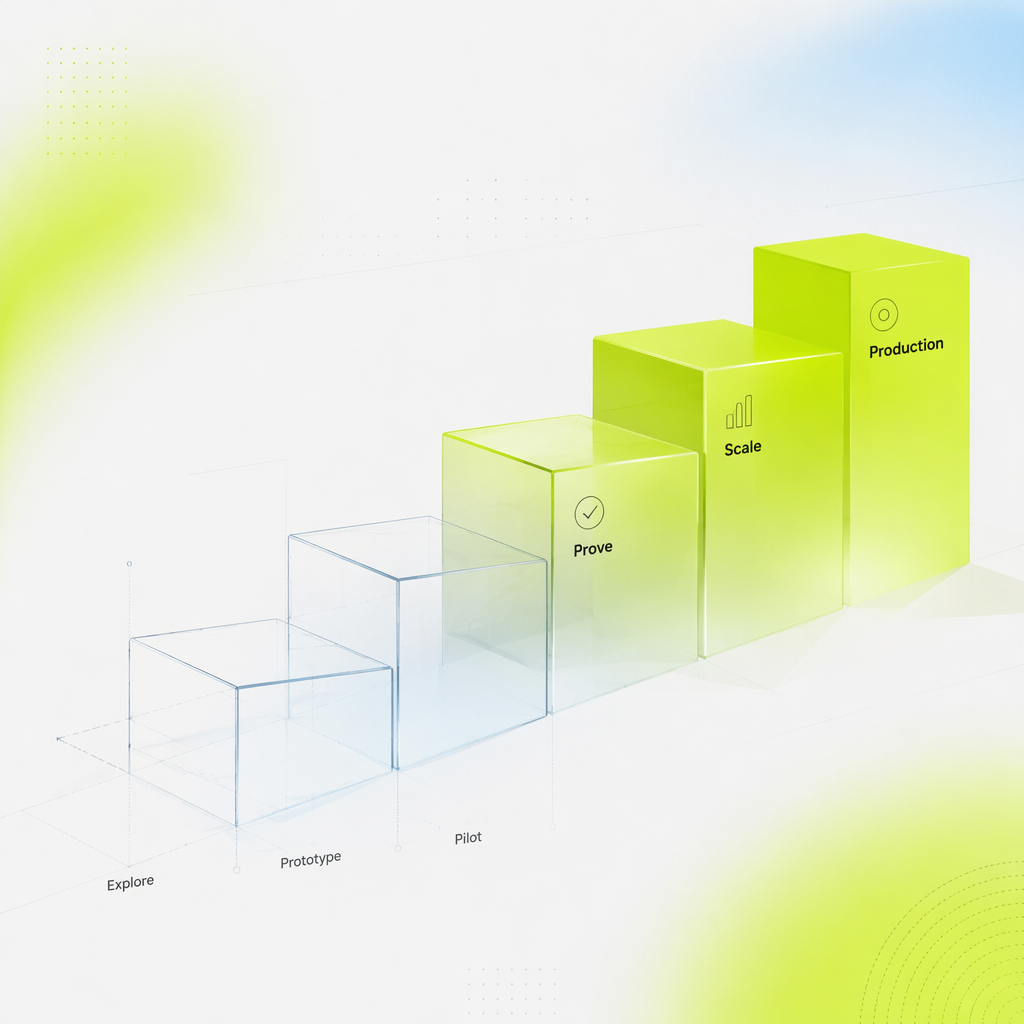
Trend 1: agentic AI crosses from pilots to production
The cleanest signal that agentic trading is becoming real infrastructure is not a product launch. It is survey and filings data showing institutions quietly committing.
The Cambridge Centre for Alternative Finance and the World Economic Forum surveyed financial firms for their 2026 Global AI in Financial Services Report (May 2026). The headline numbers: 81% of firms report some level of AI adoption, and on agentic AI specifically, 23% describe themselves at the scaling or transforming stage while another 29% are piloting. Roughly 40% report increased profitability linked to AI investment. Fintechs are moving faster than incumbents, 47% versus 30% at advanced stages.
Corporate filings tell the same story from a different angle. A March 2026 study in Modern Finance (Mustafa & Aysan) searched US finance firms' annual filings for agentic-AI references: none in 2021 through 2023, then 0.4% of firm-years in 2024 and 1.6% in 2025. That is a late start and a steep slope. Filings language is conservative by nature; firms rarely describe capabilities to regulators and shareholders before those capabilities exist.
What to watch: whether the 29% piloting cohort converts to production over the next survey cycle, or stalls the way many enterprise AI pilots do.
What it means for you: institutional adoption pulls tooling downmarket. The pattern of software that perceives, reasons and acts, traced across the industry in Agentic AI in Finance, stops being exotic, and retail platforms inherit infrastructure built to survive professional scrutiny. The gap between what a fund can automate and what you can automate keeps narrowing.
Trend 2: natural language becomes the default strategy interface
For two decades, automating a strategy meant code: Pine Script, Python, MQL. That filter selected for programmers, not for people with good strategies. The retail segment of algorithmic trading was estimated around $3.95 billion in 2025, growing at roughly 13.4% a year (Grand View Research, 2025), and much of that growth comes from people who will never write a backtest loop by hand.
Plain language is replacing code as the entry point, which moves the hard engineering problem from execution to translation. "Buy the dip" has no definition a machine can act on. The systems worth using resolve ambiguity in the open: they restate what they parsed and make you approve it before anything runs.
Here is that loop concretely, on Obside. You type: "DCA $200 into an S&P 500 ETF every Monday, skip the buy if RSI(14) on the daily is above 75." The copilot restates it as monitored conditions, an order size and a schedule. You approve it, and it runs as a paper agent before it ever touches money. The restatement step is not a convenience; it is the safety mechanism that makes plain-language automation defensible.
What to watch: whether platforms compete on transparency of translation, showing you the exact parsed rule, or hide it behind a chat bubble.
What it means for you: the moat is no longer syntax. It is the clarity of your strategy. A vague idea now becomes a running automation faster than ever, which is exactly why the validation discipline described in What Is Agentic Trading? matters more, not less.
Trend 3: guardrails become the product, not the fine print
Regulators have settled, for now, on a technology-neutral stance. FINRA's 2026 Annual Regulatory Oversight Report (January 2026) treats GenAI under existing supervision, model-risk and communications rules, and is explicit that firms remain responsible for the outcomes of the AI tools they deploy. In the EU, the AI Act (in force since August 2024, with obligations phasing in through 2027) places most retail trading-automation tools under transparency provisions rather than high-risk categories, while still requiring providers to document capabilities and limits.
One detail connects regulation to product design. The Modern Finance filings study found that autonomy language clusters where governance and controls language is dense: firms build the control framework first, then deploy the systems that take actions. Governance maturity precedes autonomy. The CCAF survey (May 2026) flagged the adequacy of human oversight as a key risk as agentic AI spreads, which points the same direction.
What to watch: risk controls migrating from settings pages to marketing pages. When platforms advertise drawdown caps and approval gates as loudly as returns, the market has repriced what buyers care about.
What it means for you: evaluate the guardrail layer before the intelligence layer. A mediocre signal inside hard limits loses slowly and recoverably; a brilliant one with no limits can fail all at once. The regulatory direction, mapped in plain English in How Regulators See AI Trading, also means responsibility stays with you, automated or not.
Trend 4: multi-agent architectures leave the lab
The most-cited recent design pattern in this field is TradingAgents (Xiao et al., arXiv:2412.20138, December 2024, 250+ citations): a stock-trading framework modeled on a trading firm, with specialized LLM agents playing fundamental, sentiment and technical analysts alongside researcher, trader and risk-manager roles that debate before any action is taken. It reported improved cumulative return and Sharpe versus baselines in backtests.
Treat those backtest numbers with care. A 2024 survey of LLM trading agents (arXiv:2408.06361) found that most papers report superior backtest performance while suffering short test windows, small universes and lookahead risk. The durable contribution of this research lineage is not the return figures. It is the architecture: decomposing a trading decision into specialized roles with an explicit risk veto, so every step can be inspected.
What to watch: products adopting role separation as an auditable pipeline, with distinct stages for signal, risk and execution that log their reasoning, versus products using "multi-agent" as a synonym for "complicated."
What it means for you: nobody needs five LLMs debating a DCA schedule. But the transferable idea, separating signal generation from risk management from execution so each part is checkable, is the one explored in Multi-Agent Trading Systems, and it scales down cleanly to a single retail account.

Trend 5: the evidence bar rises
The research community spent 2025 and 2026 dismantling its own hype, which is the healthiest thing that could have happened to this field.
First came the demonstration that LLM-strategy backtests are inflated by memorization: a model whose training data overlaps the backtest window can "remember" tickers, dates and price moves, and performance often degrades out-of-sample (arXiv:2505.07078, 2025). A memory-controlled benchmark then showed the effect directly — evaluating agents only on data past their knowledge cutoff sharply reduces apparent skill (arXiv:2605.28359, 2026). Finally, an audit of 77 studies (arXiv:2605.19337, 2026) reframed LLM trading agents as expert-system decision pipelines and concluded that evidence for durable alpha remains thin, with the practical value sitting in disciplined execution, monitoring and research assistance.
What to watch: buyers learning to ask the memorization question. "Was this backtest window inside the model's training data?" is on its way to becoming as standard as asking about slippage assumptions.
What it means for you: demand out-of-sample proof. Walk the strategy forward on data the system could not have memorized, and treat paper trading as the one test that cannot recall the past. The bar is rising because the tools to check are now public. Use them.
The future of AI trading, without a crystal ball
Notice the shape of these five trends: adoption invites scrutiny, scrutiny produces governance, governance demands evidence. The direction of travel does not reward whoever promises the most autonomy. It rewards whoever survives verification.
That is the bet we have made at Obside: guardrails and evidence over autonomy theater — agents that execute your logic inside your limits, with backtest, paper and live as the graduation path. If that is the version of the future you want to build on, start at Obside: write a strategy in one sentence and see what disciplined automation looks like.
Educational content only. This is not investment advice. Trading involves risk, including possible loss of capital.
FAQ
Graduated autonomy under your own rules, not hands-off robot profits. The visible trajectory through 2026 combines plain-language strategy creation, execution-time risk controls, and a much higher standard of proof before capital is committed. Institutional adoption data (Cambridge CCAF, May 2026: 23% scaling agentic AI, 29% piloting) suggests the tooling keeps improving and keeps trickling down to individuals. The winners on the buyer side will be people who bring a clear strategy and validate it properly.