
AI Agents for Stock Trading: What Works in 2026
Stock markets close, gap, and halt. Here is what AI trading agents genuinely do well in equities, what they cannot fix, and how to run one safely.
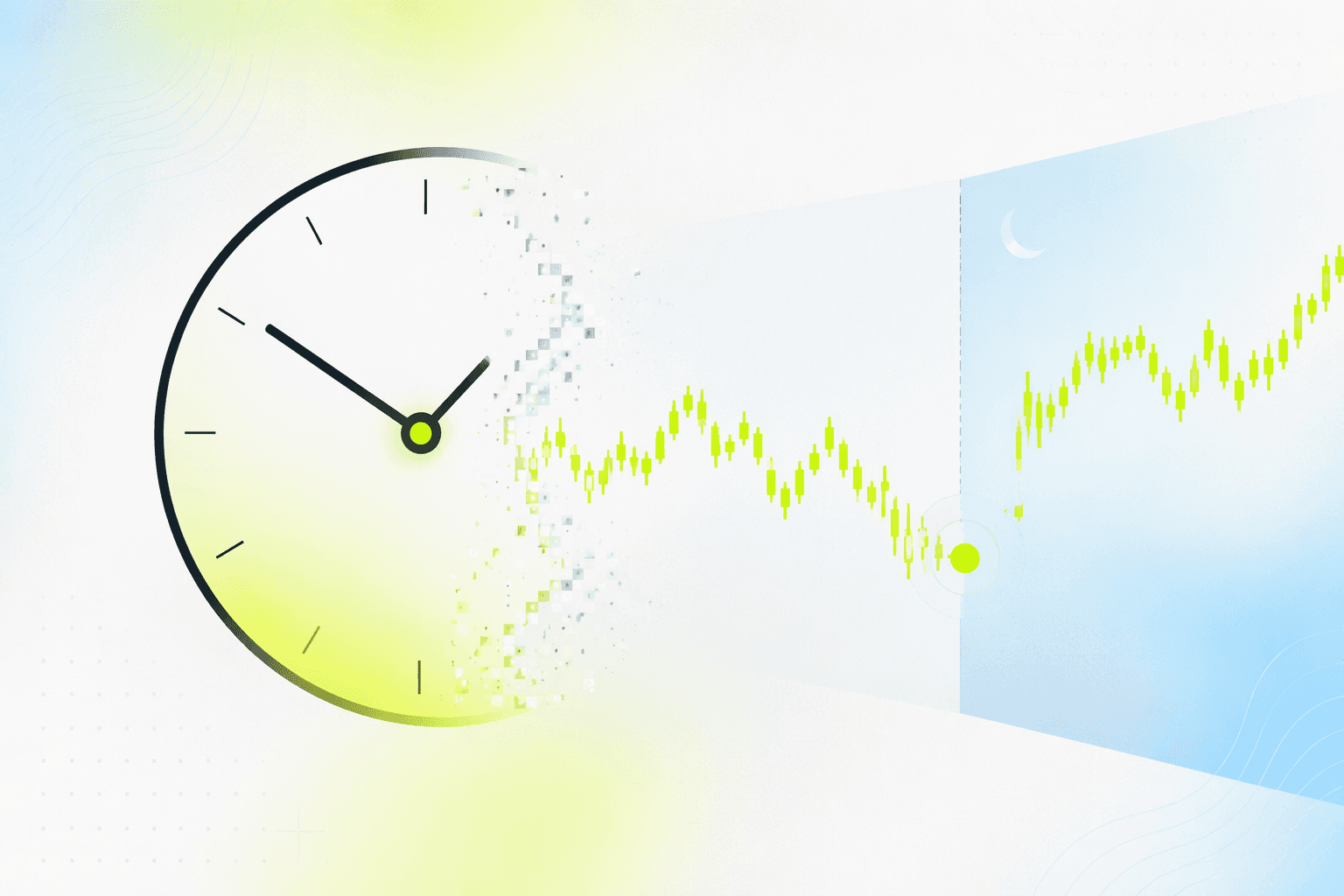
Crypto-style automation breaks quietly when you point it at equities. An AI agent stock trading setup inherits everything specific to the stock market: a session that ends at 4:00 p.m. while your thesis keeps moving, overnight gaps that jump straight over a stop-loss, halts that freeze a single symbol mid-plan, and a pattern day trader rule that can restrict a small account for months. This guide covers the equities mechanics that shape agent design in 2026, the plumbing that connects an agent to a broker, and the jobs where automation genuinely earns its keep.
The market closes. Your risk doesn't.
US equities trade a regular session from 9:30 a.m. to 4:00 p.m. Eastern. Extended hours exist, but liquidity there is thin, spreads widen, and many brokers restrict which order types you can use. For an agent, this changes the physics of risk management: for most of every weekday and the whole weekend, no rule you wrote can execute at a fair price, or at all.
The practical consequence is gap risk. A stop order at $95 on a stock that closes at $98 protects you only while the market is open. If bad news lands overnight and the stock opens at $86, your stop triggers at the open and fills near $86, not $95. No agent, however clever its reasoning layer, exits a closed market.
Good agent design accepts this instead of pretending it away. Three patterns work:
- Size for the gap, not the stop. If a realistic overnight gap on a single stock is 10–15%, position sizing should assume the stop can slip that far. Risking "1% of the account" through a 3% stop is fiction on an instrument that routinely gaps 8%.
- Respect the close. Rules like "no new entries in the final 15 minutes" or "review exposure at 3:45 p.m." give the agent a daily decision point matched to the market's actual rhythm.
- Watch while closed, act at the open. An agent can classify after-hours news on your holdings overnight and queue a decision for the open, either for your approval or inside pre-set limits.
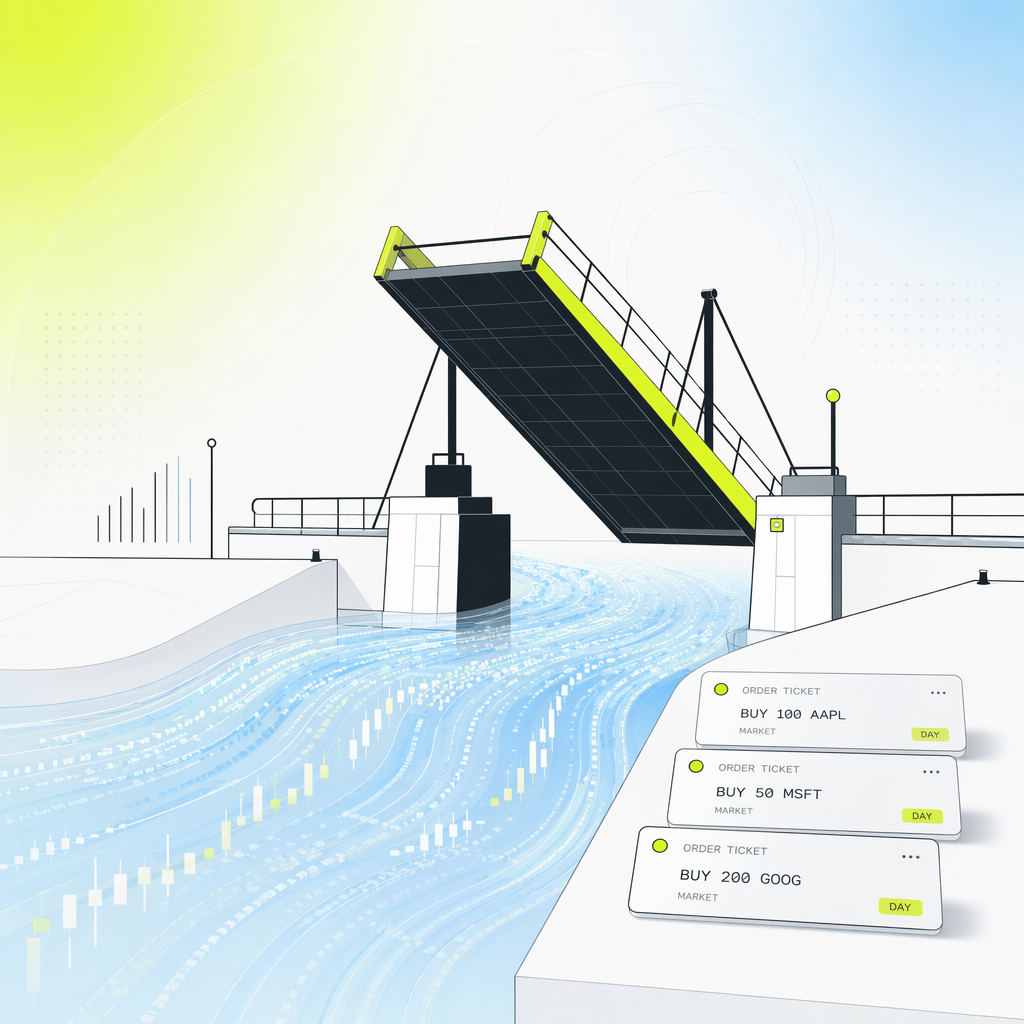
Earnings, halts, and scheduled ambushes
Equities concentrate risk into known dates. Most companies report earnings outside regular hours, which means the reaction arrives as an opening gap you cannot trade through. An agent can't predict the print, but it can read a calendar. Knowing every holding's report date and applying your rule before it (trim, hedge, or deliberately hold and accept the risk) is exactly the kind of unglamorous work automation does better than willpower. The full playbook lives in our guide to agents for earnings season.
Halts are the other equity-specific interruption. Under the Limit Up-Limit Down mechanism, a stock that moves too far too fast is paused, typically for five minutes, sometimes repeatedly; news-pending halts can last hours. During a halt your agent's orders don't execute, and when trading resumes the price often reopens far from where it stopped. Every stock agent needs a defined halt behavior. The sane default: stand down until the reopening print, then re-evaluate, rather than stacking orders that all fire into a chaotic reopen.
Corporate actions round out the list. Splits, dividends, and ticker changes silently corrupt naive price-based rules: "down 50% overnight" after a 2-for-1 split is not a crash. Serious platforms adjust their data for these events. If you run your own stack, this is where quiet bugs live.
PDT, settlement, and the rules your agent must count
The US pattern day trader rule is a mechanical constraint, and mechanical constraints are what agents should respect automatically. The core of it: in a margin account holding under $25,000, executing four or more day trades (buying and selling the same stock within the same session) inside five business days flags the account as a pattern day trader and restricts it. An agent that closes positions the same day it opens them can walk into that flag without you noticing — the rule counts trades, not intentions.
Design responses, roughly in order of sanity:
- Trade a swing cadence. Holding overnight sidesteps PDT entirely, and multi-day horizons are where retail agents are most defensible anyway.
- Make the agent count. If same-day exits are possible (say, a stop that triggers three hours after entry), the agent should track the rolling day-trade count and warn or refuse before crossing the line.
- Understand cash-account mechanics. Cash accounts avoid PDT but settle T+1, and re-spending unsettled proceeds triggers good-faith violations. Automation that ignores settlement discovers it the expensive way.
None of this is investment advice; it's plumbing. But plumbing is precisely what should never depend on you remembering it at 3:52 p.m. on a Friday.
How an agent actually reaches the stock market
There is no public stock-exchange API a retail agent can call the way crypto agents call an exchange. Orders route through a brokerage account, so the agent's reach is defined by the broker connection.
Two connection models dominate for retail:
| Model | How it works | Typical scope |
|---|---|---|
| Broker aggregator | OAuth-style link to an existing US or Canadian brokerage account | Read positions and place orders; no withdrawals |
| MetaTrader 5 | Credentials on an MT5 broker, global reach | Trade execution on the broker's instrument list |
This is how Obside connects agents to equities: a broker aggregator link to your existing US or Canadian brokerage account, with the same backtest, paper, then live discipline at every stage. The agent definition never changes between stages; only the destination of its orders does.
Whatever platform you choose, the checklist is identical. The connection should be trade-only, with no rights to withdraw or transfer funds. It should be revocable in one step from the broker's side. And it should start on a small allocation, because a stock agent is only as trustworthy as the narrowest permission it holds.
What an AI agent does well in stock trading, and where it loses
Start with the evidence. A 2026 audit of 77 studies on LLM-based trading agents concluded that proof of durable stock-picking alpha remains thin; the demonstrated value sits in disciplined execution, monitoring, and research support (arXiv:2605.19337, 2026). That finding maps cleanly onto equities practice.
Where stock agents earn their keep:
- Swing and position automation. Multi-day rules (enter on a pullback within an uptrend, exit on a defined invalidation) fit session structure naturally: decisions key off daily closes, gaps become a sized risk rather than a surprise, and PDT never enters the picture.
- Portfolio maintenance. Band rebalancing, drift alerts, and contribution schedules across stocks and ETF holdings are high-value and hard to sabotage emotionally, because there is no thrill to chase.
- Event de-risking. Calendar-aware trimming before report dates, exposure caps during reporting weeks, news-severity alerts scoped to your actual holdings.
- Exit discipline. The agent honors the stop you set in calm conditions, on the exact day you would rather "give it room."

Where they lose: intraday microstructure. Sub-second equities games are contested by firms with co-located servers, exchange fee schedules, and full-time engineers. A retail agent competing there pays the spread to players who see the order book better and move first. If the intraday itch persists, read our honest assessment of AI agents for day trading before committing money. And if what you actually want is a deterministic rules executor rather than a reasoning agent, a simpler AI stock trading bot may serve you better at lower cost.
A concrete example of the defensible middle ground. On Obside you might type: "Every trading day at 3:45 p.m., check my stock holdings. If any position reports earnings within the next two sessions and exceeds 5% of the portfolio, trim it to 5% and message me." The copilot restates that as monitored conditions: a calendar check, a position-size check, an order size, an alert. You approve it, and it runs in paper mode first, so you watch it handle a real reporting week with zero capital at risk.
Where to go from here
Treat equities as a market with a personality: it sleeps, it gaps, it halts, and it enforces rules that crypto never taught you. Agents that respect those traits through swing cadences, gap-aware sizing, calendar awareness, and counted day trades do real work. Agents that ignore them fail predictably, usually at an open. Start with one narrow rule you already follow manually, write it down precisely, and put it through a backtest and a paper run before a single live share moves. If you want that whole path in one place, Obside turns a plain-language rule into a stock or ETF agent running through your own broker, with risk limits enforced at execution time.
Educational content only. This is not investment advice. Trading involves risk, including possible loss of capital.
FAQ
No. Regular US equity trading runs 9:30 a.m. to 4:00 p.m. Eastern, and while an agent can monitor news and prepare decisions around the clock, it cannot execute at a fair price in a closed market. Extended-hours sessions exist but are thin and often broker-restricted. Good agents plan around the close: they size positions for gap risk and act at the open instead of pretending the market never sleeps.