
Free Trading Signal Bot: What Works, What's a Scam, and What to Use Instead
Most free signal bots are marketing funnels or outright scams. Here is how the free-signal economy really works, the red flags, and how to generate your own signals from rules you control.
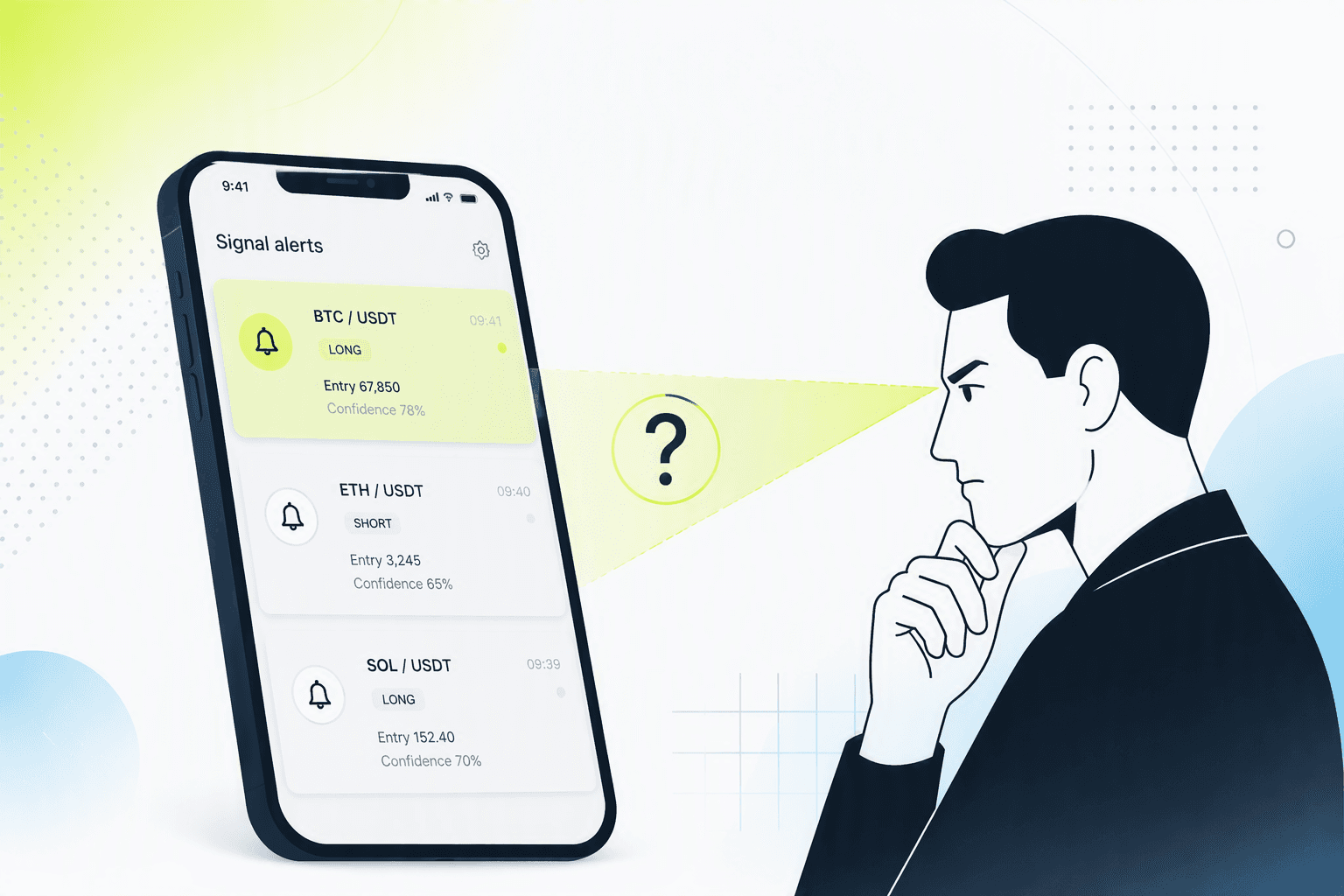
Search for a free trading signal bot and you will find thousands of Telegram channels, Play Store apps, and "AI signal" websites promising precise entries with 90% win rates, for nothing. Some are harmless marketing funnels. Many are scams with a well-documented playbook. A few are legitimate tools that are free because you do the strategy work yourself. This guide sorts the three categories, explains how the free-signal economy actually pays for itself, and shows the more durable route: generating your own signals from rules you define and control.
Why "free" signals exist: follow the money
Nobody with a genuinely profitable signal gives it away at scale, because distribution destroys the edge — the more people trade a signal, the worse the fills get. So every free signal service is monetizing something else, and knowing what tells you how much to trust it.
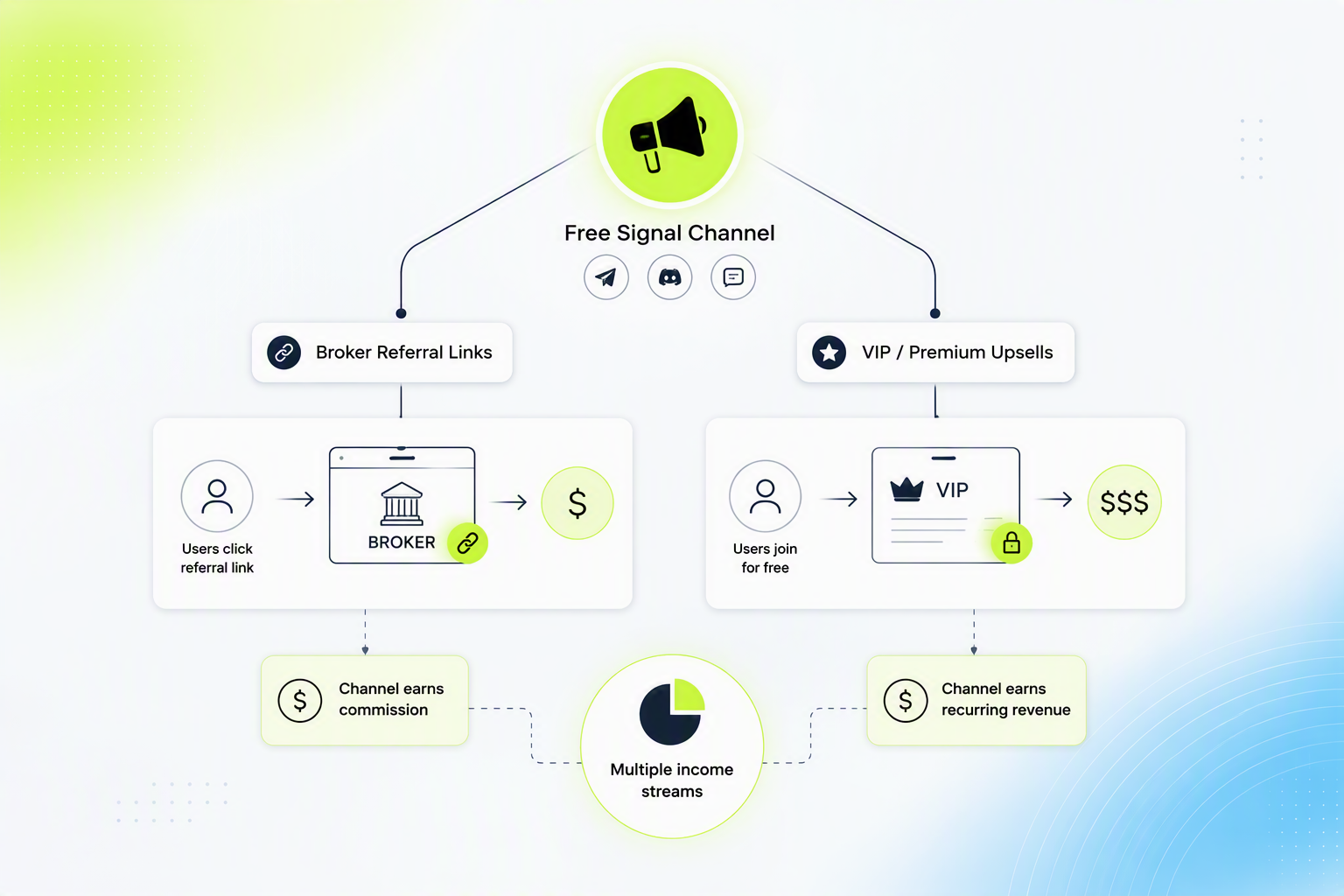
Affiliate funnels are the dominant model. The channel sends you signals free of charge, but urges you to trade them at a specific broker via their referral link. The channel earns a share of your spread or losses. Their incentive is your trading volume, not your profit, which explains the relentless push toward high-leverage instruments.
Freemium upsells give away a delayed or diluted feed to sell a "VIP" tier. The free tier's job is to look just good enough — often via cherry-picked screenshots — to convert you. The VIP results are unverifiable by design.
Outright scams use signals as bait for the real play: pushing you to deposit on a fake or complicit platform, or advertising a "signal bot" download that wants your exchange API keys with withdrawal permissions. Recovery-room follow-ups — someone offering to recoup your losses for a fee — complete the cycle.
Legitimate free tools do exist, and they share one property: they are software, not advice. Alert engines, screeners, and automation platforms let you define conditions and notify you when they trigger. They are free or cheap because you bring the strategy. That distinction — signals sold to you versus signals generated by you — is the entire subject.
Red flags: the five-second scam check
Run any signal service through this list before connecting money or attention to it.
Guaranteed or extreme win rates — anything above roughly 70% claimed, with no verifiable track record — is disqualifying on its own; real strategies lose often and say so. Results shown only as screenshots rather than a verifiable, timestamped record. Pressure to sign up at one specific unregulated broker through their link. Requests for exchange API keys with withdrawal rights, or for remote access to your device — no legitimate tool needs either. And urgency theater: countdown timers, "only 5 VIP slots left," DMs from "account managers." Regulators including the SEC and FCA have repeatedly warned about social-media signal fraud, and the pattern above is the template (warnings current as of 2026-08-27).
One more honest test: ask what happens if the signal is wrong. A real system talks about stop placement, position sizing, and drawdowns. A funnel talks about the next win.
What a signal actually is (and why yours beat theirs)
Strip the mystique: a trading signal is a condition on data. RSI below 30 on a daily close. Price crossing the 50-day moving average. An index dropping 5% from its 30-day high. A macro release surprising consensus. Every paid channel is selling you the output of conditions like these, with the logic hidden so you cannot evaluate it — or leave with it.
Generating your own signals inverts the relationship. You know exactly why an alert fired, you can test the condition against history before trusting it, and no intermediary sits between the trigger and your decision. The tooling for this is genuinely free or close to it: charting platforms offer price and indicator alerts on free tiers, and screeners surface conditions across whole markets. The limitation of most free alert tools is what happens next — the alert arrives, and everything from there is manual.
From signals to a system: rules that alert you — or act for you
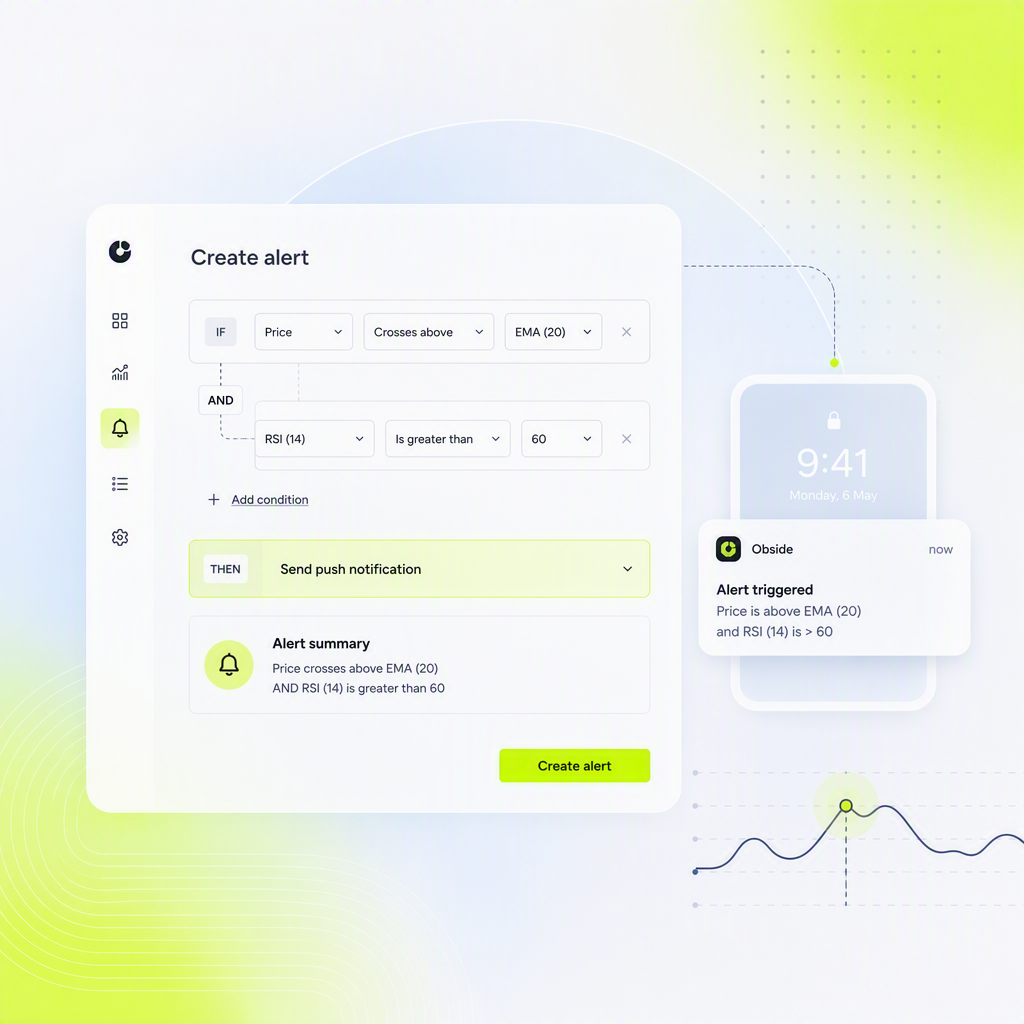
This is where Obside fits. Rather than subscribing to someone's signals, you describe your own conditions in plain language, and the platform turns them into persistent automated agents that watch markets around the clock and react to price levels, technical indicators, macro data, or news events (feature live as of 2026-08-27). An agent can stop at notifying you — a signal bot in the honest sense, where the dashboard and alerts push you the trigger and the reasoning. Or it can go further and execute the rule through your connected broker account: the same condition, with the manual gap removed.
Two properties matter compared with signal channels. First, testability: the built-in backtesting engine replays your rule against years of historical data and reports the equity curve, max drawdown, and win rate with slippage assumptions (as of 2026-08-27) — so you know how the "signal" would have behaved before following it, something no Telegram channel offers about its own calls. Second, paper trading: the identical agent can run on live data with zero capital at risk, which turns signal evaluation from screenshots into evidence. Obside automates your logic; it does not recommend trades — that inversion is exactly what removes the conflict of interest that funds the free-signal economy.
A concrete starter: "alert me when any stock in my portfolio drops more than 4% from yesterday's close" or "when the S&P 500 ETF's RSI closes below 30, notify me and buy a fixed slice on my paper account." Both are one-sentence agents, both are testable, and neither requires trusting a stranger's win rate.
How to read a win rate: the arithmetic that exposes most claims
Signal marketing leans entirely on one number — the win rate — because it is the easiest to inflate and the least informative. Two pieces of arithmetic protect you.
First, win rate means nothing without the risk-reward ratio. A feed can honestly win 85% of the time and destroy accounts: sell signals that take 20 small profits and then one loss forty times their size — the classic profile of martingale and "no stop loss" systems — produce beautiful streaks and a terminal drawdown. Conversely, a 40% win rate with winners twice the size of losers is solidly profitable. Whenever you see a win rate, ask for the average winner, the average loser, and the maximum drawdown. Refusal to provide them is an answer.
Second, sample size and selection. Twenty trades prove nothing — a coin flip strategy produces impressive twenty-trade stretches routinely, and a channel running five simultaneous "VIP" groups with different calls can always screenshot the winning one. Meaningful evidence starts at hundreds of consecutive, timestamped calls including every loser, over conditions that include at least one bad market. This is precisely what a backtest over years of history simulates in minutes, and what no screenshot can fake: the losing streaks, their depth, and whether the edge survives costs.
Run this arithmetic once on any feed you are tempted by, and most of the temptation resolves itself. Then notice, again, that your own tested rule gives you all of these numbers by construction.
If you still want external signals: a due-diligence protocol
Some traders want outside ideas as input, and that is defensible if you treat signals as hypotheses rather than instructions. Demand a verifiable track record — a third-party-audited or at least timestamped public log, never screenshots. Paper trade the feed for at least a month, logging every call including the losers, before any real order. Check the provider's incentive: regulated advisory services state fees openly; funnels hide compensation in broker kickbacks. Never grant API keys with withdrawal permissions, and never install signal "bots" from links in chat groups. And size any experiment so a total loss is tuition, not damage.
Notice that this protocol — verify, backtest, paper trade, size small — is identical to validating your own strategy, except that with an external feed you are doing the work blind, on logic you will never see and cannot fix when it degrades. Same effort, less control, plus a middleman whose incentives you have to police forever. Which is the quiet argument for skipping the middleman entirely.
One habit ties this whole guide together: keep a written log of every signal you act on, whoever generated it — the date, the trigger, the size, the outcome, and what you felt. Thirty days of honest logging teaches more about signal quality than any marketing page, because it converts vague impressions into a sample you can count. Traders who log discover quickly whether their signal source, human or automated, deserves the next thirty days. Most free feeds do not survive the exercise; a tested rule of your own usually does, and the log then becomes the raw material for improving it.
Educational content only. This is not investment advice. Trading involves risk, including possible loss of capital.
FAQ
Free tools that generate alerts from conditions you define genuinely exist — charting-platform alerts, screeners, and automation platforms with free tiers. Free feeds of someone else's buy/sell calls are a different product: they are monetized through broker affiliations or VIP upsells, and their incentives rarely align with your results.