
Python Trading Bot: How to Build One, What It Takes, and When Not To
What building a Python trading bot really involves — libraries, data, broker APIs, and the operational grind nobody mentions — plus when a no-code alternative is the smarter engineering call.
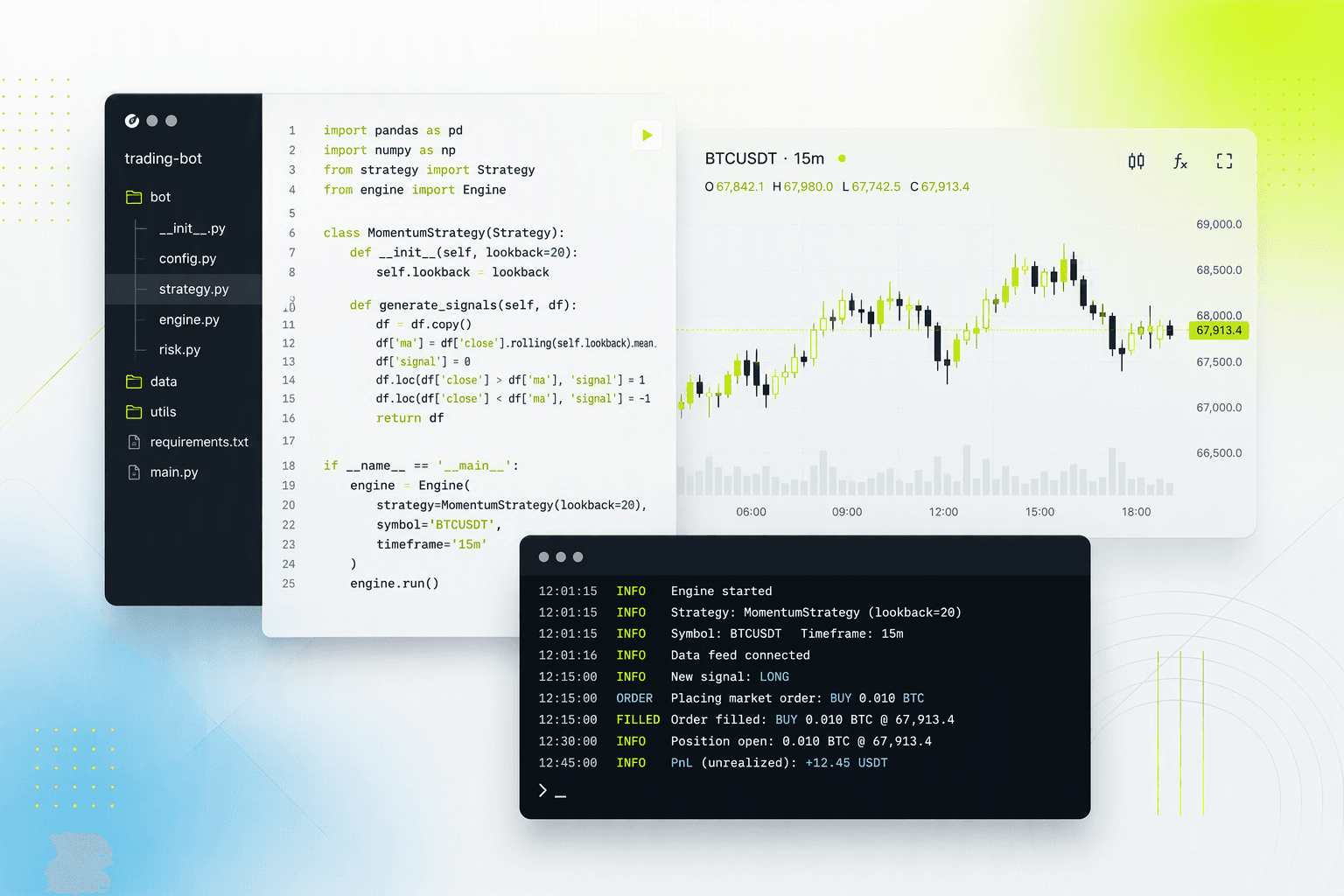
Python has become the default language for retail algorithmic trading, and for good reason: the ecosystem is mature, the tutorials are endless, and a working prototype fits in a weekend. But a python trading bot that runs safely with real money is a different project from the notebook that produced a nice backtest. This guide walks through the real build — components, libraries, and the operational grind — and is honest about when writing code is the wrong tool for the job you actually have.
What a Python trading bot actually consists of
Strip away the mystique and every bot has five components.
A data feed. Historical candles for testing, live prices for trading. Libraries like yfinance cover free daily data; intraday and real-time feeds usually mean a paid API or your broker's own stream via websockets.
A strategy function. The logic that turns data into decisions: a moving-average crossover, an RSI threshold, a breakout rule. In code this is the easy part — usually twenty lines with pandas and an indicator library such as ta or pandas-ta.
A backtesting harness. Frameworks like backtesting.py, vectorbt, or backtrader replay the strategy over history. The subtle work is avoiding self-deception: executing signals on the next bar rather than the one that generated them, modeling fees and slippage, and resisting the urge to tune parameters until the past is memorized.
A broker interface. The bridge from decision to order. Brokers and exchanges expose REST or websocket APIs with Python SDKs; ccxt wraps many crypto exchanges behind one interface, while stockbrokers each have their own client. This is where authentication, rate limits, and order-state management live.
An execution loop and its supervision. The part tutorials skip: a process that runs continuously, handles disconnects, retries idempotently so a network blip does not buy twice, logs every decision, and alerts you when something goes wrong at 3 a.m. Most of the engineering effort in a production bot lives here, not in the strategy.
The build path, step by step
Start with the strategy expressed as testable rules — if you cannot write it as code that consumes only past data, you do not have a strategy yet. Backtest it across at least one hostile year; a rule set that only saw 2023–2024 has never met a real drawdown. Then paper trade: nearly every serious broker API offers a sandbox or paper environment, and running the live loop against fake money is where you discover the difference between backtest fills and real order books.
Only then connect real capital, small. Keep hard limits in the code itself: maximum position size, maximum daily loss, a kill switch. Your bot will eventually do something you did not anticipate — the guardrails decide whether that is an anecdote or a disaster.
Expect the timeline to surprise you. The strategy takes a weekend. The backtesting honesty takes another. The broker integration, error handling, deployment (a VPS or small cloud instance, since your laptop sleeps), monitoring, and the slow accumulation of trust take weeks. None of it is beyond a motivated beginner, but the effort is real and permanent: APIs change, packages break, and an unmaintained bot is a liability with an API key.
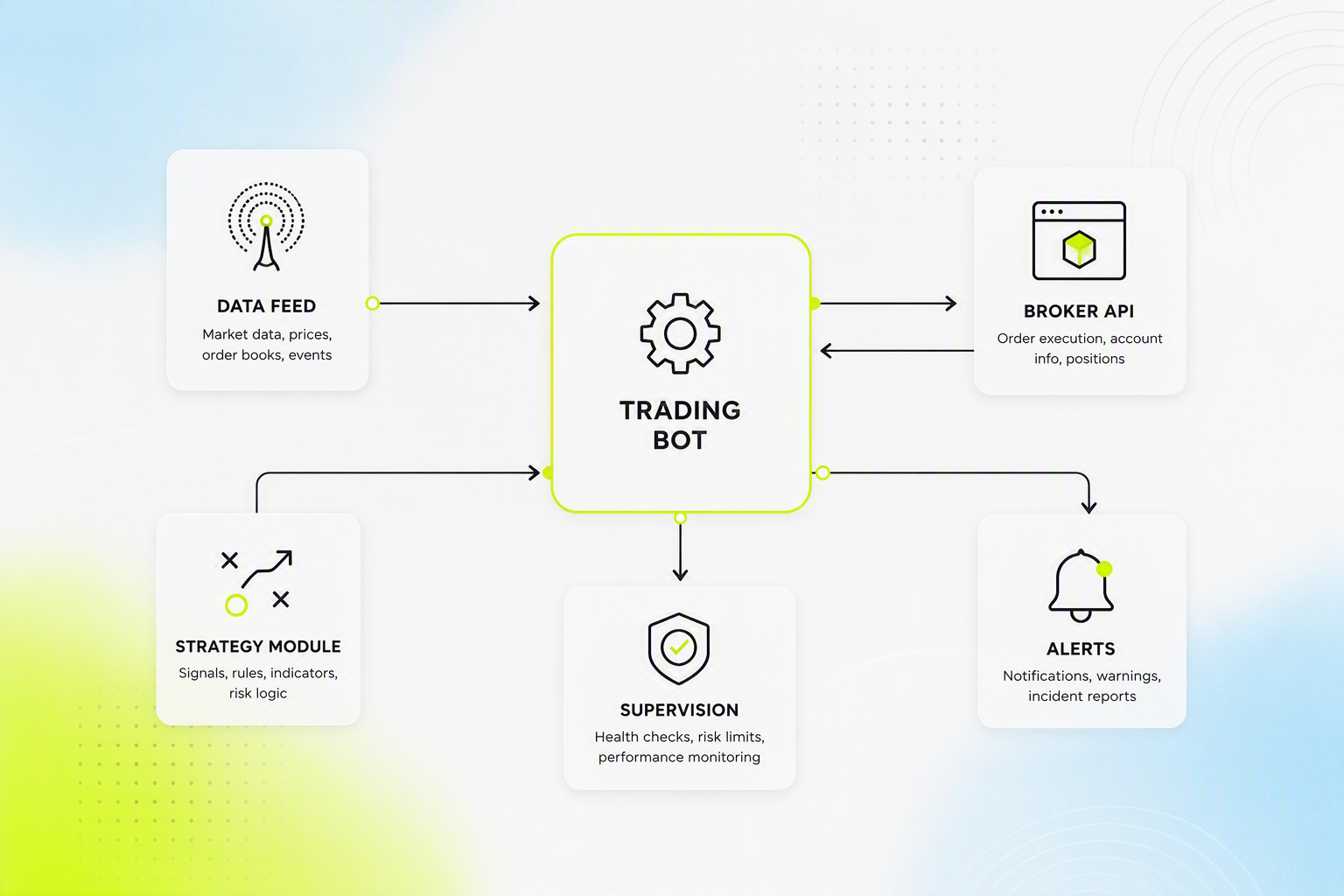
A reference architecture (and what each piece costs you)
For readers who want to build, here is the minimal architecture that experienced hobbyists converge on, with the honest cost of each piece.
Strategy module: a pure function from a dataframe of candles to a target position. Keeping it pure — no API calls, no side effects — is the single best design decision you can make, because the identical function then runs in backtest and live modes, which is your only structural defense against look-ahead bugs. Cost: discipline.
Data layer: scheduled fetches of candles into a local store (SQLite is plenty), plus a websocket subscription for live prices if the strategy needs them. Cost: an afternoon, then occasional breakage when an API changes its schema.
Execution layer: a thin wrapper over the broker SDK that translates target positions into orders, with idempotency keys so retries never double-order, and reconciliation on startup so the bot re-learns its actual positions after a crash rather than assuming. Cost: this is where the real engineering lives; budget more time here than for the strategy.
Supervision: the process under systemd or a container with restart policies, structured logs, and an alert channel (email, or a messaging webhook) for errors and fills. A daily heartbeat message is worth its two lines of code: silence from a bot should itself be an alarm. Cost: half a day to set up, permanent vigilance to honor.
The kill switch: a config flag checked every loop that flattens positions and halts. You will be grateful for it exactly once, which is enough.
Hosting all of this runs a few euros per month on a small VPS. The meaningful cost is attention: every component is yours to patch, and markets do not pause while you debug.
What Python is genuinely great at — and where it punishes you
The case for code is flexibility. If your edge needs custom data, unusual logic, machine-learning features, or portfolio math no platform exposes, Python has a library for it and no vendor decides what you can express. The community is enormous; whatever error you hit, someone hit it first.
The case against is everything around the strategy. Watch the failure modes of hobbyist bots and a pattern emerges: the strategy was fine, but the process crashed silently on a Tuesday, or the retry logic double-ordered during an outage, or a dependency update changed indicator values, or the developer became the single point of failure for their own savings. Security deserves its own mention — API keys with trading permissions sitting in plaintext on a rented server is a common and avoidable sin.
There is also an honest question of purpose. If the goal is to learn programming and market mechanics, building the bot IS the payoff. If the goal is simply to have your rules execute reliably while you live your life, writing infrastructure is a detour.
The no-code alternative: describe the strategy instead of coding it
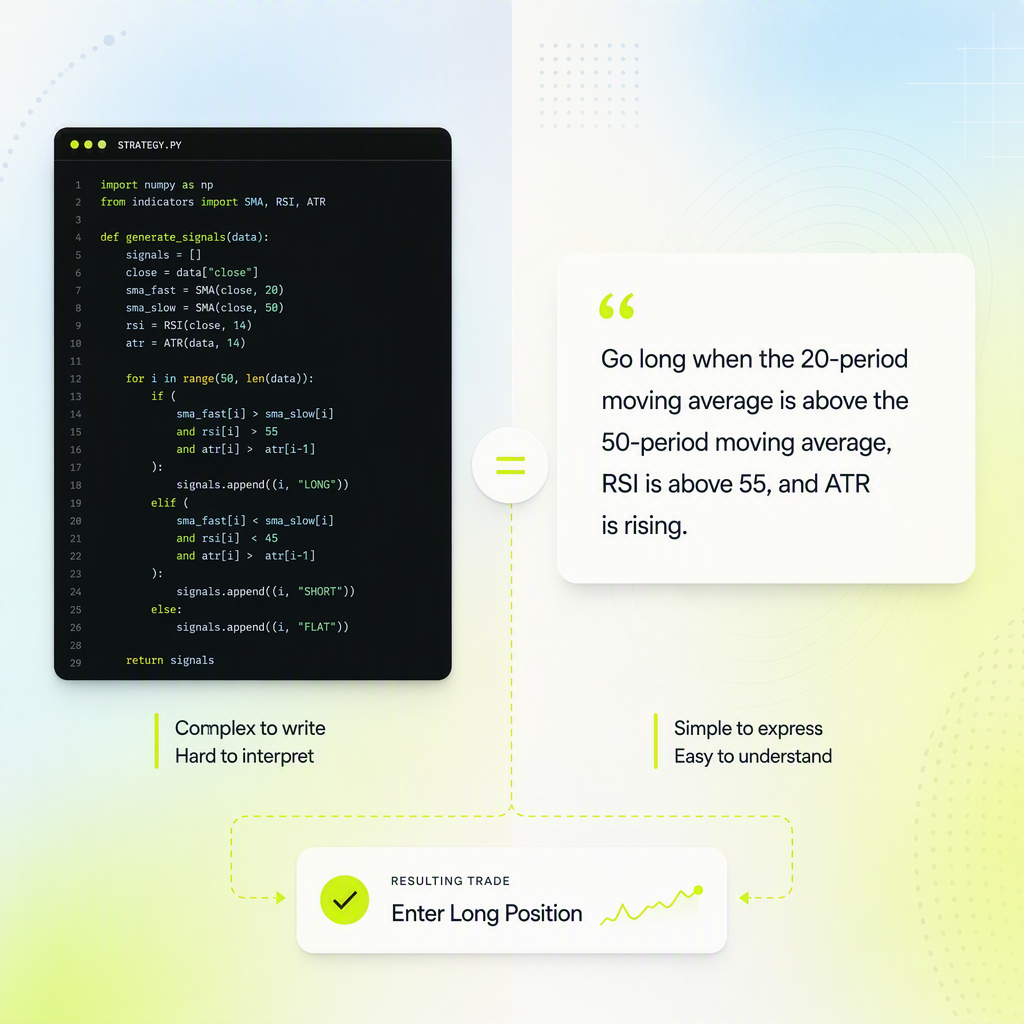
A newer generation of platforms compresses the five components into a managed pipeline, and the strategy input shifts from code to plain language. Obside is built this way: you connect a compatible broker account, describe your rules in natural language, and the platform compiles them into a persistent automated agent that watches markets and executes on price, indicator, macro, or news triggers, around the clock (feature live as of 2026-08-27).
The workflow mirrors the Python path without the infrastructure. The built-in backtesting engine replays your agent against years of historical data and reports the full breakdown — equity curve, Sharpe, max drawdown, win rate, with slippage assumptions stated (as of 2026-08-27). Paper trading runs the identical agent on live data with zero capital at risk. Going live is the same definition pointed at your real account, with guardrails and alerts built in rather than hand-rolled, and you can pause or edit an agent without a redeploy. The AI assistant handles the iteration loop — refining a rule is a sentence, not a pull request.
The trade-off is symmetrical. Obside will not run your custom machine-learning pipeline, and a platform necessarily constrains what is expressible compared with arbitrary code. What it removes is precisely the part of the Python project that fails most often: the operations. For a moving-average, RSI, rebalancing, or event-driven strategy — which is what the large majority of retail bots actually are — the engineering-honest comparison is twenty minutes of describing rules versus weeks of building and maintaining a server.
Decision guide: code it or describe it?
Build in Python if at least one of these is true: your strategy needs data or logic no platform offers, you want full control over every execution detail, or learning to build it is itself the goal. Choose a no-code platform if your strategy is expressible as rules on prices, indicators, schedules, macro data, or news; if you want backtest, paper, and live to run on one identical definition; or if you are honest about not wanting to maintain infrastructure for years.
A hybrid path is underrated: prototype ideas quickly on a platform, and reserve custom code for the one idea that genuinely cannot be expressed there. Most traders discover the platform ceiling is higher than expected, and the maintenance cost of code is, too.
Whichever path you take, version everything. A bot's strategy parameters, its code or rule definitions, and the data snapshot behind each backtest should be traceable, because three months from now you will not remember why the threshold was 5% or which test justified it. Code-side, git and tagged releases do the job. Platform-side, prefer tools that keep a history of agent edits and their backtests. The traders who improve over years are the ones who can compare today's system with last quarter's and say precisely what changed and why — a practice that costs nothing and compounds indefinitely.
Educational content only. This is not investment advice. Trading involves risk, including possible loss of capital.
FAQ
Yes — the strategy and backtest are approachable with `pandas` and a framework like `backtesting.py`, and tutorials cover every step. The hard 80% is what follows: robust broker integration, deployment on an always-on machine, error handling, and monitoring. Budget weeks, not a weekend, for something you would trust with real money.