
Look-Ahead Bias in Backtesting: How to Detect It Before It Costs You Money
Look-ahead bias makes bad strategies look brilliant by letting them peek at future data. Here is how it sneaks into backtests, the warning signs, and a practical audit checklist.
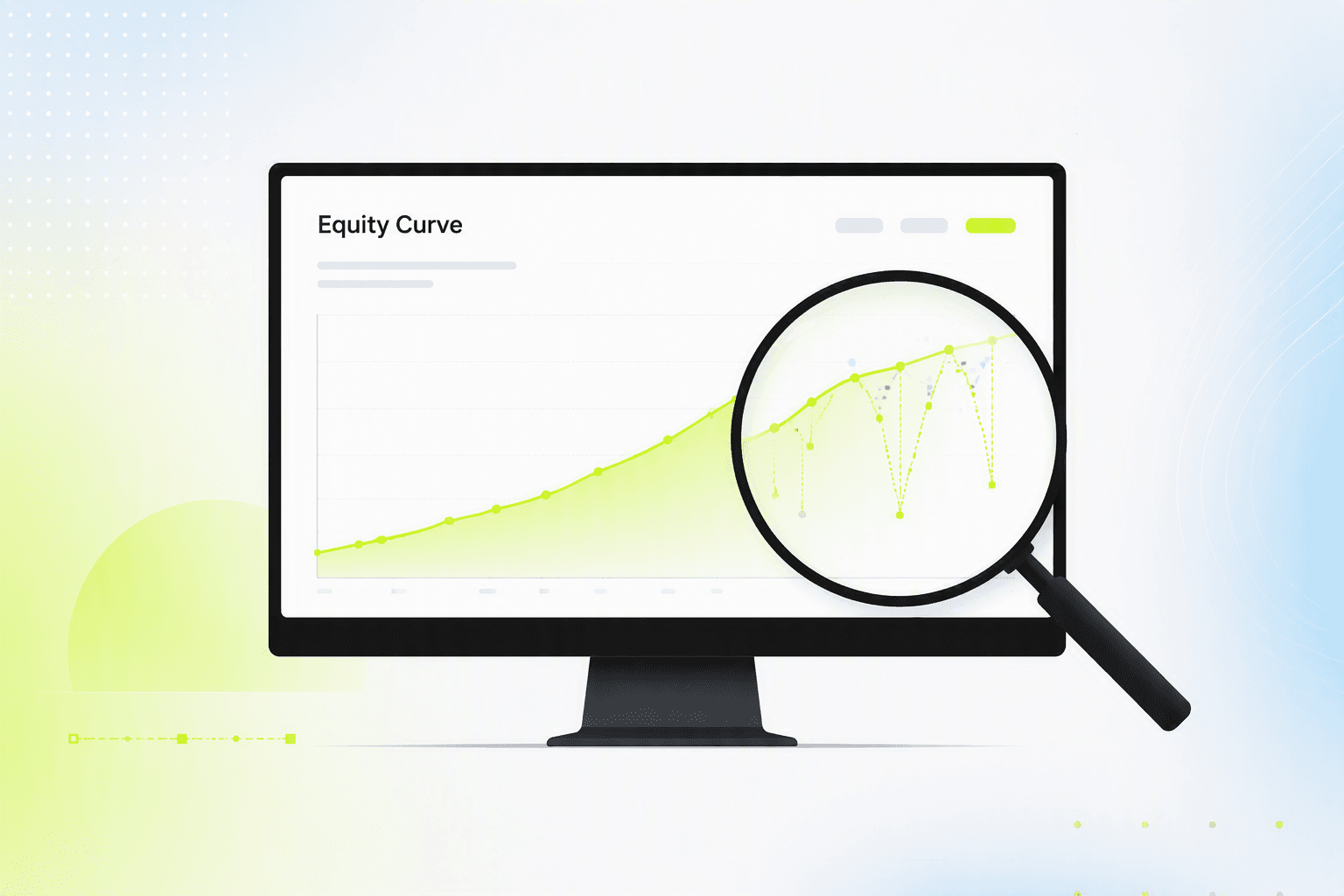
A backtest can only lie to you in a handful of ways, and look-ahead bias is the worst of them. It happens when a simulated strategy uses information that would not have been available at the moment the trade was placed — tomorrow's close, this quarter's earnings before they were published, an index composition that did not exist yet. The result is a strategy that looks brilliant in the test and falls apart on day one of live trading. This guide explains how look-ahead bias creeps into backtests, how to spot it, and how to audit your own results before real money is involved.
What look-ahead bias is, and why it is the worst bias
Backtesting suffers from a family of biases. Selection bias comes from cherry-picking the best result of many trials. Data-snooping and overfitting come from tuning parameters to the same data until the past is memorized. Look-ahead bias is different in kind: the results are not fragile, they are simply wrong, because the simulated trader had access to the future.
That difference has a practical consequence. An overfit strategy may keep working for a while until the regime shifts; its failure is delayed and ambiguous. A look-ahead-biased strategy is exposed immediately in live execution, because the real world will not sell you yesterday's price. The trades your live system generates will not match the backtest's, and the mismatch is the tell. Quantitative researchers treat it as the most dangerous bias precisely because it produces the most convincing equity curves — the smoother and steadier the curve, the more suspicious you should be.
The bias is also more common than most traders assume. It has been found in peer-reviewed momentum research and in commercial strategy marketing, not just in hobbyist notebooks. If professionals with review processes ship it, your weekend backtest deserves an audit.
The five ways it sneaks into your backtest
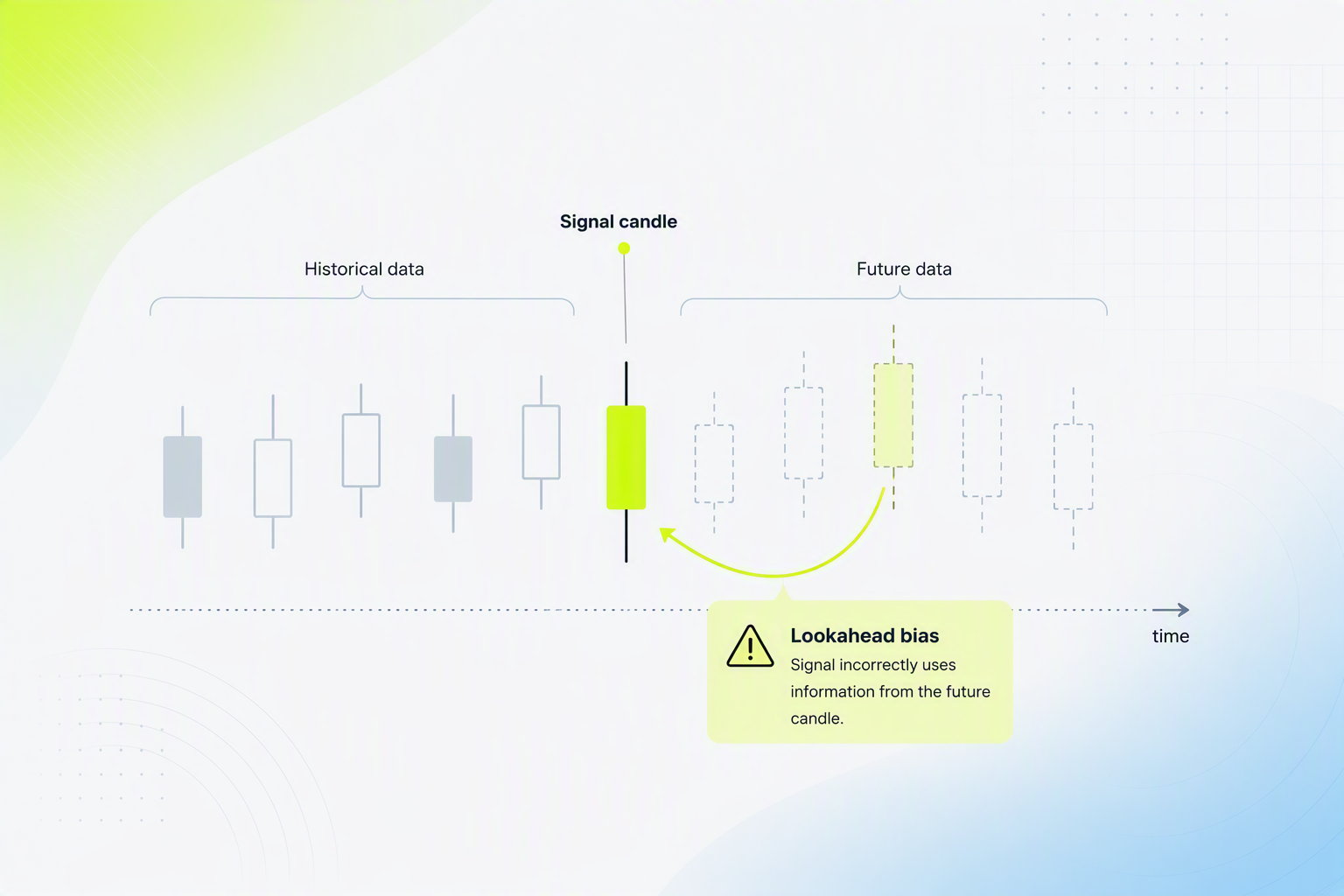
Signal-versus-execution timing. The classic: computing a signal on today's close, then "executing" at today's close. In reality, by the time the close is known, the close is gone. The honest version executes at the next bar's open, and on daily strategies that one-bar shift routinely turns a stellar backtest into a mediocre one.
Indicators that repaint. Some indicator implementations recalculate past values as new data arrives — certain zigzag, pivot, and smoothed indicators are notorious. The chart you see today shows signals nobody could have seen at the time. If your backtest reads a repainting indicator's historical values, the future is baked into every entry.
Fundamental data with publication lag. Q4 earnings dated December 31 were not knowable on December 31; they were published weeks later. Point-in-time fundamental databases exist precisely because standard databases backfill values to the period they describe, not the date they became public. Any strategy trading on fundamentals must use the publication date, not the reporting date.
Survivorship in the universe. Testing "the current S&P 500 members" over the past decade means selecting companies you already know survived and thrived. The 2016 version of the index included names that later collapsed and were removed. Strict point-in-time universes are the fix; without them, the bias inflates results in stock-picking strategies.
Corporate actions and revised data. Split-adjusted or dividend-adjusted price series are applied retroactively, and economic statistics get revised — the GDP print available in real time differs from the revised figure a year later. Models trained on final revised data saw numbers that did not exist at decision time.
A worked example: the one-bar shift that deletes an edge
Abstract definitions undersell how mundane this bug looks in practice, so walk through the classic case.
You test a simple rule on a daily index ETF: buy when today's close crosses above the 20-day moving average, sell when it crosses below. In the notebook, the natural implementation computes the signal from today's close and books the trade at that same close. The backtest sparkles — double-digit annual returns, shallow drawdowns, a curve you want to frame.
Now ask the operational question: at what moment do you know today's close? At the close. And at what moment can you trade it? You cannot. The earliest honest execution is tomorrow's open, and overnight gaps mean tomorrow's open is routinely a meaningful distance from today's close — in the direction the signal predicted, which is precisely the point. The biased version silently pockets that overnight move on every single trade.
Re-run the same rule with execution shifted to the next open and the transformation is brutal: on trend-following rules over daily bars, the one-bar correction routinely removes a large share of the apparent edge, and frequently all of it. Nothing about the strategy changed. The backtest simply stopped being paid for information it never had.
The lesson generalizes. Every rule has a "when is this knowable?" timestamp and a "when is this tradable?" timestamp, and look-ahead bias is any gap between them that favors the strategy. Intraday strategies meet the same bug through indicator values computed on incomplete bars; weekly strategies meet it through Friday closes executed on Friday. The audit is always the same two questions, asked of every input.
Warning signs your backtest is contaminated
None of these prove bias, but each one demands investigation before you trust the result.
An equity curve that is nearly a straight line in log scale, with tiny drawdowns across regime changes like 2020 and 2022, is the strongest smell. Unleveraged annualized returns far above index norms combined with a Sharpe ratio north of 1.5 deserve the same skepticism. A win rate that seems too consistent across all market conditions suggests the strategy is not actually facing uncertainty. And the definitive test: run the strategy forward, on paper, and compare each live signal with what the backtest claims it would have done on the same day. Any systematic mismatch in entry or exit levels means the backtest had information the live system does not.
How to audit a backtest for look-ahead bias
Work through the checklist in order; each step is cheap compared with funding a broken strategy.
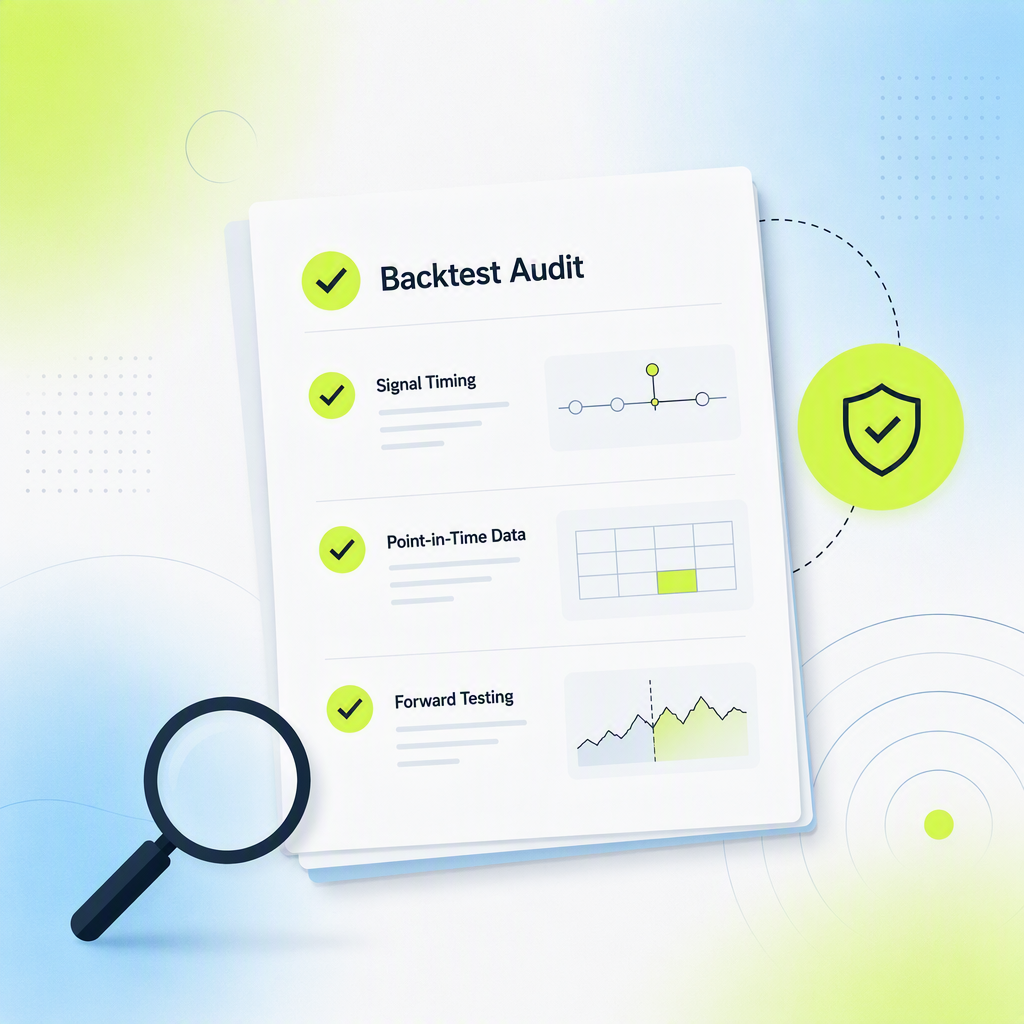
First, trace the timing of every signal. For each rule, write down exactly when its inputs become known and when the simulated execution happens. Anything executed at time T using data finalized at time T is a bug — shift execution to the next available price.
Second, add realistic frictions. Slippage and fees do not fix look-ahead bias, but a backtest without them hides many sins, and a strategy whose edge disappears under honest costs was not an edge.
Third, forward-test on live data. Paper trading is the single most effective look-ahead detector, because live data arrives in the only order reality permits. Weeks of matching signals between the paper run and the backtest build justified confidence; a divergence in week one saves you the capital.
This is also where tooling matters more than diligence. When your backtester and your execution engine are separate systems — a notebook here, a broker there — you re-create the timing assumptions by hand and every seam invites a bug. On Obside, the same agent definition runs through backtesting, paper trading, and live execution: the backtesting engine replays your strategy against years of historical data with the full performance breakdown — equity curve, Sharpe, max drawdown, win rate, and explicit slippage assumptions (as of 2026-08-27) — and the identical rules then run forward on live data. Automated agents execute on price, indicator, macro, and news triggers exactly as defined (feature live as of 2026-08-27), so the comparison between test and reality is a like-for-like diff rather than a reconstruction.
Look-ahead bias versus overfitting: know which enemy you face
The two failures get conflated because both produce beautiful backtests. Keep them apart, because the cures differ.
Look-ahead bias is an information error: the test used data the trader could not have had. It is binary — present or absent — and it is fixed by correcting timing, using point-in-time data, and validating forward. Overfitting is a statistical error: the test used only legitimate data but tuned itself to noise. It is a matter of degree, and it is mitigated by out-of-sample testing, walk-forward validation, and restraint with parameters. Audit for look-ahead first: there is no point running walk-forward analysis on a strategy that is still reading tomorrow's newspaper. Once timing and data are clean, the overfitting toolkit — held-out periods, parameter restraint, skepticism toward optimized decimals — has something real to measure, and its verdicts start meaning what they claim to mean.
A note on team discipline for those building with others or with AI assistance: look-ahead bugs thrive in handoffs. A strategy described in prose, implemented by someone else — or generated by a coding assistant — acquires timing assumptions nobody explicitly chose. Whoever validates the backtest should be able to answer, for every input, the two questions from this guide: when was this knowable, and when was it tradable? Write those timestamps into the strategy's documentation. Five minutes of explicitness at design time is cheaper than discovering the answer in your fill reports.
Educational content only. This is not investment advice. Trading involves risk, including possible loss of capital.
FAQ
Look-ahead bias occurs when a backtest uses information that was not yet available at the simulated moment of decision — executing on the same close that generated the signal, trading on earnings before their publication date, or testing on today's index members across past years. The backtest reports performance no real trader could have achieved.