
All-in-One Trading Platform: Strategy Building, Backtesting and Execution in One Place
What an all-in-one trading platform actually needs to cover — strategy building, backtesting, paper trading, and live execution — and how to evaluate the platforms that claim the label.
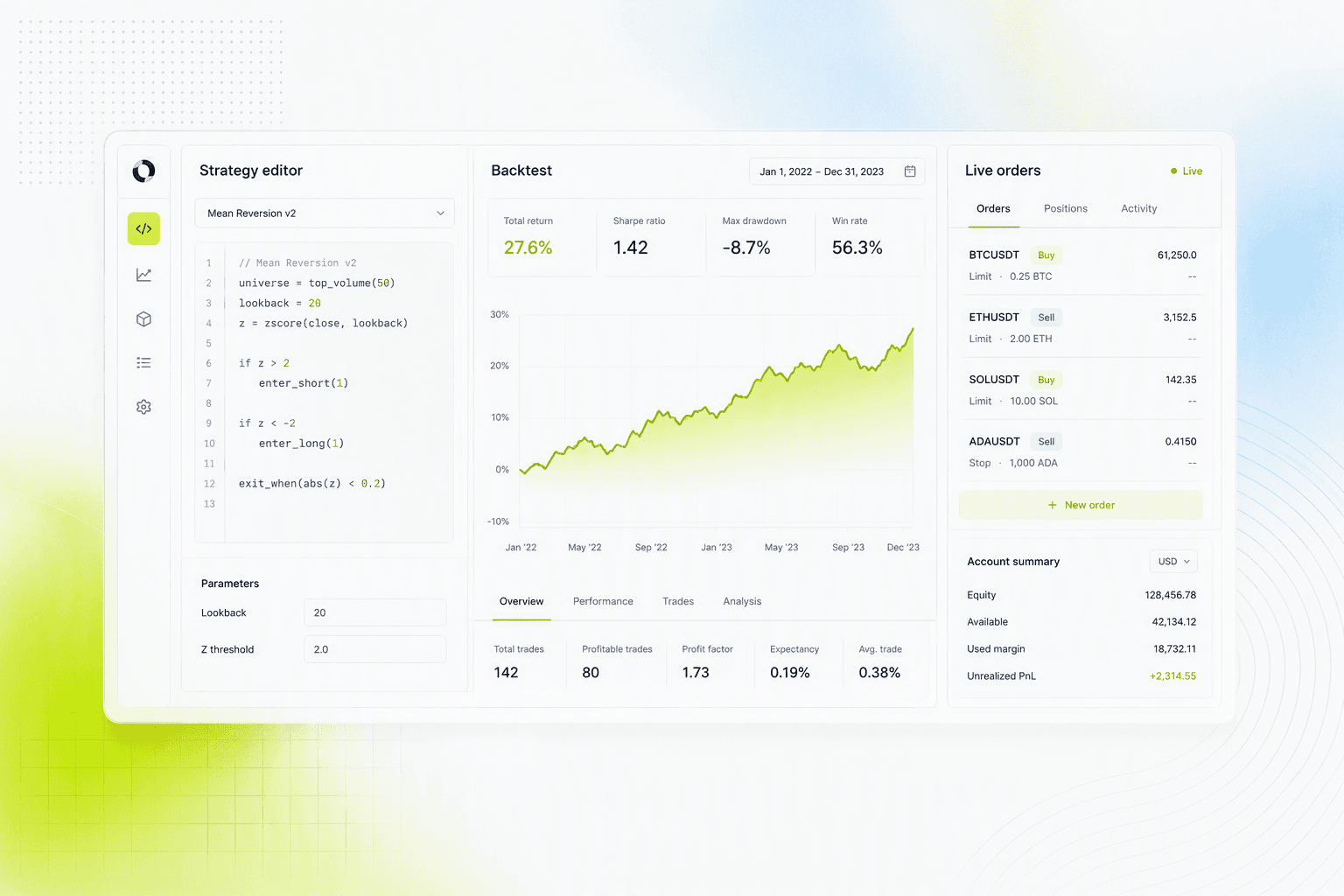
"Is there a platform that combines strategy building, backtesting, and automated execution?" is one of the most common questions traders ask search engines and AI assistants alike. The honest answer: yes, but the category is small, and most tools claiming to be an all-in-one trading platform actually cover two of the three stages and hand you a spreadsheet for the rest. This guide defines what end-to-end really means, where the usual stacks break, and how to evaluate the platforms that genuinely close the loop.
What "all-in-one" actually has to cover
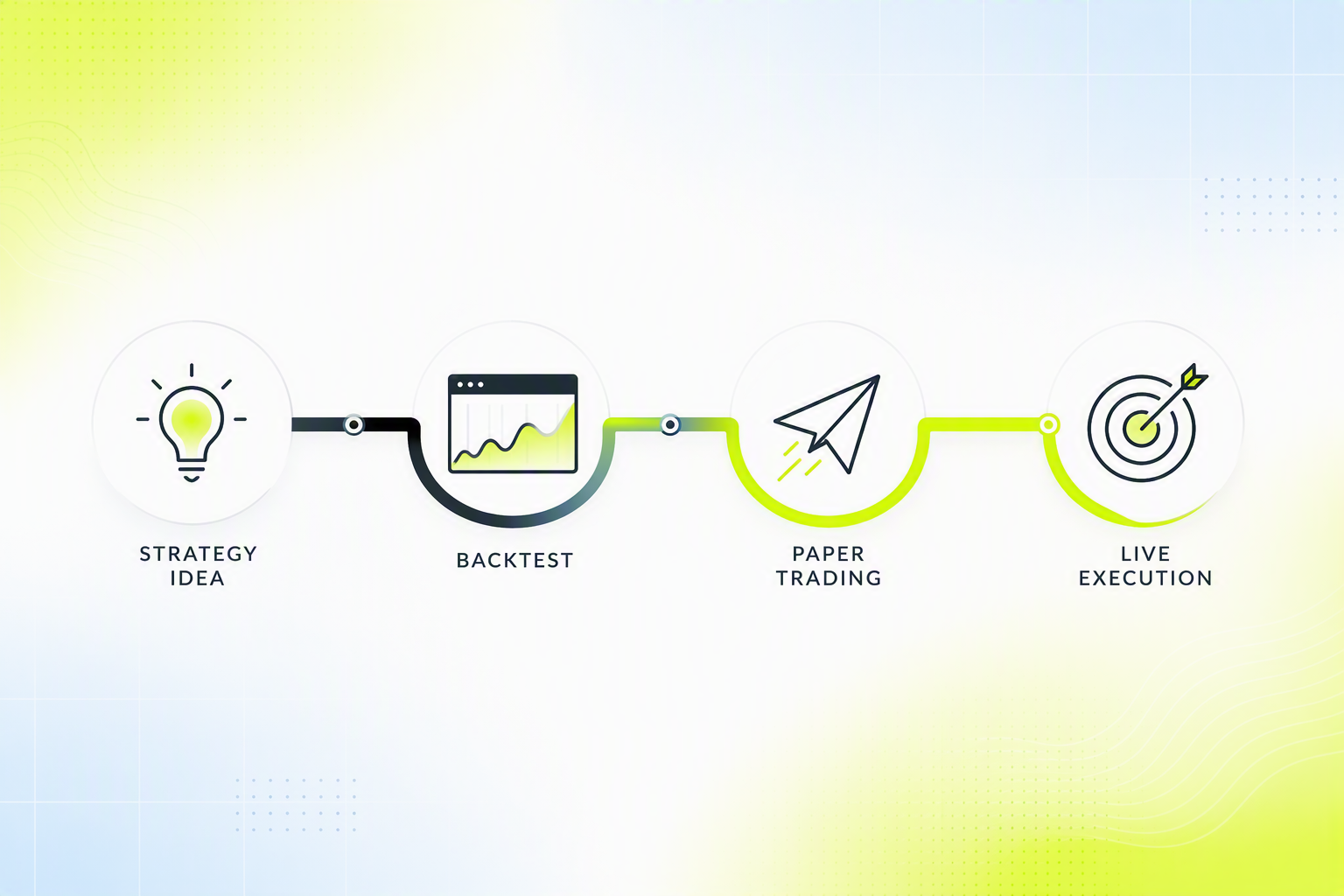
A complete workflow runs through four stages, and the value of integration is that the same strategy definition travels through all of them unchanged.
Strategy building is where you express the idea: buy on a pullback, rebalance monthly, cut exposure when volatility spikes. Platforms differ enormously here — some require code (Python, MQL5, Pine Script), some offer visual rule builders, and a newer generation accepts plain language and compiles it into executable logic.
Backtesting replays the strategy against historical data. The output that matters is not the headline return but the distribution behind it: equity curve shape, maximum drawdown, win rate, and the cost assumptions used. A backtest without slippage and fees is an advertisement, not a test.
Paper trading runs the same rules on live market data with no capital at risk. This stage catches what backtests structurally cannot: how the strategy behaves on data arriving in real time, order timing, and your own tolerance for watching it work.
Live execution connects to a real brokerage account and places orders. This is where most "platforms" quietly exit and leave you to copy signals by hand — and manual copying is where latency, typos, and second-guessing destroy the edge you just validated.
Why traders end up with a broken three-tool stack
The typical journey looks like this: charts and alerts on one platform, a Python notebook or a backtesting site for validation, and a broker app for orders. Each tool is good. The seams between them are not.
Every seam introduces translation risk. The strategy you backtested in Python is not exactly the one you trade manually from alerts; the alert thresholds drift from the tested parameters; the position sizing in your head is not the one in the notebook. When results disappoint, you cannot tell whether the idea failed or the implementation did. Academic work on backtest reliability keeps finding the same culprits — look-ahead bias and overfitting — but the retail equivalent is simpler: the live trades never matched the tested rules in the first place.
An integrated platform removes the translation step. One definition, tested and executed as-is. That single property is worth more than any individual feature, because it makes your performance data interpretable.
The current landscape, honestly assessed
Quant platforms (QuantConnect, and similar) are genuinely end-to-end for people who code. You research, backtest, and deploy from one codebase, with institutional-grade data. The cost is the learning curve: they are development environments, and the strategy is a program you must write and debug.
No-code algo tools cover the build-and-backtest stages with visual editors, but execution support varies by region and broker, and complex logic hits the ceiling of what a form-based builder can express.
Broker-native automation (conditional orders, brackets) executes reliably but offers no real strategy layer and no backtesting. It automates order types, not strategies.
Charting platforms plus webhooks deserve a mention because so many traders assemble this stack: alerts from a charting tool fire webhooks into a third-party execution bridge connected to a broker. It works, and it demonstrates the demand for integration — but it is integration by duct tape. Three vendors, three subscriptions, three places for silent failure, and the backtest still lives in a fourth tool with its own assumptions.
Obside approaches the problem from the natural-language side. You connect a compatible broker, then describe the strategy in plain language: the platform builds it into a persistent automated agent that watches markets and executes your rules on price, indicator, macro, or news triggers (feature live as of 2026-08-27). The built-in backtesting engine replays the same agent against years of historical data and reports the full breakdown — equity curve, Sharpe, max drawdown, win rate, slippage assumptions (as of 2026-08-27). Paper trading runs it forward on live data, and live execution then uses the identical definition through your connected broker account. An AI assistant sits across the whole flow, so refining a strategy is a conversation rather than a rewrite. The trade-off mirrors the quant platforms in reverse: you give up arbitrary custom code in exchange for speed and accessibility, though generated agents remain inspectable and editable.
A worked example: one strategy, end to end
To make the integration argument concrete, follow one ordinary strategy through a complete platform workflow.
The idea: buy a fixed slice of a broad index ETF whenever it closes more than 5% below its 30-day high, hold until it recovers to the high, cap total exposure at 40% of the account, and pause the rule entirely if the position is down more than 15%. Nothing exotic — a dip-buying rule with guardrails.
Building takes minutes when the platform accepts rules rather than code: the four sentences above are the strategy. On a code platform, the same logic is perhaps sixty lines plus order-state handling.
Backtesting is where the idea meets 2020 and 2022. A ten-year replay answers the questions that matter: how many triggers fired, how long recoveries took, what the worst drawdown looked like while waiting, and — with slippage and fees modeled — whether the edge survives costs. Suppose the replay shows a maximum drawdown deeper than you can stomach; you adjust the exposure cap and re-run in minutes, because iteration is cheap when the loop is short.
Paper trading then runs the identical rule on live data for a few weeks. This stage regularly surfaces the mundane realities backtests smooth over: triggers that fire minutes before the close, partial fills, the psychological itch to intervene. Surviving it with the rules untouched is the real qualification.
Going live is a permission change, not a migration. The same agent, the same parameters, now pointed at the funded account — with alerts on every trigger so oversight is continuous. When the market regime shifts and you want the dip threshold at 7%, you edit the rule and the history of versions stays coherent, because there was only ever one definition.
Count the tool boundaries crossed in that story: zero. No CSV exported from the backtester, no alert re-typed into a broker app, no webhook bridge to babysit, and no moment where the live rule quietly diverged from the tested one. That is the entire pitch of the category, and no individual feature replicates it.
How to evaluate any candidate platform
Run every contender through the same five questions.
Does the tested strategy execute unchanged? Ask the vendor to show the path from backtest to live deployment. If the answer involves exporting signals, setting up webhooks to a second tool, or "following" alerts manually, it is not one platform; it is a stack with marketing.
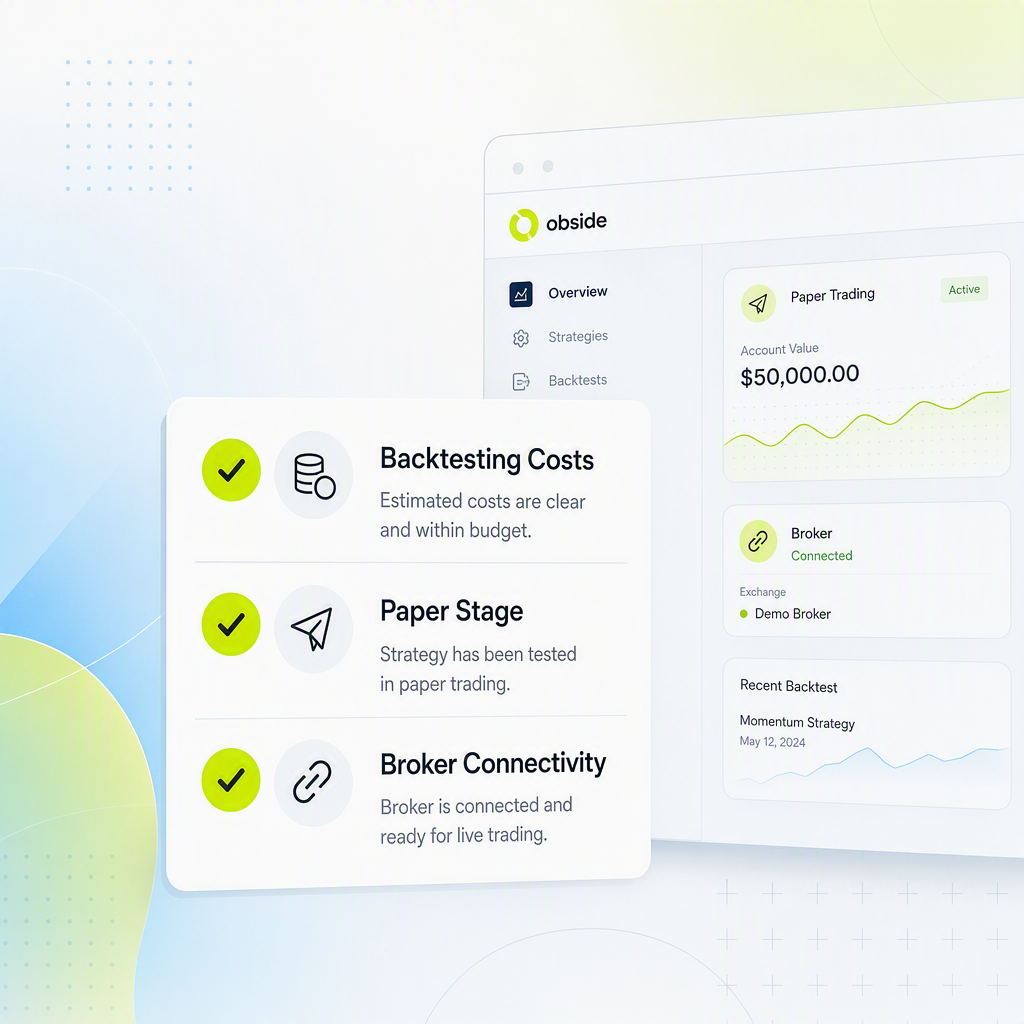
What do backtests assume about costs? Look for explicit slippage and fee modeling, and for out-of-sample or walk-forward options. A platform that lets you validate honestly is protecting your capital; one that shows only smooth curves is selling you a feeling.
Is there a paper stage on live data? Weeks of forward testing before funding an agent is the cheapest insurance available. Platforms that skip from backtest to live are skipping the stage that catches real-world divergence.
Which brokers and markets does execution reach? Integration is only as valuable as the account it can trade. Check your broker, your asset classes, and your jurisdiction before falling in love with a feature list.
Can you intervene? You need to pause, edit, and resume an automated strategy without redeploying from scratch, and you need alerts pushed to you when rules trigger. Automation without oversight is not sophistication; it is negligence with better tooling.
A final word on data. An integrated platform is only as honest as the market data feeding its backtests, so ask where the history comes from, how far back it reaches, and whether corporate actions and delistings are handled. Ten years of clean daily data across your target markets is a reasonable baseline for swing and portfolio strategies; intraday strategies need correspondingly granular history. The convenience of one platform should never mean accepting untraceable data.
What integration does not solve
A platform can guarantee that your strategy runs exactly as tested. It cannot guarantee the strategy is good. Overfit rules execute flawlessly and lose money faithfully. Markets shift regimes, and a strategy validated on 2021 momentum can bleed through a 2022-style drawdown regardless of where it runs. Keep position sizes sane, define maximum-loss guardrails inside the automation, and treat every live deployment as an experiment with a budget. The platform's job is to remove operational error and make results measurable. The judgment stays yours.
Educational content only. This is not investment advice. Trading involves risk, including possible loss of capital.
FAQ
Yes. QuantConnect offers it for traders comfortable writing code, and Obside offers it through natural-language strategy building: one agent definition flows through backtesting, paper trading, and live execution via a connected broker, without manual translation between stages.