
Best Capitalise.ai Alternatives in 2026: 6 Tools Compared
Capitalise.ai is excellent — when your broker supports it. If yours doesn't, or you need more than if-then price rules, here are the six alternatives worth considering in 2026, compared by broker coverage, AI depth and price. Written by the Obside team, disclosure included.
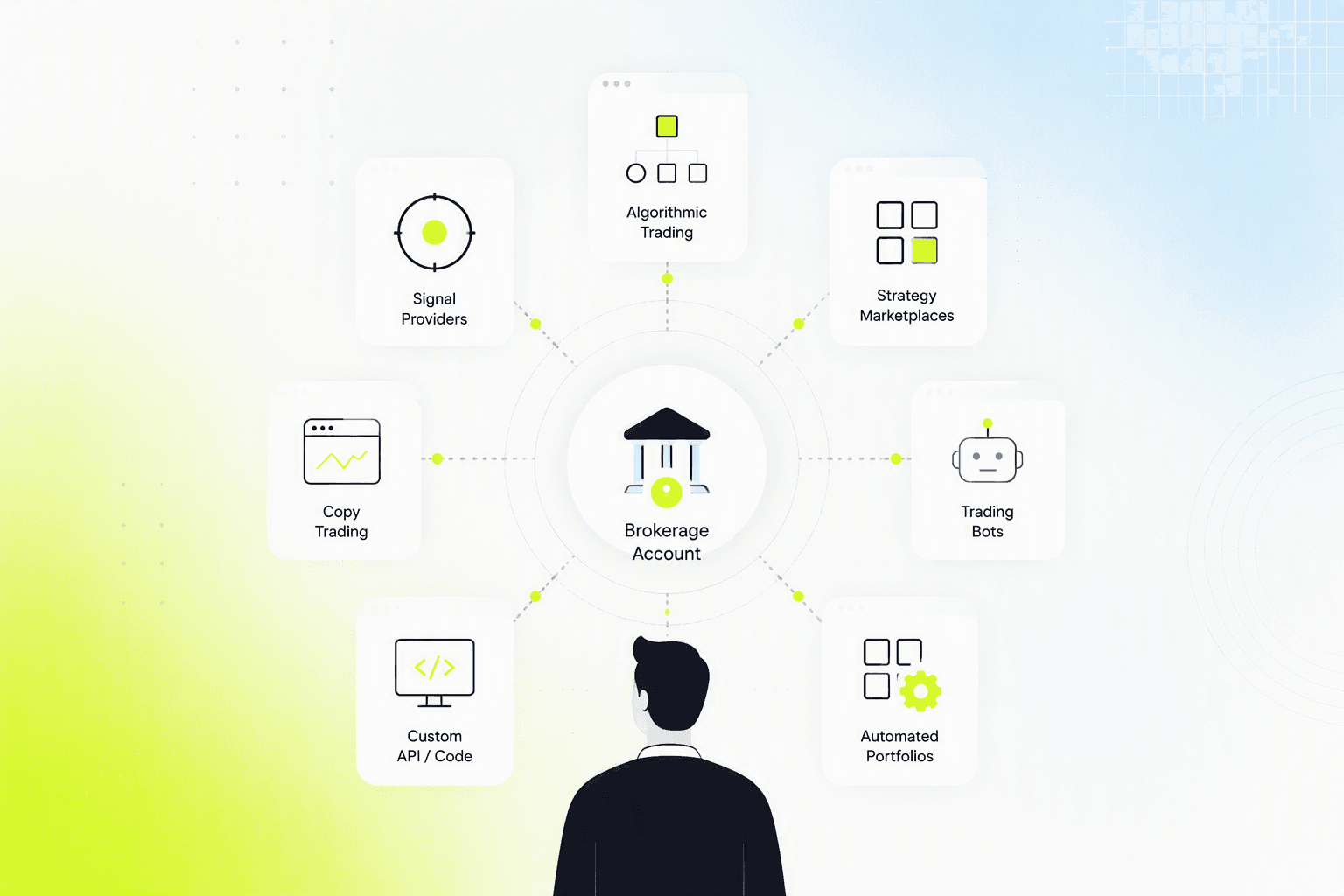
Capitalise.ai deserves its reputation. Plain-English if-then rules, solid backtesting and simulation, native execution — and free for the trader, because partner brokers pay for it. If your broker is on their partner list and your needs are price-triggered rules, you can stop reading: keep using it.
People look for Capitalise.ai alternatives for three concrete reasons:
- Their broker isn't a partner. Capitalise.ai only exists inside partner brokers — largely CFD/forex names plus Interactive Brokers and Binance. If you trade at a mainstream retail broker without a partnership, you simply can't activate it.
- They need more than price triggers. Rules that react to news, macro releases or fundamentals are outside its scope.
- They want a portfolio layer, not just an execution engine — something that understands and monitors what they hold.
Before the list, a disclosure: we build Obside, the first entry below. We put it first because it is the closest functional substitute for the plain-English promise, not because we pretend to be neutral. Every claim about the other five is factual as of August 2026, and each entry says who it genuinely fits best.
1. Obside — plain-language automation on the brokers you already use
Obside takes Capitalise.ai's core idea — describe an automation in plain English — and moves it outside the broker. Instead of being distributed through broker partnerships, it connects to 30+ existing brokerage and crypto accounts (Interactive Brokers, Trading 212, Degiro, eToro, Robinhood, Fidelity, Binance, Coinbase, Kraken and more) across the US, Europe, the UK, Canada, Australia and India.
The automation vocabulary is wider than if-then price rules: agents combine price action with news, macroeconomic data and fundamentals ("alert me if a holding drops 5% on negative news", "rebalance my custom ETF monthly"), can run as alert-only agents, and backtest plus paper trade before touching real money. Around the agents sits a portfolio copilot: exposure analysis, dividend tracking, daily briefs, and news filtered to your actual holdings. Paid plans add MCP connections so Claude or ChatGPT can query your portfolio directly.
Honest limitations: unlike Capitalise.ai, it isn't free — there's a free plan, but live execution starts at the Pro plan ($69/month; Plus is $39, baselines in USD, localized at checkout — see pricing). And on some brokers (Interactive Brokers included) the connection is currently read-only: full monitoring and analysis, no live orders there yet. The supported brokers page states access per broker.
Best for: traders and investors whose broker isn't a Capitalise.ai partner, anyone in Europe, and anyone who wants news/macro-aware automation plus portfolio intelligence rather than a rule engine alone.
2. Composer — systematic portfolios, if you're in the US
Composer replaces the rule-engine model with "symphonies": weighted, conditional, auto-rebalanced portfolios you build visually or describe to its AI. Backtesting over long histories is core to the experience, and a large community library of shared symphonies lowers the starting bar. Composer is itself a US brokerage (SIPC member), priced from about $24/month billed annually.
Honest limitations: US residents only, and your capital moves to Composer. Strategy logic centers on allocation and rotation — event-driven rules on news or individual position management aren't its game.
Best for: US investors who want systematic, rebalancing-driven portfolio strategies with excellent backtesting.
3. TrendSpider — automated technical analysis for chart-first traders
TrendSpider approaches automation from charting: automated trendline and pattern detection, multi-timeframe analysis, a strategy tester, and alert-driven trading bots that can fire into brokers via webhooks. It has steadily added AI-assisted features and is one of the most capable platforms for traders whose workflow starts with technical analysis. Paid tiers only.
Honest limitations: it is a charting-and-signals platform first; automation runs through alerts/webhooks rather than a native plain-English order engine, and there's no portfolio intelligence layer.
Best for: active technical traders who live in charts and want their analysis, alerts and automation in one place.
4. Coinrule — if-then bots for crypto
Coinrule is the closest spiritual sibling to Capitalise.ai in crypto: template-driven if-then rules ("buy when price increases 2% in 15 minutes") deployed across major exchanges like Binance, Coinbase Advanced and Kraken. A free tier exists, with paid plans scaling rule counts and features.
Honest limitations: crypto only — no stocks or ETFs — and rules are price/indicator-based, without a news or fundamentals dimension.
Best for: crypto traders who want simple, reliable rule automation across exchanges without coding.
5. QuantConnect — institutional-grade, if you can code
QuantConnect is the opposite end of the spectrum: an open algorithmic-trading platform (the LEAN engine) where strategies are written in Python or C#, backtested against deep institutional datasets, and deployed live to supported brokers. Enormous power, active community, research-grade rigor.
Honest limitations: it's programming. If Capitalise.ai's appeal was "no code, plain English", QuantConnect is a different sport entirely.
Best for: developers and quants who want full control and are happy writing code.
6. Trade Ideas — AI scanning and signals for day traders
Trade Ideas built its name on AI-driven stock scanning — its engine surfaces intraday setups, backtests them, and can automate entries through partner integrations. It is a signal-generation machine more than a rule-automation layer for your own strategy ideas.
Honest limitations: priced for serious day traders, US-equity focused, and you adopt its signals rather than encoding your own plain-English strategies.
Best for: active US day traders who want a proven scanner feeding them setups.
How to choose
Match the tool to your actual constraint. If your broker is a Capitalise.ai partner and price-triggered rules are enough — stay put. If your broker isn't covered, or you're in Europe, or your rules need news and macro awareness, Obside is the closest like-for-like replacement. If you're a US systematic investor, look at Composer; a chartist, TrendSpider; crypto-only, Coinrule; a programmer, QuantConnect; a day trader hunting signals, Trade Ideas.
Educational content only. This is not investment advice. Trading involves risk, including possible loss of capital.
FAQ
Usually you don't "leave" — you never could use it, because your broker isn't a partner. Its distribution model is its main constraint: no partner broker, no Capitalise.ai. The second reason is scope: rules that need news, macro data or portfolio context are outside its engine.