
AI Trading: What It Actually Is and How to Start
The term AI trading covers four very different things. This guide separates them, states plainly what each can and cannot do today, and lays out the backtest-paper-live sequence that keeps automation useful instead of expensive.
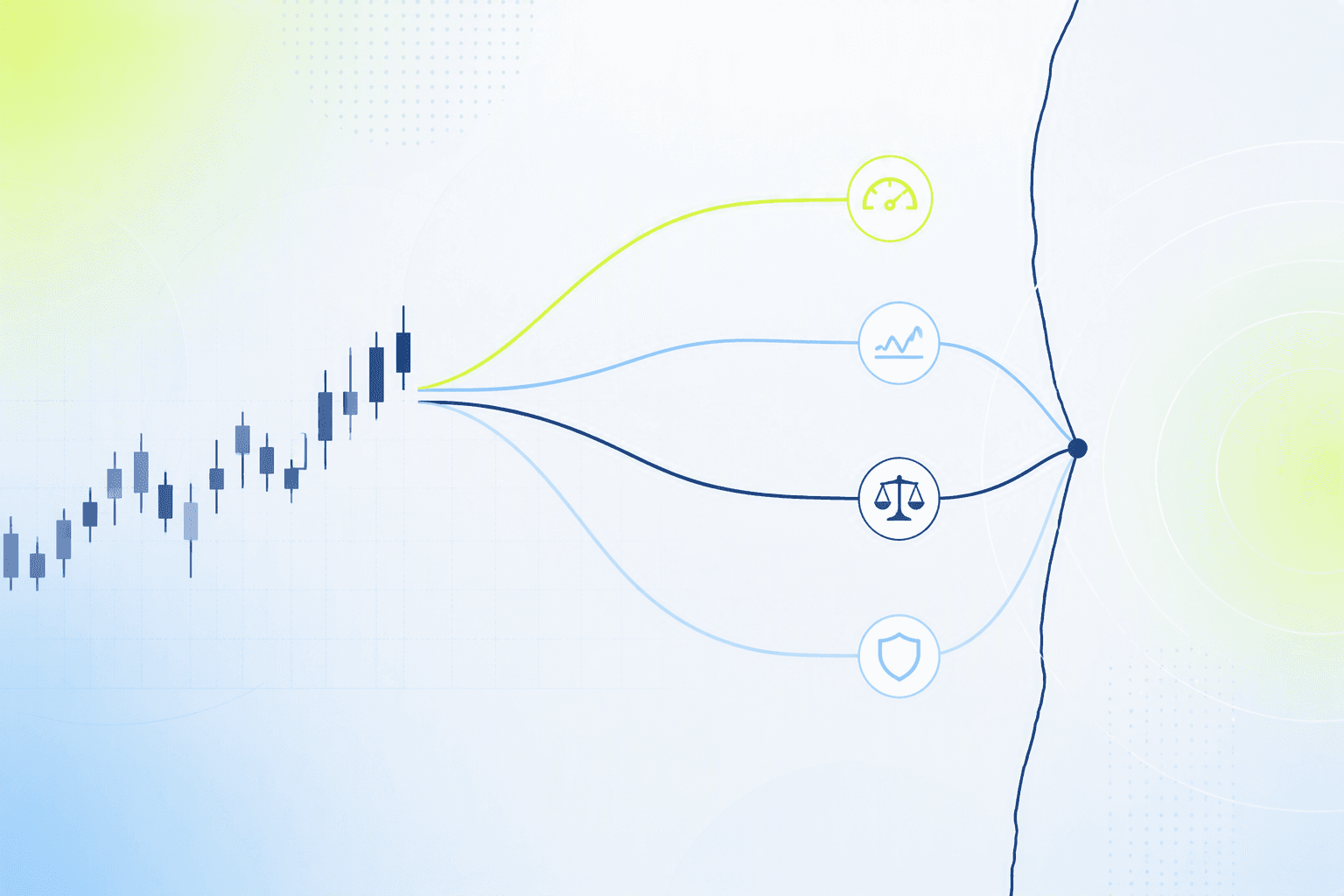
Ask ten people what AI trading means and you get four answers: a chatbot that explains a chart, a model that ranks stocks, a bot that fires orders on a rule, and an agent that watches markets and acts on its own. Those are not variations of one product. They fail in different ways and cost different amounts. This guide separates them, says what each can honestly do today, and gives you a sequence for testing any of them before real money is on the line.
The four things people call AI trading
Conversational analysis is the most common entry point. You point a language model at price history, filings, or news and ask it questions. It summarizes, compares, and screens. It does not touch your broker. The risk here is not financial, it is epistemic: a fluent answer about a stock reads as authoritative whether or not the underlying numbers were retrieved correctly.
Signal generation is the oldest branch and the one with real academic history. A statistical or machine-learning model scores instruments and emits a ranking, a probability, or an alert. Something else decides what to do with that output. Most of what quantitative funds have run for two decades sits in this category, and most of it is unglamorous regression rather than deep learning.
Rule execution is what the phrase "trading bot" usually means. You define conditions, the software watches for them, orders go out when they are met. A great deal of software marketed as AI trading is this and nothing more. That is not a scandal — deterministic execution is genuinely useful — but you should know when you are buying an if-then statement with a neural network on the landing page.
Agentic trading is the newest branch, where a model perceives market state, reasons about it, and acts inside limits you set in advance. It differs from a rule bot because the reasoning step is not enumerated ahead of time. That flexibility is the appeal and the hazard, which is why the useful implementations wrap the model in hard constraints rather than letting it decide freely.
Laid side by side, the differences are easier to price:
| What it outputs | Who decides | Main failure mode | |
|---|---|---|---|
| Conversational analysis | Explanations, summaries, screens | You | Confident answers built on badly retrieved data |
| Signal generation | Scores, rankings, probabilities | You or a downstream rule | Overfitting to the sample it was trained on |
| Rule execution | Orders, on stated conditions | You, in advance | The rule was wrong, and it runs anyway |
| Agentic trading | Orders or proposals, inside limits | The model, within your bounds | Reasoning drifts as conditions change |
The column that matters when you are comparing products is the third one. Anything that moves decisions away from you should buy you something specific in return, and the vendor should be able to say what.

What demand for AI trading looks like right now
Interest is climbing fast, and the shape of the curve says something about where readers actually are. In our analysis of United States Google search data as of 2026-07-31, the head term "ai trading" draws roughly 18,100 searches a month and grew 83% year over year. App-shaped queries grew harder still: "ai trading app" and "ai investing app" each ran about 175% above the prior year, and "robo advisor for investing" rose roughly 376%.
The skeptical queries are the interesting part. "Does ai trading work" and "is ai trading profitable" together pull several hundred searches a month in the same dataset, and both spiked in spring 2026. People are not only shopping. They are checking whether the category is real.
They get thin help when they look. As of 2026-07-31, the first page for "ai trading platform" consists of an AI Overview, three vendor homepages, two affiliate ranking posts, an app store listing, and a Reddit thread. Almost nothing on it explains the mechanics without also selling something. Notably, the community consensus surfaced from that Reddit thread points the opposite way from the vendor copy: experienced practitioners there describe strictly defined rules and hard risk limits as the thing that makes autonomy survivable, not model sophistication.
What it can and cannot do
Automation reliably removes three specific failures, and they are the expensive ones. It watches continuously, so a level that triggers at 3am is not missed. It executes without hesitation, so the plan you wrote calmly is the plan that runs when the screen is red. And it applies the same logic to every position, which is where discretionary portfolios usually drift.
What it does not do is generate an edge you did not have. No credible evidence supports the claim that adding a language model to a strategy produces durable market-beating returns, and any vendor implying otherwise is describing a backtest, not a track record. A model can enforce your reasoning faithfully and quickly. If the reasoning is wrong, you now get to be wrong on schedule.
Two failure modes deserve naming. Overfitting is the first: a strategy tuned until it looks perfect on history has usually learned that history's noise, and it degrades the moment conditions shift. Regime change is the second, and it is worse, because the system keeps executing confidently while the assumption underneath it has quietly expired. Neither is solved by a bigger model.
There is a practical test for both. Take the strategy you are about to trust and ask what market conditions would have to hold for it to keep working. If you can state them in a sentence, you can watch for them breaking. If you cannot, the system is not encoding a thesis you hold, it is encoding a pattern someone found, and you will have no signal that it has stopped applying until the losses tell you.
What AI trading actually costs
Sticker price is the smallest line. Retail tools sit somewhere between free and a few hundred dollars a month, and comparison content tends to stop there. The costs that decide whether a strategy is viable are elsewhere.
Broker commissions and spreads apply to every order the automation sends, so a rule that rebalances often can be arithmetically unprofitable at a scale where the same rule works fine run monthly. Slippage widens the gap between the fill your backtest assumed and the fill you get. Data subscriptions become real once you want anything beyond delayed quotes. And there is the cost nobody prices: the hours spent building, testing, and repairing something that must survive contact with a live market.
Work the arithmetic before you commit to a frequency. A strategy that turns over a position every week pays its round-trip cost fifty-odd times a year, and on a modest account that total can exceed the edge the strategy was built to capture. This is the most common reason a promising backtest dies in production, and it has nothing to do with the model.

A sequence that keeps you out of trouble
Run every strategy through three stages in order, and do not compress them.
Start with a backtest on historical data, including a period the strategy was not designed around. Include fees and slippage. A backtest that omits costs is a demonstration, not a test. Look specifically at maximum drawdown rather than total return, because drawdown is the number that determines whether you would have stayed in the position.
Move to paper trading on live data with no capital committed. This is where implementation bugs surface: orders that never fill, triggers that fire twice, a data feed that lags exactly when volatility arrives. Give it enough time to see conditions your backtest period did not contain. A week of calm markets proves very little.
Only then go live with limits — small size, defined maximum loss, and an off switch you can reach quickly. Approval-first execution, where the system proposes and you confirm, is a reasonable permanent setting rather than a beginner's mode. Autonomy is a dial, not a switch, and most people are better served somewhere below the maximum.
Where Obside fits
Obside is a portfolio automation platform with an AI assistant. You connect a compatible broker or exchange, then write prompts in plain language that automate the portfolio: rebalancing, conditional orders, alerts. Triggers can key off price levels, technical indicators, macro data, or news events, so a rule like "alert me if this position drops below its 200-day average" does not require code.
Two other pieces matter for the categories above. You can assemble a custom ETF, a personal index you define, without management fees beyond your broker's standard costs. And you get AI insights on the portfolio you actually hold, pushed to your dashboard or pulled on demand through the chat assistant.
What it is not: Obside does not replicate other users' trades, does not run leaderboards or public portfolios, and does not recommend what to buy. It automates logic you define. That distinction is the whole point of the guardrails discussed above.
The honest summary of this category is that AI trading is a discipline amplifier. It will not find an edge for you, and it will execute a bad idea with the same precision as a good one. The people who get value from it start with a rule they already believe in, test it properly, and expand scope only after the machine has earned it. If you have such a rule, describe it to Obside and let it run as a paper strategy this week before a single euro is committed.
Educational content only. This is not investment advice. Trading involves risk, including possible loss of capital.
FAQ
No, though they overlap. Algorithmic trading is the broader, older discipline of encoding rules and executing them systematically, and most of it involves no machine learning at all. AI trading refers specifically to systems where a learned model does some of the analysis or decision-making. Every AI trading system is algorithmic; the reverse is not true.