
The Real Risks of AI Trading Agents (and the Fixes)
Seven AI trading risks ranked by likelihood and blast radius, from overfit backtests to leaked API keys, with the specific fix for each one.

An AI agent trading your account is a force multiplier, and force multipliers do not care which direction you point them. The real AI trading risks are rarely the cinematic ones. No rogue model is secretly shorting your savings. The dangers are ordinary, compounding, and fixable: a bad strategy executed with perfect discipline, a backtest that lied politely, an instruction that meant one thing to you and something else to the machine. This article ranks seven risks by likelihood and blast radius, then gives the specific fix for each. No hand-waving about "AI safety" in the abstract.
Ranking AI trading risks: likelihood times blast radius
A useful risk register needs two axes. Likelihood: how often this actually happens to retail automators, not how scary it sounds. Blast radius: the worst plausible loss when it does happen, given sensible account sizes.
The ranking matters because your attention is finite. Most people worry about the exotic risks (the AI "going rogue") and ignore the boring ones that actually drain accounts. Institutions have reached similar conclusions: the Cambridge CCAF and World Economic Forum's 2026 Global AI in Financial Services Report (May 2026) flags model reliability, cyber vulnerabilities, and the adequacy of human oversight as the key risks accompanying agentic AI adoption. Swap "compliance department" for "you, on a Tuesday evening," and the same categories apply to a personal account.
Here is the register we will work through:
| # | Risk | Likelihood | Blast radius |
|---|---|---|---|
| 1 | Automating a bad strategy, faster | High | Medium |
| 2 | Overfit backtest | High | Medium–high |
| 3 | Misinterpreted intent | Medium | Medium |
| 4 | Hallucinated reasoning | Medium | Medium |
| 5 | Technical failures | Medium | Low–medium |
| 6 | Compromised API keys | Low | Catastrophic |
| 7 | The over-trust ratchet | High (over time) | Grows silently |
Notice the shape: the most likely risks are self-inflicted, and the worst-case risk is operational, not algorithmic.
Risks 1 and 2: you, amplified
Risk 1: automating a bad strategy, faster. This is the most common failure by a wide margin, and no vendor puts it in the brochure. An agent does not improve your logic; it executes it more often, with fewer excuses. If your strategy loses 0.3% per trade after costs, manual hesitation was accidentally protecting you. Automation removes the friction and compounds the leak.
Fix: treat the agent as an amplifier and audit the signal before amplifying. Write the strategy down with entry, exit, size, and an invalidation rule ("if X happens, this thesis is wrong"). If you cannot state what would prove it wrong, it is not ready to automate. Then cap the damage structurally: small allocation, hard per-trade sizing, a drawdown limit that halts the agent.
Risk 2: the overfit backtest. A backtest with twelve tuned parameters and one glorious equity curve is not evidence; it is a fitted costume. The strategy memorized one stretch of history and will meet a different future. LLM-generated strategies add a twist: research in 2025 showed that models whose training data covers the backtest window can effectively remember market history, inflating results that then degrade out-of-sample (arXiv:2505.07078, 2025).
Fix: demand out-of-sample survival. Test across regimes (a crash year, a chop year, a rally year), prefer parameter ranges that work broadly over a single magic value, and treat paper trading as the real exam. The full mechanics deserve their own read: backtest overfitting and how to catch it.

Risks 3 and 4: the machine misunderstands
Risk 3: misinterpreted intent. The agent did what you said. You meant something else. "Buy the dip" has no definition: you pictured 5% pullbacks inside an uptrend; a literal reading buys every red candle in a collapse. Ambiguity is not an edge case of natural-language trading; it is the central problem.
Fix: never run an instruction that has not been restated back to you in precise terms. This is where a translation layer earns its keep. On Obside, you might type "buy $150 of ETH when it pulls back 5% from its 30-day high, but only if the daily trend is still up." The copilot restates it as monitored conditions: the reference high, the exact trigger level, the trend filter (say, price above the 50-day moving average), the order size, and a weekly cap. You approve that restatement, not your original sentence, and the agent runs in paper mode first. Any gap between what you meant and what it understood surfaces before money moves.
Risk 4: hallucinated reasoning. Language models produce fluent, confident fabrications, and financial questions (numbers, tickers, dates) are exactly the terrain where they do it. Benchmarks have measured hallucination on a substantial share of finance queries, up to roughly 41% in one 2024 study without safeguards (FailSafeQA and related financial-LLM benchmarks, 2024–2025).
Fix: architecture, not hope. The LLM should interpret language while deterministic engines supply every price, indicator value, and order. If a platform lets the model itself be the source of numbers, walk away. The failure mode is subtle enough that we gave it a full article: AI hallucinations in trading.
Risks 5 and 6: plumbing and keys
Risk 5: technical failures. Exchange APIs go down, usually during the volatility that made you want automation in the first place. Orders partially fill. Data feeds lag. A stop that lives only in your platform's memory does nothing if the connection between platform and exchange drops at the wrong minute.
Fix: know your failure modes before they happen. Ask three questions of any setup: where does my stop actually live (platform logic or exchange-native order), what happens to open positions if the platform goes dark, and how am I alerted when an order fails? Position caps limit how much any single technical hiccup can touch. Blast radius here is usually low because failures tend to affect one order or one position, not the account. Usually.
Risk 6: compromised API keys. The inverse profile: rare, and catastrophic when the key was over-scoped. A leaked key with withdrawal rights means your funds can leave your exchange account. A leaked trade-only key is still bad (an attacker can churn your balance into garbage fills) but your money cannot be sent anywhere.
Fix: withdrawal-disabled keys are non-negotiable, full stop. Add IP allowlisting where the exchange supports it, rotate keys on a schedule, and rehearse revocation so you know it takes you ninety seconds and not a frantic evening. Obside connects exchanges through trade-scoped keys only; execution is possible, withdrawals are not, by construction. The complete threat model is covered in trading API security.
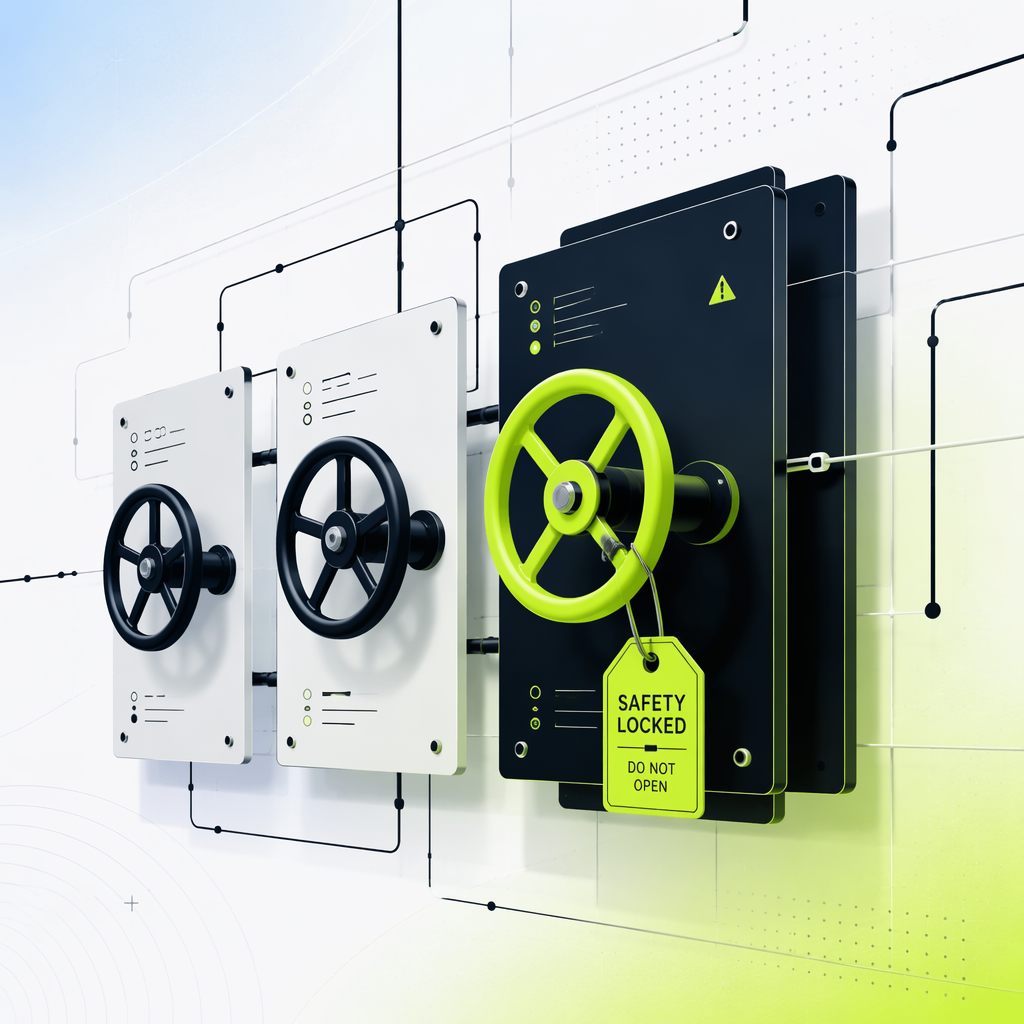
Risk 7: the over-trust ratchet
The quietest risk on the list, and over a long enough horizon, the most reliable. It works like this: the agent has a good month. You increase its size. Another good quarter; you stop reading the weekly reports. You add a second strategy without paper trading it, because the first one worked. Each step is small and feels earned. None of them was a decision you would have made on day one.
Autonomy creep is dangerous precisely because there is no single moment of failure to point at. The system you actually run in month eight bears little resemblance to the system you validated in month one, and nobody signed off on the difference.
Fix: make trust increases explicit events, never drift. Set a fixed review cadence (weekly, fifteen minutes, calendar-blocked) that does not shrink with good performance. Treat every size increase as a new go-live: it gets stated, sized, and logged. And keep hard limits outside the confidence loop. On Obside, sizing rules, stops, drawdown caps, and leverage limits are fields on the agent itself, enforced at execution time; loosening one requires deliberately editing it, which is exactly the speed bump this risk needs. A structured tour of those limits is here: guardrails for AI trading agents.
Where to go from here
Rank your defenses the way the register ranks the risks. Kill the catastrophic tail first: fix your key permissions today. Then attack the high-likelihood pair, bad strategy and overfit backtest, with the boring discipline of invalidation rules, regime-spanning tests, and paper trading. Then design against your future self with approval gates and a review ritual that survives success.
None of this requires abandoning automation. It requires automating like someone who has read an incident report. If you want a platform where the mitigations are the default path rather than an expert setting, Obside was built with paper-first workflows, restated intent, and execution-time risk caps for exactly that reason.
Educational content only. This is not investment advice. Trading involves risk, including possible loss of capital.
FAQ
Automating a flawed strategy is the most common way people lose money with AI trading, because automation executes a bad idea more often and more consistently than a hesitant human would. The largest single-event risk is different: an over-permissioned API key, which in the worst case exposes funds to withdrawal. Fix the key permissions first, then validate the strategy properly.