
ChatGPT for Trading: Useful Assistant, Terrible Trader
ChatGPT explains, critiques, and brainstorms well, but it can't see live prices, place orders, or stop hallucinating numbers. Here's how to use it safely.
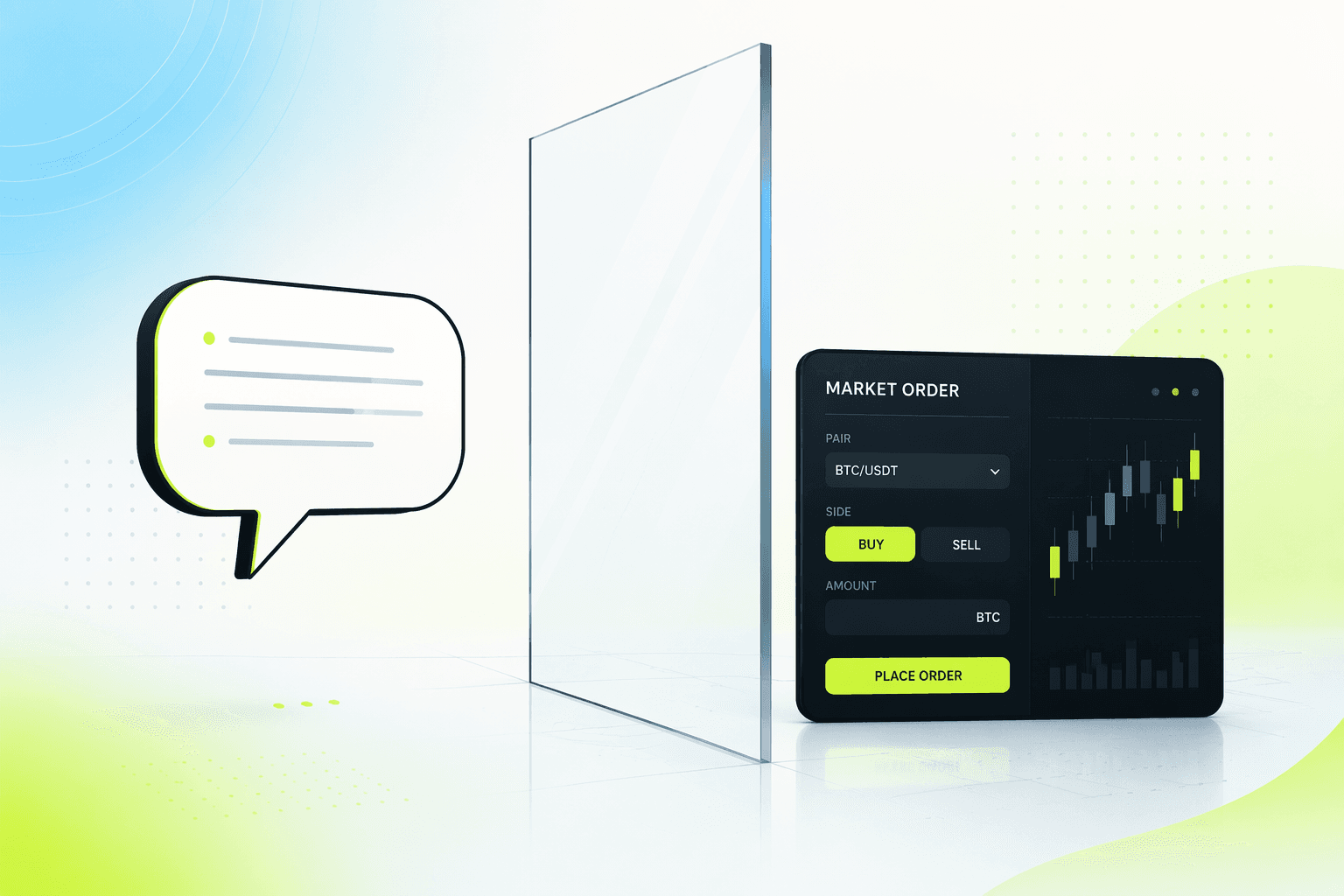
Every week, people paste tickers into a chatbot and ask what to buy. ChatGPT trading is now a mainstream search, and the honest answer to it has two halves that rarely appear together. Yes, a general-purpose LLM is genuinely useful to traders, more useful than skeptics admit. And no, it cannot trade, cannot reliably see prices, and will sometimes invent numbers with total confidence. This article separates the two halves cleanly: what ChatGPT does well, where it fails dangerously, a list of safe uses, and what actually fills the gap between a good conversation and an executed order.
What ChatGPT is genuinely good at for traders
Dismissing chatbots outright is as lazy as worshipping them. On the language side of trading, ChatGPT and its peers are strong tools.
Explaining concepts on demand. Ask what a trailing stop does in a fast market, why funding rates matter on perpetuals, or how RSI differs from stochastics, and you get a patient, competent answer with follow-up questions allowed. For learning mechanics, it beats most search results.
Critiquing strategy logic. Describe your plan and ask it to attack the reasoning. "I buy breakouts above the 20-day high and exit on a close below the 10-day low; what kills this?" will surface whipsaw regimes, costs from frequent stops, and missing position-sizing rules. The model has absorbed decades of trading literature, and stress-testing an argument is language work, exactly its home turf.
Summarizing long documents. Earnings call transcripts, annual reports, protocol documentation: condensing 40 pages into the ten claims that matter is a real time-saver, provided you spot-check anything you intend to act on.
Brainstorming conditions. When you sense an idea but can't formalize it, a dialogue helps: "I want to buy weakness but only in uptrends; what conditions could define both?" generates candidate rules faster than a blank page. Our deeper dive into what LLMs can and can't do in trading maps this terrain fully.
Notice the pattern: every strength involves transforming or evaluating language. None involves knowing current facts or touching money.
Where ChatGPT trading breaks down
The failures follow just as predictable a pattern, and they cluster where language ends and numbers begin.
It can't reliably see the market. A chat model's knowledge froze at its training cutoff, and even browsing-enabled versions fetch quotes with lag and without guarantees. Ask for a price and you may get a stale one, a plausible one, or a wrong one, formatted identically.
It fabricates with fluency. Hallucination is not an occasional glitch; it is the failure mode of systems built to produce plausible text. Finance is a worst case because it is dense with precise entities: tickers, dates, ratios, prices. Financial-LLM benchmarks such as FailSafeQA have measured chatbots hallucinating on a substantial share of finance questions, with one 2024 study finding rates up to roughly 41% without safeguards. The standard mitigations, grounding on retrieved data, constrained tool use, and human approval gates, are architectural. You cannot prompt your way to them inside a chat window. Our guide to AI hallucinations in trading covers the mechanics and defenses in depth.
It forgets your rules. Tell it your maximum position size in one conversation and it is gone in the next. There is no persistent risk profile, no state, no memory of the drawdown limit you swore by last Tuesday.
It cannot act, and worse, it cannot refuse to act. ChatGPT has no broker connection, so it cannot place an order. But it also has no execution-time checks, so when you carry its suggestion to your broker by hand, nothing verifies the price is still valid, the size fits your rules, or the setup still exists. Every one of those checks becomes your job, performed at the worst possible moment: right after being persuaded.
Safe uses of ChatGPT for trading
Kept strictly on the language side of the line, a chatbot earns its place in a trader's toolkit. This list is the boundary, drawn explicitly.
- Learning mechanics. Order types, margin math, indicator definitions, options greeks. Verify anything surprising against your broker's documentation.
- Red-teaming your strategy. Ask it to argue against your plan before capital does. Its objections are hypotheses to test, not verdicts.
- Summarizing filings and transcripts. Condense first, then verify the two or three numbers you plan to rely on against the source document.
- Drafting precise rules from vague instincts. Turn "I keep buying tops" into candidate entry filters you will later validate properly.
- Explaining your own backtest results. Paste metrics you computed elsewhere and ask what questions a skeptic would raise about them.
- Writing a journal template or review checklist. Process scaffolding is pure language work and it does this well.
- Translating jargon in news. "Explain what a hawkish pause means for rate-sensitive sectors" is a safe, useful query.
The disqualified uses matter as much: never ask it for current prices you'll act on, never treat a recalled statistic as a fact, never request buy or sell calls, and never let it perform arithmetic that decides a position size. Each of those hands number-work to a text engine.
The gap between chat and execution
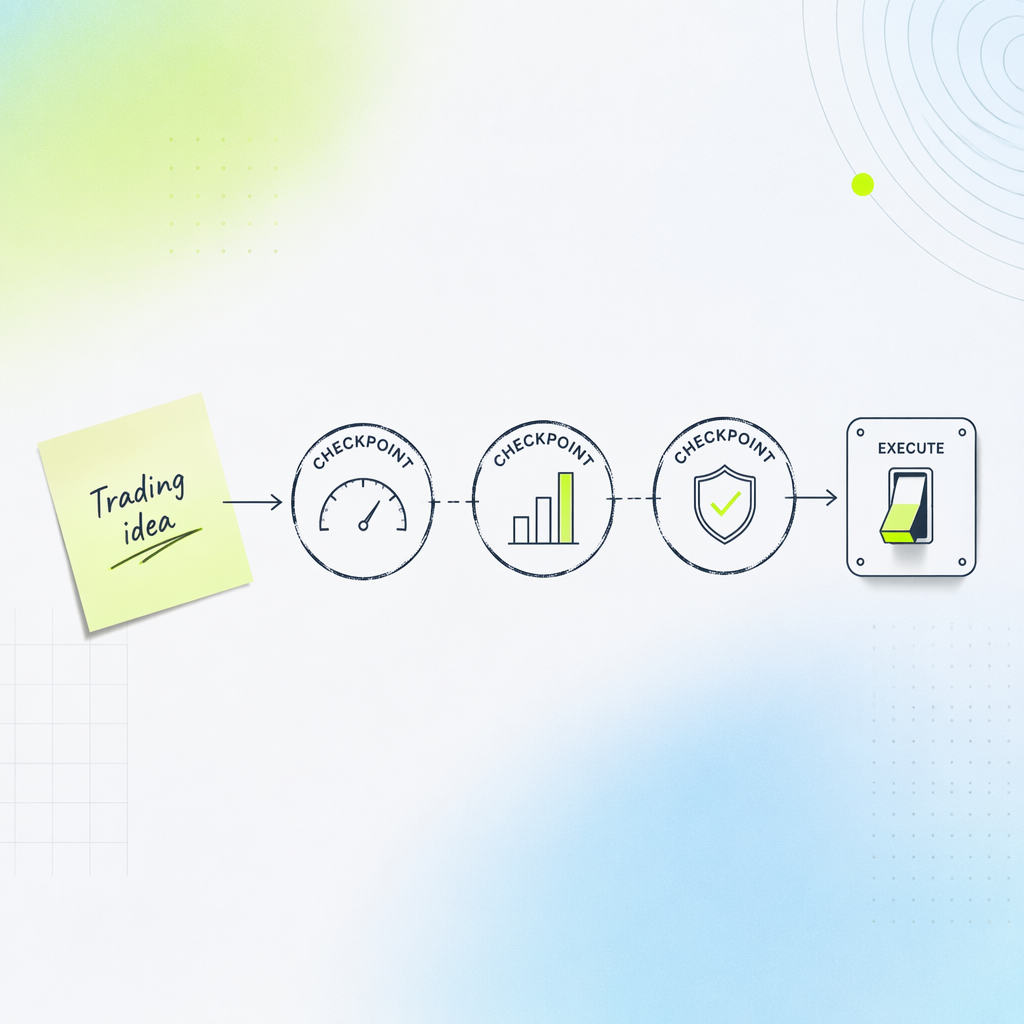
Look at what the safe list has in common: every item ends with you, a human, carrying words away from the chat and doing something rigorous with them elsewhere. That handoff is the gap, and it is exactly the gap that agent platforms exist to close. Closing it takes four things a chat window lacks: grounding in live market data, typed tools that can place and cancel orders, guardrails enforced at execution time, and a broker or exchange connection.
The contrast is sharpest as a workflow. Suppose ChatGPT helps you refine an idea: buy pullbacks in an ETF you already own, but only while its longer trend holds up. Route one, chat-then-manual: you carry the suggestion to your broker, eyeball the chart, size the order in your head, and click buy, with no test of whether this rule ever worked and no limit enforcing your risk if you misjudge.
Route two, the same idea described to an agent platform. On Obside you type: "Buy $200 of my chosen ETF whenever it closes 6% below its 20-day high, only while it holds above its 200-day moving average, at most one buy per week, and pause the agent if this strategy's drawdown passes 10%." The copilot restates the parsed conditions for your approval, which catches translation errors before they cost anything. The strategy then runs against years of historical data, then paper trades on live data, and only goes live inside hard risk caps. The LLM in that pipeline does what LLMs are good at, interpreting your language, while prices, indicator math, and order routing run on deterministic engines. A hallucination can misphrase a restatement, which you would catch at approval; it cannot fetch a wrong price or place a trade.
How natural-language strategies get translated into precise machine conditions is a topic of its own, covered in our guide to natural language trading.
When ChatGPT alone is enough, and when it isn't
Chat-only is sometimes the right call, so here is the honest split.
ChatGPT alone serves you fine if you are studying rather than trading, you make a few long-horizon investments a year and do your own verification, or you want a thinking partner for ideas you will execute rarely and deliberately. Adding an automation platform to a twice-a-year rebalance you enjoy doing by hand solves no real problem.
You have outgrown chat-only if any of these are true: you act on time-sensitive setups where lag and hesitation cost money; you have repeatedly broken your own risk rules in the moment; your strategy involves conditions that need round-the-clock watching; or you have caught the chatbot confidently wrong about a number even once and felt the chill. From there, the path is not "trust the bot more." It is moving the idea into a system where testing and limits are structural; our walkthrough on how to create an AI trading agent shows the full journey from paragraph to live automation.
Nobody should use ChatGPT as a price feed, a stock picker, or an oracle. Not because the model is bad, but because those jobs require properties, real-time truth and accountability, that text generation does not have.
Where to go from here
Keep the chatbot; respect the wall. ChatGPT is a strong analyst of language, a fair critic of logic, and a hopeless custodian of numbers and money. Use it to learn, to attack your ideas, and to draft rules, then insist that anything touching capital passes through grounded data, a backtest, a paper run, and hard limits. That second half is what Obside is built for: describe the strategy you refined in chat, watch the copilot restate it precisely, and let it earn live capital the disciplined way.
Educational content only. This is not investment advice. Trading involves risk, including possible loss of capital.
FAQ
No. ChatGPT generates plausible text from training patterns; it has no forecasting model, no live data feed, and no probability calibration for market outcomes. Any prediction it produces is a fluent guess, sometimes decorated with invented statistics. Research on LLM trading strategies also shows their apparent backtest skill often comes from memorized history rather than genuine foresight. Treat its market forecasts as entertainment, not analysis.