
Obside vs Composer: AI Copilot or Symphony Brokerage?
Composer is a US brokerage where you build rule-based 'symphonies'; Obside is an AI copilot that automates the brokerage accounts you already have. The team behind Obside compares both honestly — including the cases where Composer is the better pick.
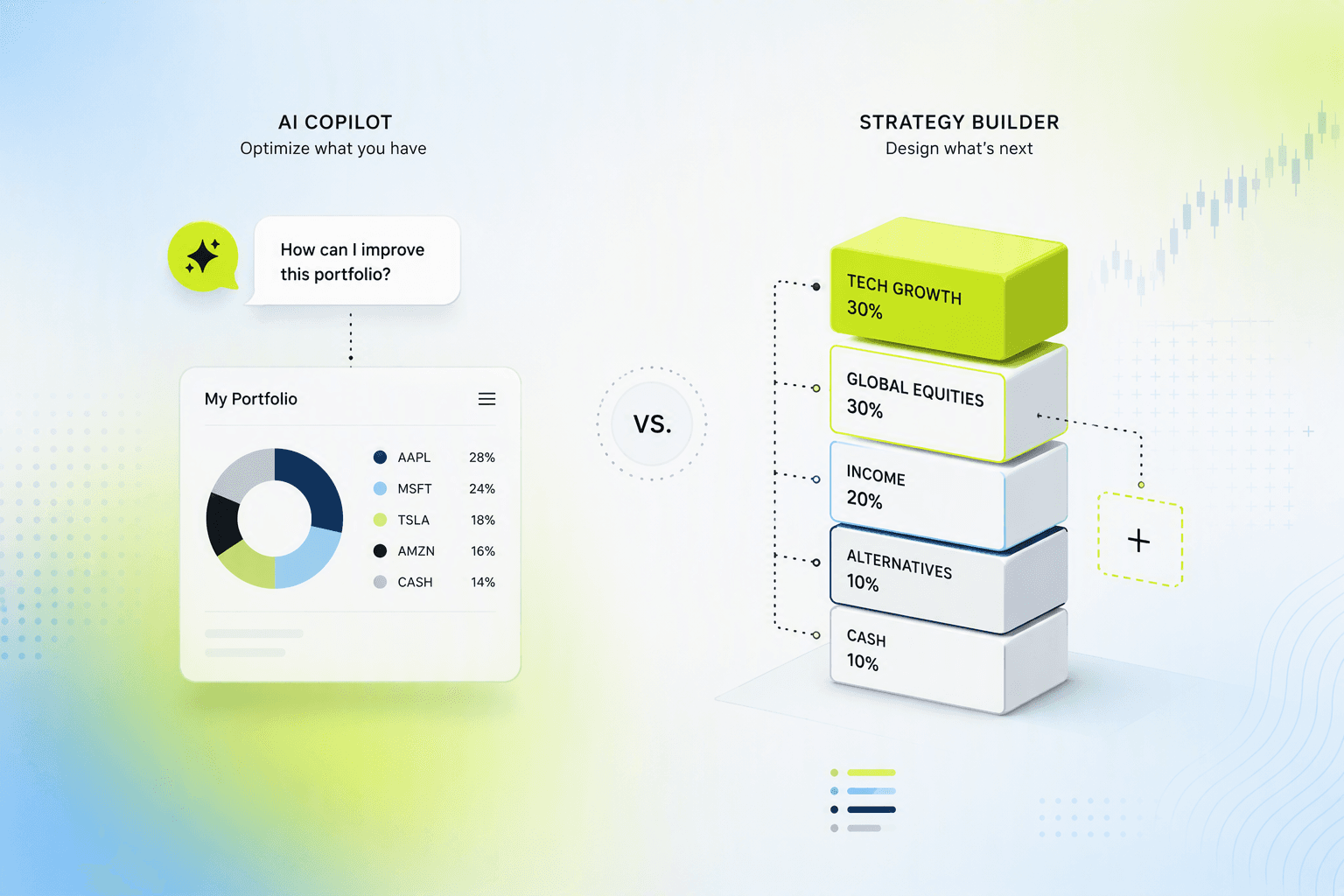
Let's get the disclosure out of the way: Obside is our product. We wrote this because "Obside vs Composer" is a question we now get weekly, and because the honest answer is more useful than a sales pitch — these two platforms overlap far less than their marketing suggests. Facts about Composer below are accurate to the best of our knowledge as of August 2026; check their site for current terms.
Two different species
Composer is a US brokerage with a strategy builder on top. You open an account at Composer Securities (member SIPC), fund it, and build "symphonies" — rule-based portfolios that allocate and rebalance according to logic you define in a visual editor or describe to their AI in plain English. Backtesting is deeply integrated, there is a community of shared symphonies you can copy, and pricing starts around $24/month billed annually. It supports individual taxable accounts and IRAs, and it is available to US residents only.
Obside is not a broker. It is an AI copilot that connects to the brokerage and exchange accounts you already hold — 30+ brokers across the US, Europe, the UK, Canada, Australia and India — and gives you one chat to understand your portfolio, monitor everything that moves it, backtest and paper trade ideas, and run automation agents that can alert you or place orders (live execution from the Pro plan, $69/month; there is a free tier and a $39 Plus tier below it).
So the real question isn't which product is "better" — it's whether you want to move your money to a new brokerage built for systematic investing (Composer) or add an AI layer on top of the accounts you already have (Obside).
Strategy building
Composer's symphony model is genuinely good at what it targets: weighted allocations with conditional logic, evaluated on a schedule, rebalanced automatically. "If SPY's 10-day momentum is negative, rotate into treasuries, else hold QQQ" is exactly the kind of strategy the symphony editor was made for, and the backtester gives you decades of history against it. The community library is a real asset for beginners — you can start from someone else's tested symphony instead of a blank page.
Obside's agents are event-driven rather than schedule-driven. They combine price, technical indicators, news, macroeconomic data and fundamentals in one rule: "sell my semiconductor positions if any of them drops 7% intraday on bad news", "buy $200 of an S&P 500 ETF every month, but double it if the index is 10% below its high", "brief me every morning on anything affecting my holdings". Agents backtest against historical data, can run in paper mode first, and the same engine powers pure alert agents.
The philosophical difference: Composer automates a portfolio construction methodology. Obside automates reactions to what markets and news do to your actual portfolio.
Portfolio intelligence
With Composer, the portfolio it manages is the one you build inside Composer. It does not look at your Fidelity IRA or your Binance account.
Obside starts by connecting what you already own — multiple accounts, multiple brokers, stocks and crypto together — and layering understanding on top: exposure and concentration analysis, dividend tracking, performance attribution, and news filtered to what you actually hold. You can also build a custom auto-rebalanced ETF-style basket from your own weights, without fund fees, inside your existing account. On paid plans, MCP connections let you query all of this from Claude or ChatGPT directly.
Availability and money movement
- Composer: US residents only. Your capital moves to Composer Securities. SIPC protection applies.
- Obside: available internationally (site and product in nine languages). Your capital stays at your current broker; Obside connects via secure aggregation and never holds funds. Some broker connections are trade-enabled, others read-only — the supported brokers page is explicit about which.
Neither model is "safer" in the abstract — SIPC coverage at Composer is real, and so is the comfort of never moving your money at all. They are just different commitments.
Pricing
- Composer: from $24/month billed annually for the trading pass (fee structures have varied over time — verify current terms on their site).
- Obside: Free plan; Plus $39/month; Pro $69/month (adds live trading); Max $119/month (unlimited agents). USD baselines, localized at checkout. Full breakdown on the pricing page.
Choose Composer if…
- You are a US resident and comfortable opening a dedicated brokerage account.
- Your style is systematic portfolio construction: weighted allocations, momentum rotations, scheduled rebalancing.
- You want a large community library of ready-made, backtested strategies to copy and tweak.
Choose Obside if…
- You live outside the US — Composer simply isn't available to you.
- You want to keep your existing broker(s) and accounts exactly where they are.
- You want automation that reacts to news, macro and fundamentals, not only price-based rotation logic.
- You want the AI to also explain and monitor your whole portfolio, including accounts it doesn't trade.
Educational content only. This is not investment advice. Trading involves risk, including possible loss of capital.
FAQ
No. Composer requires opening an account at its US brokerage and is available to US residents only. Obside is available internationally and supports European brokers like Trading 212, Degiro and eToro alongside US ones.