
Technical Analysis: A Practical Guide Without the Mysticism
Most technical analysis content treats indicators like horoscopes — vague, layered, and unfalsifiable. The version that actually makes money is narrower and more boring: identify the regime, find structural levels, confirm with one or two indicators, set explicit risk, and let the math run.
Most technical analysis content treats indicators like horoscopes — vague, layered, and unfalsifiable. The version that actually makes money is narrower and more boring: identify the regime, find structural levels, confirm with one or two indicators, set explicit risk, and let the math run.
This guide gives you that version. Not the "read every pattern" survey course — the working toolkit that converts charts into rules you can backtest and automate.
What technical analysis is for
Technical analysis is the practice of reading price and volume to estimate the probable direction and magnitude of future moves. Three premises:
- Price reflects available information faster than narrative can.
- Market participants behave in patterns that recur, because humans behave in patterns.
- Trends and structures, once established, often persist longer than random chance predicts.
The honest claim isn't "predict the future." It's "find conditions where the odds favor one side, size accordingly, and exit when proven wrong." Anyone who promises more is selling something.
The three questions every chart answers
Every meaningful read of a chart returns:
- What is the current market state? Trend, range, or transition.
- Where are the high-interest levels? Support, resistance, prior highs and lows, key moving averages.
- When is the setup actionable? A trigger event — a break, a touch, a momentum cross — that defines entry and invalidation.
A trader who can answer those three for any chart, on any timeframe, has the core toolkit. Everything else is refinement.
Price action first
Indicators are derivatives of price. Master price before stacking math on top.
Trend identification
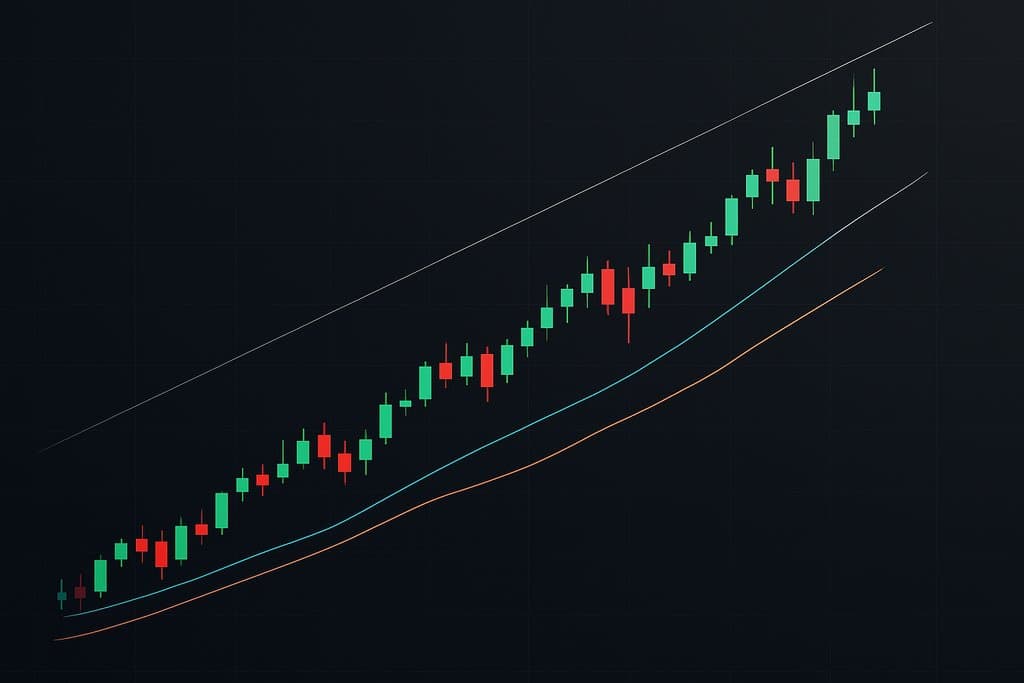
The simplest definition: an uptrend is a series of higher highs and higher lows on your trading timeframe. A downtrend reverses both. Anything else is a range.
Sub-rule: a single break of the structure (lower low in an uptrend) doesn't kill the trend. Two consecutive lower lows usually does. This filters out noise without making you blind to regime change.
Support and resistance
The price levels that matter are:
- Prior swing highs and lows on your timeframe
- The high/low of the most recent significant move
- Round numbers (psychological clusters)
- Key moving averages: 20, 50, 200
These levels matter because other traders watch them. Stops cluster above resistance and below support. Sweeps and reversals happen because of that clustering.
Volume confirmation
Price moves on rising volume have conviction. Price moves on declining volume often reverse. Two specific patterns:
- Breakout with volume expansion (1.5×+ average) — high probability of follow-through
- New high on declining volume — exhaustion, possible reversal
Volume isn't reliable in FX (no centralized exchange) but works for stocks, futures, and crypto.
Indicators: a minimum useful set
You don't need ten indicators. You need 2–3 that serve specific roles:
| Role | Tool | What it tells you |
|---|---|---|
| Trend filter | 50/200 SMA, ADX | Is the market trending and which way? |
| Momentum | RSI, MACD | Is momentum building or fading? |
| Volatility | ATR, Bollinger Bands | How wide should my stops and targets be? |
| Mean / value | VWAP, anchored VWAP | What's the institutional reference price? |
That's it. Stacking more produces correlated, conflicting signals.
Moving averages
Define trend cheaply. Common setups:
- 50 above 200 = bullish regime
- Price above the 20 EMA = short-term bullish
- Pullbacks to the 20 EMA in trend are common entry zones
Don't trade moving-average crosses in isolation — they lag. Use them as filters, not triggers.
RSI
Read as ranges, not thresholds. In an uptrend, RSI(14) typically oscillates 40–80; pullbacks to 40 are buy zones. See the full RSI indicator guide for tuning.
MACD
Tracks short-term vs long-term momentum. Histogram crossing positive after consolidation is a clean confirmation signal. Divergences sometimes precede reversals but persist often before turning — don't act on divergence alone.
ATR
The single most useful indicator for risk sizing. ATR(14) measures average price range. Use it to set adaptive stops (1.5×ATR is common) and to size positions so dollar risk stays constant across volatility regimes.
Bollinger Bands
Visualize volatility. Band squeeze (low width) often precedes breakouts. Don't use the bands as entry signals on their own — they describe condition, not direction.
Multi-timeframe context
Single-timeframe analysis is fragile. Higher timeframes provide regime. Lower timeframes provide trigger.
Daily for direction. Hourly for entry. 5-minute for execution timing.
A practical alignment workflow:
- On the daily, confirm trend (price > 200 SMA, RSI holding 40+)
- On the hourly, wait for a pullback to support (20 EMA or prior swing high)
- On the 5-minute, time the entry with a candle reversal or momentum cross
- Set stop on the entry timeframe, target on the higher timeframe
This pattern produces high-quality entries because three independent layers must agree.
Chart patterns worth knowing
Most chart patterns are statistical noise dressed up as mysticism. A short list of patterns with documented edges:
- Double top / M pattern — reversal at resistance, neckline break
- Double bottom / W pattern — mirror of above at support
- Range breakout — clean consolidation, volume on break
- Bull / bear flag — consolidation in trend, continuation on resolution
Everything else — head and shoulders variants, complex Elliott Wave counts, harmonic patterns — has weak statistical backing. Master the few that work before chasing exotics.
Building a technical analysis strategy
A trend-pullback strategy as a worked example:
- Market filter: SPY price > 200-day SMA (regime)
- Setup: pullback to the 20-day EMA in an uptrend
- Trigger: bullish engulfing candle that closes above the 20 EMA
- Confirmation: RSI(14) > 50 and daily volume > 20-day average
- Stop: 2×ATR(14) below entry
- Targets: partial at +1.5R, trail rest at 3×ATR
- Time stop: exit after 15 sessions if neither hit
That's a complete, testable strategy. Backtest it on 10 years of SPY data, validate on out-of-sample 2024–2025, paper trade for a month, then go live. The structure is the deliverable, not a clever indicator combo.
Backtesting without lying to yourself
Three rules that save accounts:
- Realistic costs: spread + commission + slippage. Use conservative numbers.
- Out-of-sample testing: develop on 2019–2023, validate on 2024–2025. Don't touch the test set during tuning.
- Robustness: small parameter changes shouldn't collapse performance. If they do, you've curve-fit.
If a backtest looks too clean — equity curve a smooth line — it probably is. Real strategies have rough patches and drawdowns.
Where Obside fits
The technical analysis rules above are mechanical. Most of them can run unattended.
Describe your strategy to Obside Copilot in plain English:
"On SPY daily: when price > 200 SMA and price pulls back to the 20 EMA, wait for a bullish engulfing candle closing above the 20 EMA with RSI > 50 and volume > 20-day average. Buy 0.5% of equity, stop at 2×ATR below entry, take 50% off at +1.5R, trail rest at 3×ATR, exit after 15 sessions."
Copilot translates, backtests instantly across history, paper-trades against live feeds, and executes via your connected broker when you flip to live. Same rules, three modes.
Create a free Obside account to convert your technical analysis rules into automated alerts, backtests, and live execution — all from plain English.
Educational content only. This is not investment advice. Trading involves risk, including possible loss of capital.
FAQ
As a probabilistic framework, yes — for traders who treat it as such. As a deterministic prediction tool, no. The edge comes from disciplined application of structure + risk management, not from any single indicator.