
Human-in-the-Loop Trading: Why Full Autonomy Is a Trap
What you keep, what the machine takes, and how to design approval gates that protect you without turning you into a rubber stamp.
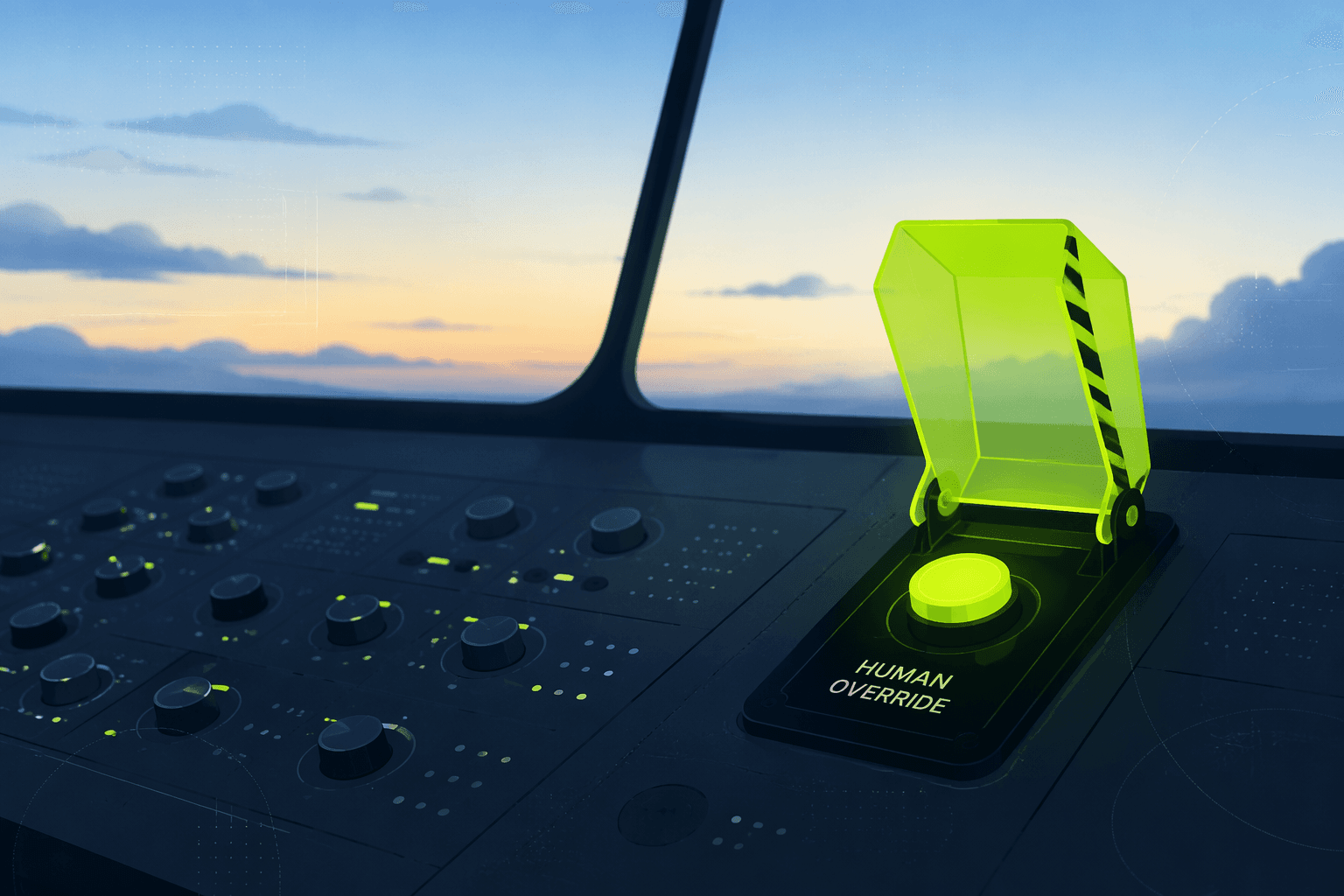
Every AI trading pitch eventually reaches the same slide: "fully autonomous." It sounds like the destination. It is actually the cliff. Human-in-the-loop trading is the alternative that serious operators converge on, and it is not a compromise between manual and automated; it is a deliberate division of labor where each side does what it is structurally better at. This article lays out that division, walks through the airline-autopilot analogy properly instead of as a slogan, and shows how to design approval gates that protect you without making you the bottleneck.
What human-in-the-loop trading actually means
The phrase gets used loosely, so let's be precise. Human-in-the-loop trading means the machine executes within boundaries a human authored, and specific classes of decisions always return to the human. It does not mean a person clicks "confirm" on every order. That is a different (and mostly worse) arrangement we will get to.
The division of labor looks like this:
The machine takes: watching, because it does not sleep, blink, or get bored at hour six of a flat market; arithmetic, because it computes position sizes and indicator values without rounding by vibe; execution, because it places the order at the trigger instead of ten minutes of second-guessing later; and consistency, because it applies the same rule the same way on day one and day two hundred.
You keep: the thesis, because "why should this trade make money" is a judgment about the world, not a computation; the risk appetite, because only you know what drawdown you can hold without capitulating; override authority, because the map is not the territory and you are the one watching the territory; and the kill switch, because accountability cannot be delegated to something that cannot be held accountable.
Notice what the machine's list has in common: those are the tasks where humans reliably underperform, not occasionally but structurally. And the human list shares something too: every item is a form of ownership. Automation transfers labor. It must never transfer ownership. When it does, you are no longer running a strategy; you are hoping at one.
This is not just a retail intuition. A study of US finance firms' annual filings found that agentic-AI language appears almost exclusively in firms whose filings are already dense with governance and controls language: institutions build the oversight first and grant autonomy second (Mustafa & Aysan, Modern Finance, March 2026). The firms deploying agents with real money treat autonomy as something earned by control infrastructure, not something switched on.
The autopilot analogy, done properly
The lazy version of this analogy says "AI is your autopilot" and stops, which manages to be both a cliché and an argument for the wrong conclusion. The useful version comes from looking at what pilots actually do.
A modern airline crew does not hand-fly the cruise phase. Autopilot flies the overwhelming majority of every flight, and it flies more precisely than a human holding the yoke for four hours could. No airline would accept the error rate of hand-flown cruise. In that sense, the machine won, decades ago, and nobody mourns it.
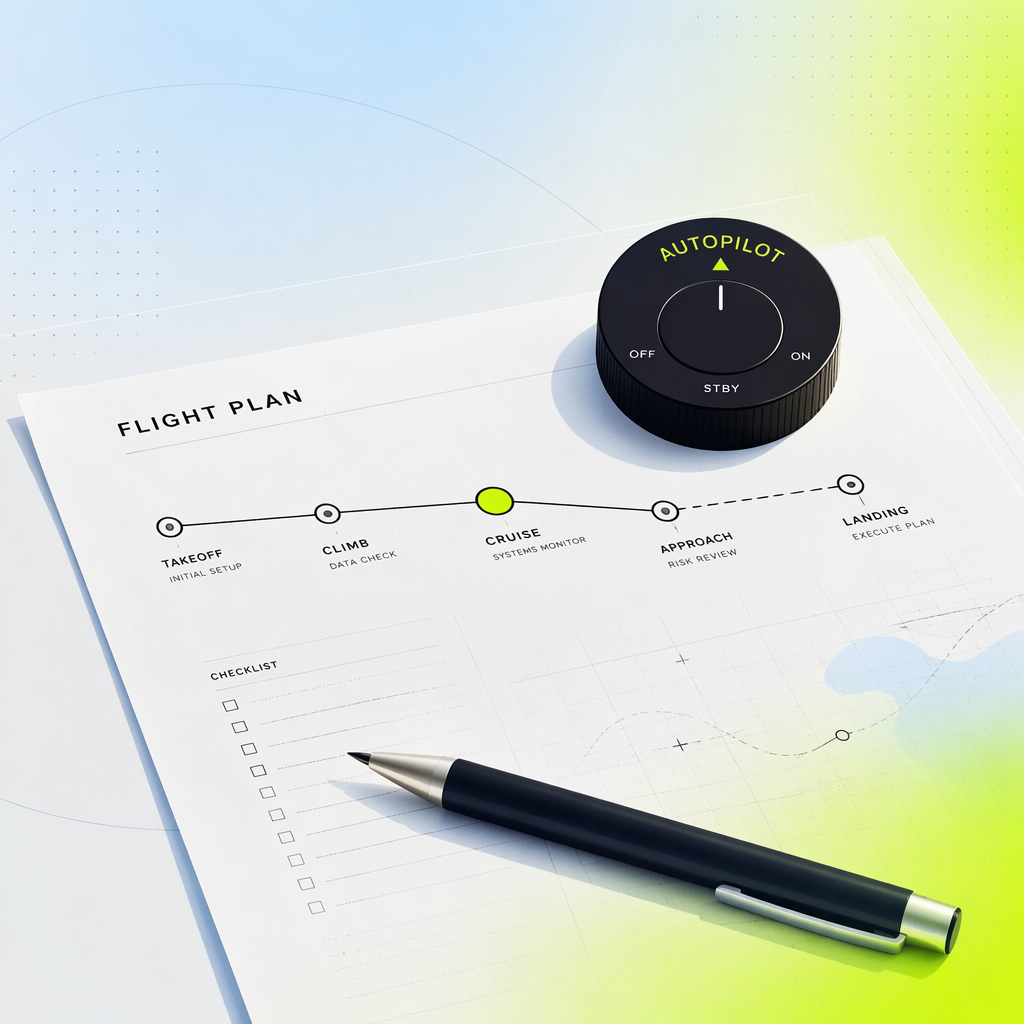
But look at what the crew still owns. They filed the flight plan; the autopilot has no opinion about where the aircraft should go. They set the modes and the altitudes; the autopilot holds what it was given. They brief the failure cases before the engines start: what we do if an engine quits at rotation, where we divert if weather closes the destination. They monitor continuously, cross-checking what the automation is doing against what it should be doing. And in the edge cases the automation was never designed for, they take the aircraft back, which is why they train in simulators for exactly those handoffs.
Pilots do not hand-fly cruise. Pilots own the flight.
Aviation also learned the failure mode the hard way, and gave it a name: automation complacency. Crews that monitored passively, trusting the system because it had always worked, were the slowest to notice when it quietly stopped doing what they assumed. The industry's answer was not less automation. It was structured monitoring, explicit handoff procedures, and recurrent training that keeps the human sharp enough to take over.
Translate every element to trading and the mapping is almost embarrassingly direct. Your strategy is the flight plan. Your guardrails are the altitude and mode selections. Your invalidation rules are the briefed contingencies. Your review ritual is the cross-check. Your paper-trading runs are the simulator. The trader who says "the agent handles it, I don't look anymore" is the passively monitoring crew, and markets punish that posture on a schedule aviation would find familiar.
Designing approval gates: what waits for you, and what must not
An approval gate is a rule that certain actions pause until a human says yes. Gate design is where human-in-the-loop setups succeed or quietly rot, because both directions of error are costly.
Always gate these:
- A new strategy going live. Backtest and paper results are inputs to a human decision, never a trigger for automatic promotion. Going live is a signature moment.
- Size increases. Any increase in allocation, per-trade size, or leverage is a new risk decision, even when performance "justifies" it. Especially when performance justifies it.
- Out-of-distribution actions. Anything the agent proposes that does not match the pattern you validated: a new asset, an unusually large order, a trade outside its normal cadence. If it surprises you, it waits for you.
- Loosening any limit. Widening a stop, raising a drawdown cap, extending a leverage bound. Tightening can be automatic; loosening never should be.
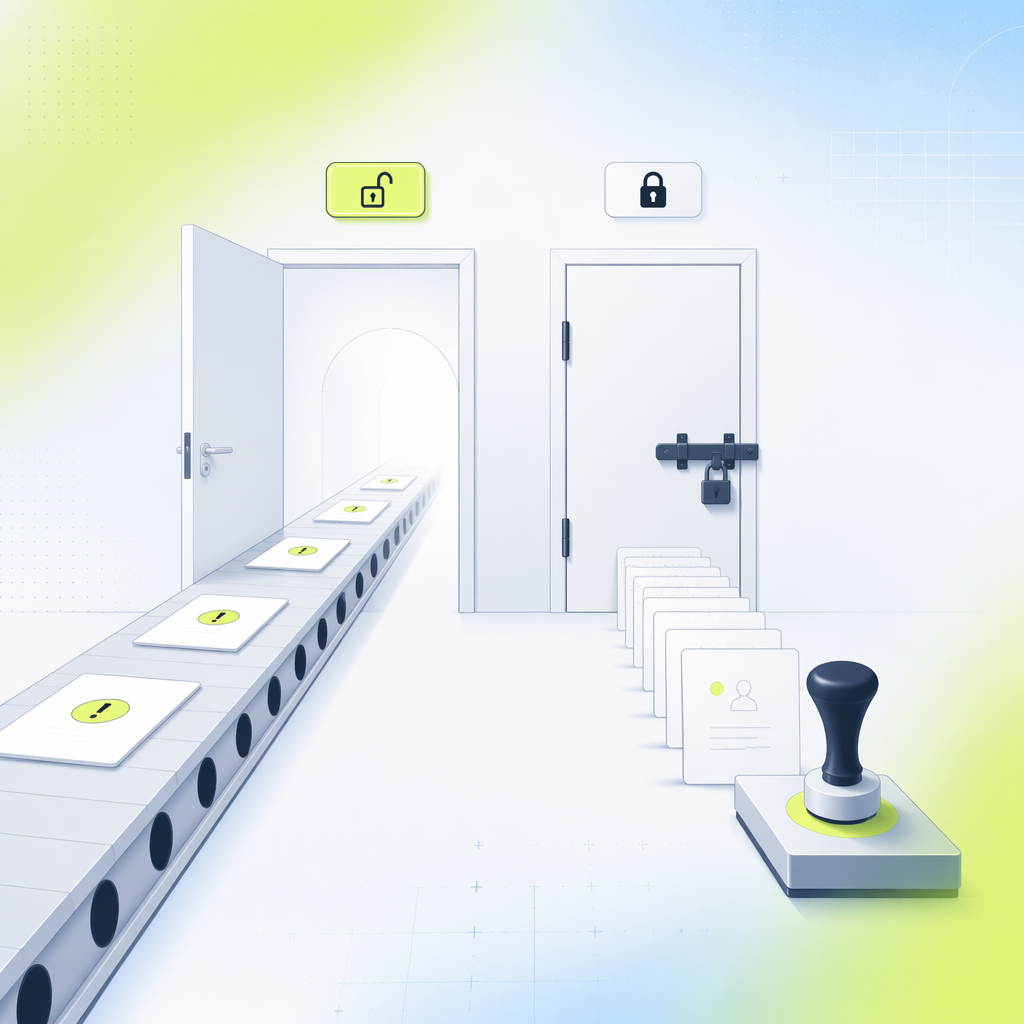
Do not gate routine executions. If the agent needs your click for every order inside pre-approved bounds, two things happen. First, you have reinstalled the exact human failure automation was meant to remove: the 3am trigger fires and you are asleep; the entry comes during a meeting and you hesitate. Second, and more corrosive, you become a rubber stamp. After the fortieth identical approval, you stop reading them. Now the gate catches nothing, but its existence makes you feel supervised. A gate you no longer read is worse than no gate, because it launders inattention into the appearance of oversight.
The test for whether something belongs behind a gate is simple: would a thoughtful person ever say no to this? If the answer is "essentially never, it's the same validated action again," automate it. If the answer is "sometimes, and the no would matter," gate it. The five levels of autonomy in AI trading formalize this spectrum if you want the full ladder.
The two ways this goes wrong
Human-in-the-loop sits between two failure modes, and it helps to see both clearly.
The full-autonomy trap. Errors compound at machine speed: a human making a mistake per hour is a bad day, an agent making one per minute is a crater. Accountability evaporates, because "the AI did it" is not an explanation your account balance accepts, and no counterparty cares. And your own judgment atrophies: after a year of not looking, you are no longer capable of the override you theoretically retained. The kill switch exists, but the hand that would pull it has forgotten what abnormal looks like. The broader inventory of what can go wrong is cataloged in the real risks of AI trading agents.
The micromanagement trap. Approve everything and you have built an expensive alert system with extra steps. Your emotions re-enter through the approval click: you skip the valid signal that "feels wrong" after two losses, which is precisely the discretionary leak the rules were written to plug. Consistency, the machine's core contribution, dies at your fingertip.
The design goal is a corridor: wide enough that the machine's consistency survives, walled enough that nothing account-changing happens without you. The walls themselves (sizing rules, stops, exposure caps) are their own discipline, covered in guardrails for AI trading agents.
A working loop for a retail account
Here is what the loop looks like in practice, using Obside as the concrete case since its model maps cleanly onto the corridor idea: agents execute freely inside pre-approved bounds, and anything outside those bounds waits for you.
Say you run a momentum agent on a $4,000 allocation: it buys strength in two ETFs on defined signals, sized at 5% of allocation per trade, with a trailing stop and a 10% drawdown cap. Day to day, it needs nothing from you. Entries, exits, and stop adjustments inside those numbers simply happen; that is the cruise phase. But when you edit the agent to raise sizing to 8%, that is a deliberate change you make and confirm, not a dial the agent turns because last month went well. And if the drawdown cap is hit, the agent halts and tells you, rather than improvising a recovery. The machine cannot promote itself.
Around that, keep three human habits. A weekly review, fifteen minutes, calendar-blocked: read every fill, check behavior against intent, note anything that surprised you. An override journal: each time you intervene, write one line on why; if the same reason appears three times, the rule needs editing, not more overriding. And a kill-switch drill: once, deliberately, pause the agent and confirm you know exactly how fast you can flatten everything. You want to learn that procedure on a calm Tuesday, not during a flash crash.
Where to go from here
Full autonomy is a trap not because machines are bad at trading but because ownership is not transferable. The pilots kept the flight. You keep the thesis, the appetite, the override, and the switch, and you hand over the watching, the math, and the button-pressing, which was always the part you were worst at anyway. Whether this division eventually eliminates the human entirely is a fair question, and we give it a straight answer in will AI replace traders.
If you want to run this loop rather than read about it, Obside is built around exactly this corridor: describe the strategy, set the bounds, rehearse in paper mode, and stay the pilot.
Educational content only. This is not investment advice. Trading involves risk, including possible loss of capital.
FAQ
It means automated systems execute within boundaries a human defined, while specific decision classes always return to the human: strategy approval, size changes, limit changes, and unusual actions. The machine handles monitoring, calculation, and order execution. The human retains ownership of the thesis, risk appetite, and the authority to override or shut everything down. It is a division of labor, not partial automation.