
Will AI Replace Traders? A Grounded Answer
Most trading hours are already automated. Judgment and accountability are not. What the evidence says about which parts of the trader's job survive.
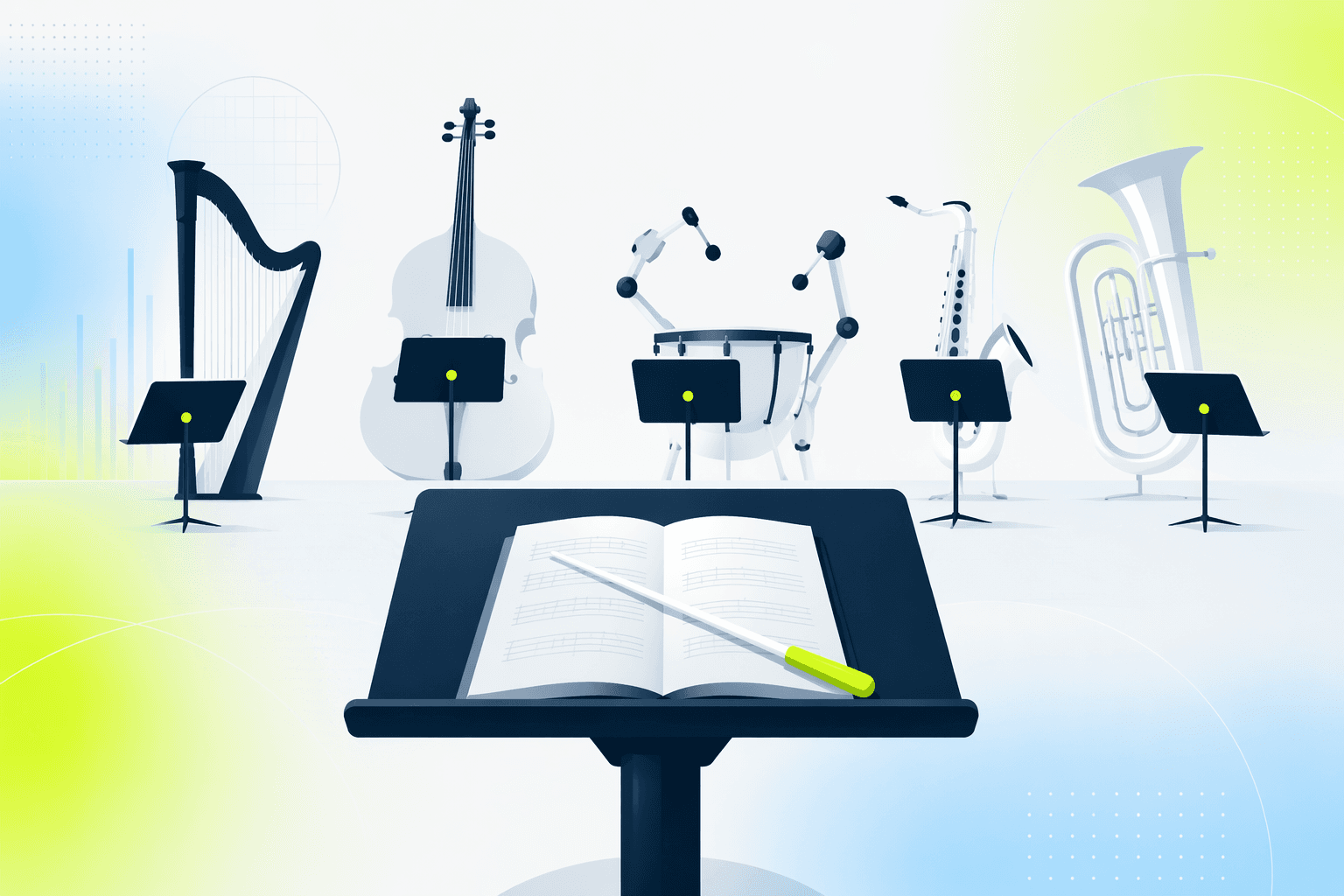
Will AI replace traders? The question usually gets answered in one of two useless ways: a breathless yes from people selling automation, a defensive no from people selling courses. The evidence supports a sharper answer. Measured in hours, most of trading is already automated, and has been for years: the watching, the arithmetic, the execution. Measured in judgment, almost none of it is, and the research keeps confirming why. What follows is the case for both halves, and a description of the job that remains — because there is one, and it is arguably better than the old one.
Will AI replace traders? It already replaced the hours
Break a trader's old working day into tasks and clock them. Watching screens for a setup to form: hours. Recalculating position sizes, checking indicator values, updating stop levels: more hours. Placing orders, managing them, sitting with them: hours again. Forming an actual view about what to own and how much to risk: minutes, on most days.
Automation ate the hours first because the hours were the mechanical part. Institutional desks handed execution to algorithms decades ago, from program trading in the 1980s through electronic and high-frequency execution in the 2000s. What changed recently is that the same delegation reached individuals. The Cambridge CCAF and World Economic Forum's 2026 report (May 2026) found 81% of financial services firms report some level of AI adoption, with 23% at mature stages on agentic AI specifically. Retail platforms now run the same pattern: persistent agents that watch markets continuously and act on predefined logic, the model described in What Is Agentic Trading?.
So the honest scorecard reads: screen-watching, delegated. Arithmetic, delegated. Order execution, delegated. If your definition of "trader" is a person performing those tasks by hand, that trader is mostly gone already, and few miss the 4 a.m. shift. The question that matters is what happened to the remaining minutes.
What stays stubbornly human
Four things resist automation, and not for sentimental reasons.
Thesis formation. An agent executes a view; it does not originate conviction. Deciding that you want exposure to energy infrastructure, or that volatility looks underpriced, requires beliefs about the world that you are willing to fund. No model holds beliefs on your behalf.
Risk appetite. How much drawdown you can absorb, financially and psychologically, is a fact about your life: your income, your obligations, your temperament, your horizon. It cannot be inferred from market data because it is not in market data.
Accountability. FINRA's 2026 Annual Regulatory Oversight Report (January 2026) states it plainly for firms: they remain responsible for the outcomes of the AI tools they deploy. The retail version is simpler and harsher. It is your account. No agent absorbs a loss for you, and no regulator anywhere is moving to change that.
Judgment under novelty. Here the research is most pointed. A 2026 audit of 77 studies on LLM trading agents (arXiv:2605.19337) found that evidence for durable alpha remains thin, locating the real value in disciplined execution, monitoring and research assistance instead. Related work explains part of the gap: apparent skill in backtests often comes from memorized market history, and performance degrades on data the model has never seen (arXiv:2505.07078, 2025). Genuinely new situations, the moments that make or break a year, are precisely where models are weakest and where a human concluding "this is not the regime my rules assumed" earns their keep.
The job shifts from operating to directing
Put the two halves together and the conclusion is not "humans out." It is a role change, and a familiar one: the operator becomes the director.
An operating trader performs the trade: watches, clicks, manages, repeats. A directing trader writes policy and supervises its execution. Concretely, directing is four recurring tasks. You author the strategy: entry, exit, size, invalidation, in language precise enough to be testable. You set the bounds inside which the agent may act: position caps, stop rules, drawdown circuit breakers, and the level of autonomy you are actually delegating; on a platform like Obside these limits are fields on the agent, enforced at execution time, not intentions written in a notebook. You review evidence: backtest reports read skeptically, paper runs checked against intent. And you own escalation: anything out of pattern comes back to you, the design covered in depth in Human-in-the-Loop Trading.
A week in the directing role looks nothing like screen-watching. Sunday, twenty minutes: review last week's fills against the rules, confirm nothing drifted. Midweek: one alert fires because a position approached its cap; you decide in thirty seconds, with full context. Month-end: a performance review, one parameter change, re-validated in paper before it touches live capital. Perhaps three focused hours in total, all of them spent on decisions machines cannot make.
Pilots, chess, translators: the rhyme, told properly
Three professions already ran this experiment, and the details matter more than the slogan.
Commercial pilots hand-fly only a few minutes of a typical flight; automation handles the cruise. Airlines did not respond by removing pilots. They redefined the job as systems management and exception handling, and training moved with it: less stick-and-rudder, more "what do you do when the automation does something you did not expect." The captain still signs for the flight.
Chess engines surpassed the best humans in 1997, and chess players did not disappear. What died was one specific model of the job, the human as deepest calculator. Everything around it survived and grew: preparation with engines, judgment about which lines suit a human opponent under a clock, and for a stretch, freestyle events where human-plus-engine teams beat engines alone on the quality of their process.
Machine translation absorbed the high-volume routine work. The translators who stayed valuable moved up the stack: editing machine output, handling nuance, owning the legal and reputational consequences of getting a contract or a diagnosis wrong.
The structure is identical each time. Automation takes the measurable middle of the job, and humans concentrate at the two ends — intent before the work, accountability after it. Trading maps onto this precisely, which is why the near-term developments that matter, tracked in Agentic Trading in 2026, concern governance and evidence rather than the removal of the human.
Your job description, rewritten
So: will AI replace traders? It already replaced most of what traders spent their days doing, and it is nowhere close to replacing what traders are for. The title survives. The job description reads differently: author of the strategy, setter of the limits, reviewer of the evidence, owner of the outcome.
That is exactly the role an Obside user plays today. You describe a strategy in plain language, the copilot restates it as precise conditions, you set the risk caps, read the backtest, watch the paper run for a few weeks, and sign off on going live small. The agent works every hour of every session; you make the calls that matter. If directing sounds like a better job than operating — it is — start by writing your first strategy at Obside.
Educational content only. This is not investment advice. Trading involves risk, including possible loss of capital.
FAQ
No, on the current evidence. Automation has absorbed the mechanical majority of trading work: monitoring, calculation, order execution. What it has not absorbed is thesis formation, risk appetite, accountability and judgment in novel conditions. A 2026 audit of 77 studies on LLM trading agents found evidence for durable alpha remains thin, placing the technology's value in disciplined execution rather than autonomous stock-picking. The realistic outcome is traders directing automated systems, not traders disappearing.