
RSI Indicator: Use It Without the Beginner Traps
Every retail trader knows the RSI is "overbought above 70, oversold below 30." Every retail trader also loses money fading those levels in trending markets. The RSI is genuinely useful — but only when you stop treating 70/30 as triggers and start treating them as context.
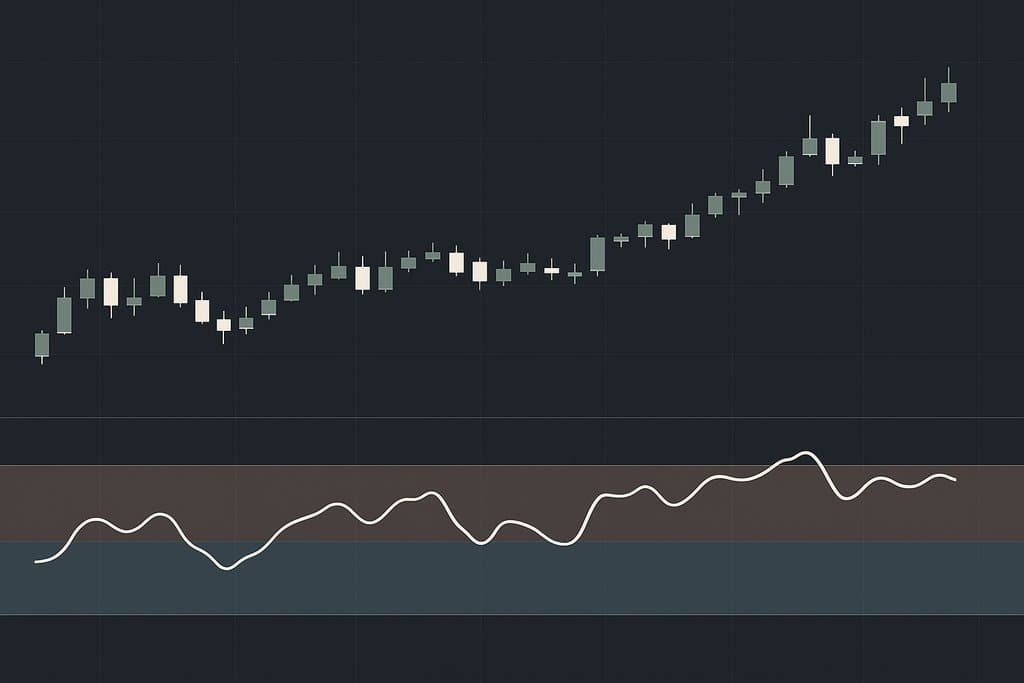
Every retail trader knows the RSI is "overbought above 70, oversold below 30." Every retail trader also loses money fading those levels in trending markets. The RSI is genuinely useful — but only when you stop treating 70/30 as triggers and start treating them as context.
This guide rewrites what most articles get wrong. You'll learn how to read RSI in regime, what settings actually fit your market, and how to convert RSI ideas into rules a machine can execute.
What the RSI measures
The Relative Strength Index, created by J. Welles Wilder, normalizes the ratio of average gains to average losses over a lookback window. It plots between 0 and 100. The standard formula:
RS = average_gain / average_loss   (over N periods, typically 14)
RSI = 100 - 100 / (1 + RS)
The default of 14 periods is a starting point, not a rule. Short settings (7, 9) react faster but produce more noise. Longer settings (21, 50) filter noise but lag. Match the setting to the asset's volatility — crypto often benefits from 7 or 9, daily equities from 14 or 21.
The 70/30 trap
Reading RSI as a binary signal is the source of most RSI losses.
- In a strong uptrend, RSI can stay above 70 for weeks. Shorting at 70 means standing in front of momentum.
- In a strong downtrend, RSI can hold below 30 for days. Buying at 30 catches falling knives.
The fix: read RSI as a range, not a threshold.
| Regime | RSI behavior | What it tells you |
|---|---|---|
| Strong uptrend | Oscillates 40–80 | Pullbacks to 40–50 are buy zones, not sell zones |
| Strong downtrend | Oscillates 20–60 | Rallies to 50–60 are short zones |
| Range / chop | Oscillates 30–70 | Classic mean reversion applies |
Identify the regime first. Then apply RSI within it.
Divergence: powerful, frequently misread
Two divergence types matter:
- Bearish divergence: price prints a higher high, RSI prints a lower high. Momentum failing to confirm price strength.
- Bullish divergence: price prints a lower low, RSI prints a higher low. Selling pressure exhausting.
Divergences are leading signals, but they can persist before price turns. The mistake is acting on the first divergence — markets routinely show 2–3 divergences before a real reversal. Pair divergence with structure confirmation: a break of the prior swing, a moving-average cross, or a candle reversal pattern.
Divergence tells you the trend is tiring. It does not tell you the trend has turned.
Failure swings: an underused signal
A failure swing is an RSI-only structure that often precedes price reversals.
Bullish failure swing:
- RSI drops below 30 (or your lower zone)
- RSI rallies, pulls back, but doesn't make a new low on the oscillator
- RSI breaks above the prior local high
This sequence can mark momentum reversal even before price structure breaks. Useful as an early-warning signal layered with other filters.
Three RSI strategies that work
1. Trend pullback with RSI confirmation
In an established uptrend (price > 200-day SMA), wait for a pullback. Buy when RSI holds above 40 or crosses back above 50 from below. Stop below the swing low. Exit when RSI loses 40 or price closes below the 50-day SMA.
Result: high R:R trend continuation entries. Works in trending equities and crypto.
2. RSI(2) mean reversion
Larry Connors' high-frequency entry on liquid index ETFs. Use RSI(2) instead of RSI(14).
- Long SPY when RSI(2) < 5 and price > 200-day SMA
- Exit when RSI(2) > 60 or after 5 sessions
Win rate often 65–75% in backtests. Small average win, high frequency. Sizing carries expectancy.
3. Divergence with structure confirmation
After an extended move, watch for divergence. Don't act on it alone. Add: a break of the trendline, a candle reversal at structure, and RSI back through 50. Trade-quality setups but lower frequency.
RSI by market
The default RSI(14) with 70/30 works adequately on diversified instruments but struggles on single names with persistent trends.
| Market | Recommended RSI period | Suggested zones | Notes |
|---|---|---|---|
| US large caps | 14 | 60/40 (trending), 70/30 (range) | Earnings cause RSI flips |
| Index ETFs (SPY, QQQ) | 14 or 2 | 70/30 or RSI(2) extremes | High-quality mean reversion setups |
| FX majors | 14 | 70/30 | Macro events can override RSI |
| BTC, ETH | 9 or 14 | 75/25 (crypto runs hot) | Weekend behavior different |
| Altcoins (top 20) | 9 | 80/20 | High volatility, extremes are common |
These are starting points. Backtest your specific instrument and timeframe to refine.
Multi-timeframe alignment
The strongest RSI signals come from alignment.
When the higher-timeframe RSI is bullish (holding above 50, ranging 40–80) and the lower-timeframe RSI dips to 30 and recovers, you have a high-probability trend-aligned entry.
A practical setup:
- Daily: RSI(14) > 50, holding above 40 on pullbacks → bullish bias
- 1-hour: wait for RSI(14) to drop to 30–40, then cross back above 45
- Enter long, stop below the 1-hour swing low
This pattern stacks regime and trigger across timeframes — a much stronger setup than either alone.
A complete RSI strategy you can ship
A swing strategy on S&P 500 constituents:
- Universe: S&P 500 constituents, daily bars
- Regime filter: price > 200-day SMA
- Entry: RSI(14) was < 40 in the last 10 days and now crosses back above 40
- Stop: 1.5×ATR(14) below entry day's low
- Targets: 50% off at +1.5×ATR, trail rest with 2×ATR
- Time stop: exit after 30 trading days if neither stop nor target hit
- Skip: within 5 trading days of the company's earnings date
That's seven rules. Each one testable. Each one automatable.
Where RSI signals leak edge
Three failure modes account for most RSI losses:
- Acting on the touch of 70/30 instead of the cross back — leads to fading strong trends
- Ignoring the timeframe — RSI(14) on a 1-min chart is barely related to RSI(14) on a daily
- Over-stacking with other oscillators (Stochastic, MACD, MFI) — they correlate heavily; you're not getting independent signals
Automating RSI rules
The rule set above is too tedious to execute manually across 500 names. Obside scans your universe and acts on confirmation.
Describe the strategy in plain English to Obside Copilot:
"On S&P 500 daily: when RSI(14) crosses back above 40 after being below 40 in the last 10 days, and price > 200-day SMA, buy 0.5% of equity. Stop at 1.5×ATR below entry day low. Take 50% off at +1.5×ATR, trail rest at 2×ATR. Skip within 5 days of earnings."
Copilot translates that, runs a backtest in seconds, and goes live across your watchlist when you're ready.
Create a free Obside account to convert your RSI rules into automated scans, alerts, and trades — across hundreds of instruments at once.
Educational content only. This is not investment advice. Trading involves risk, including possible loss of capital.
FAQ
Default is 14. Use 7 or 9 for crypto and short timeframes where you want faster signals. Use 21 or higher for noise-heavy intraday data. RSI(2) is a specialized tool for mean-reversion strategies.
Related articles
- Technical Analysis: Read Markets Like a Pro
- M Pattern Trading: Master the Double Top Strategy
- W Pattern Trading: Complete, Practical Double Bottom Guide
- Trading Strategy: Build, Test, and Automate Rules That Last
- Day Trading Strategies: Proven Setups and Risk Rules
- Trading Automation: From Idea to Real-Time Execution
Try Obside on your portfolio
Connect your broker and automate your strategy with a prompt.
Get started