
Small Account Trading Strategy: A Realistic Plan for Accounts Under $10,000
How to trade a small account without blowing it up: rules that survive the PDT restriction, position sizing that fits a four-figure balance, and automation that removes the most expensive mistakes.
Most advice about growing a small account is written by people selling the dream of turning $500 into $50,000 by summer. A workable small account trading strategy starts from the opposite premise: with limited capital, your first job is not to get rich, it is to survive long enough for skill and compounding to matter. This guide covers the constraints that actually bind small accounts, the strategy styles that fit them, and how to enforce the discipline that decides everything.
The constraints that define small account trading
The pattern day trader rule. In the United States, a margin account under $25,000 is limited to three day trades in any rolling five-business-day window. Break it and your broker restricts the account. There are three legitimate ways around the PDT rule: use a cash account (no PDT flag, but you trade only settled funds), trade instruments outside its scope such as futures, or simply hold positions overnight and swing trade instead. For most beginners, the cash account or the swing timeframe is the clean answer.
Commissions and spreads bite harder. A $2 round-trip cost is noise on a $50,000 position and 0.4% on a $500 one. Small accounts should gravitate toward liquid, tight-spread instruments — major ETFs, large-cap stocks — where transaction costs do not silently consume the edge.
One mistake is a big percentage. A single undisciplined trade that loses 20% of a $2,000 account requires a 25% gain just to get back to even. The math of drawdowns is the real enemy, which is why every serious framework starts with risk per trade, not with entries.
Position sizing: the 1% rule on a four-figure account
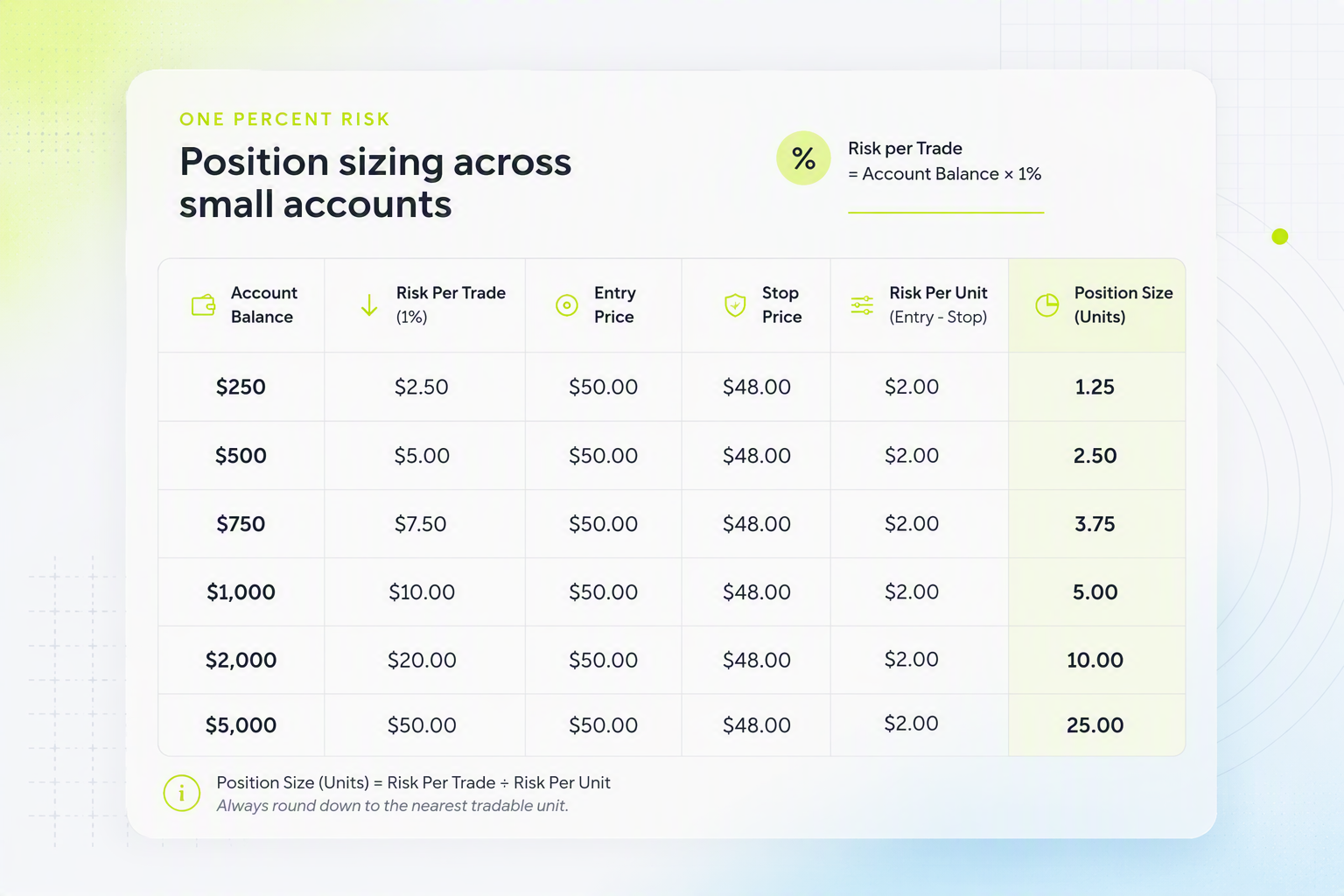
The widely used guideline is to risk no more than 1–2% of account equity on any single trade. On a $3,000 account, 1% is $30 of risk. That is not $30 invested — it is $30 between your entry and your stop. If your setup needs a stop 3% below entry, your maximum position is $1,000.
Run the numbers before every trade, or better, make them a standing rule. Fractional shares have made this practical: you can size a position at $412 instead of rounding to whole shares. Pair the per-trade cap with a hard daily maximum loss — for accounts in the $2,000–5,000 range, common practice is $50–100 — and stop trading for the day when it is hit. The traders who blow up small accounts are rarely the ones with bad entries; they are the ones who revenge-trade after hitting a limit they set for themselves the night before.
Strategy styles that fit small accounts
Swing trading liquid ETFs. Holding for days to weeks sidesteps the PDT rule entirely, keeps you in tight-spread instruments, and reduces screen-time pressure. Pullback entries within an uptrend — waiting for a higher low near a rising moving average rather than chasing strength — remain the standard playbook because they define risk naturally: the stop goes under the recent low.
Systematic accumulation with tactical adds. Less glamorous, brutally effective: a scheduled buy of a broad index ETF, plus a rule that adds a second slice on defined dips, for example a 5% drawdown from the 30-day high. This converts volatility from a threat into a discount mechanism, and it compounds without demanding daily decisions.
Mean-reversion on indices. Strategies that buy short-term weakness in a long-term uptrend (an oversold RSI reading on a major index ETF, exit on strength) historically produce many small wins with occasional larger losses — a profile that suits small accounts psychologically, provided position sizing is honest about those occasional losses.
One setup, mastered. Whatever style you pick, trade one setup until you have dozens of occurrences of data on it. Small accounts cannot afford tuition across five strategies at once. The account is small; the sample size of your discipline does not have to be.
What to avoid is equally clear: heavy leverage, illiquid small caps with wide spreads, and anything sold as a shortcut. Leverage does not fix a small account; it accelerates whatever was already going to happen.
Automating the discipline: the real edge for small accounts
Every rule above fails at the same point — the moment you are tired, tilted, or busy. This is where automation changes the economics of small account trading, because software applies rules with none of the emotional overhead that destroys manual traders.
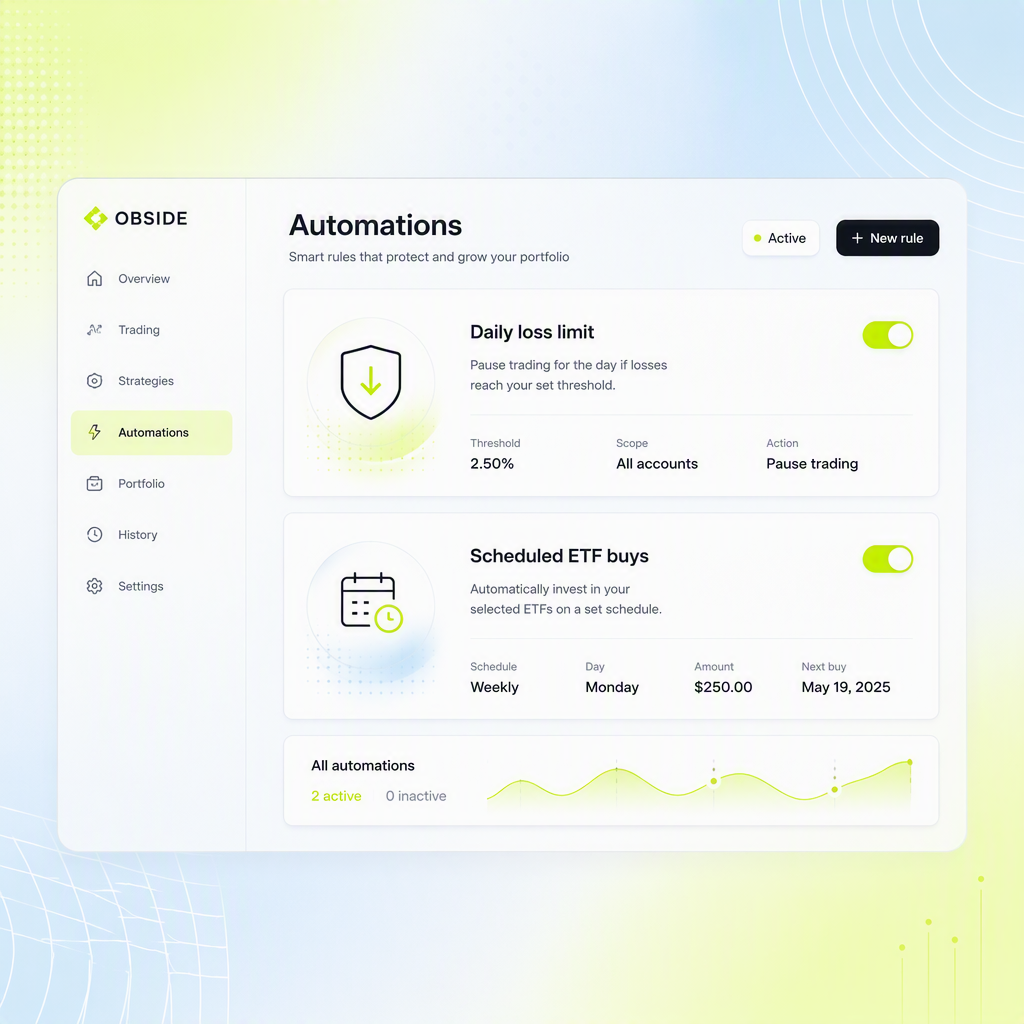
Obside is built for exactly this: you connect a compatible broker, describe your rules in plain language, and the platform turns them into automated agents that watch markets and execute around the clock on price, indicator, macro, or news triggers (feature live as of 2026-08-27). The rules from this article translate directly. A scheduled ETF buy with a dip-add condition becomes a two-line prompt. A 1% risk cap and a maximum drawdown guardrail become standing constraints an agent will not argue with at 3 p.m. on a red day.
Two features matter specifically for small accounts. Backtesting lets you replay a strategy against years of historical data — equity curve, max drawdown, win rate, with slippage assumptions included (as of 2026-08-27) — so you learn what a 2022-style year does to your rules before real dollars find out. And paper trading runs the same agent on live data with no capital at risk, which is the correct place for a $2,000 account to spend its first month: proving the process while the balance stays intact. Obside automates your logic rather than recommending trades — the strategy is still yours, which is the point.
The math nobody shows: costs, expectancy, and realistic growth
Small account advice usually skips arithmetic, so let us do it once, honestly.
Take a $3,000 account trading a swing strategy with a 45% win rate, average winners of 2R and average losers of 1R — a modest, achievable profile. At 1% risk per trade ($30), expectancy per trade is 0.35R, about $10.50. Twenty trades a month yields roughly $210, or 7% monthly before costs — a genuinely strong result that most months will not deliver, because trades cluster and drawdowns arrive in streaks. A five-trade losing streak, entirely normal at a 45% win rate, costs $150 and, more dangerously, tests whether you keep taking the sixth signal.
Now add costs. If each round trip costs $2 in spread and fees, twenty trades cost $40 — nearly a fifth of the expected edge. Halve the trade frequency or tighten instrument selection and the picture improves immediately. This is why instrument choice is a risk decision, not a preference: on a small account, costs are a position that always loses.
Run your own numbers with your own strategy's statistics — from a backtest, not from hope. If expectancy after costs is negative, no amount of discipline fixes it; if it is positive but thin, the plan stands or falls on executing every signal identically, which is exactly the argument for handing execution to rules rather than moods. And treat monthly return projections with suspicion, including these: the honest use of this arithmetic is comparing strategies and cost structures, not promising yourself a compounding schedule.
A 90-day plan for a $2,000–10,000 account
Days 1–30: define and test. Write down one strategy with exact entry, exit, stop, and sizing rules. Backtest it across at least one bad market year. If you cannot express the strategy precisely enough to backtest it, it is not a strategy yet; it is a mood.
Days 31–60: paper trade it. Run the rules on live data, ideally as an automated agent so the execution matches the test. Track every trade. The goal of this month is not profit; it is confirming that live behavior resembles the backtest and that you can leave the rules alone.
Days 61–90: go live small. Fund the strategy with an amount whose total loss you could absorb without flinching. Keep the daily loss limit active. Review weekly against the paper results, and resist the urge to double size after the first good week — the sample is still tiny.
Progress on a small account is measured in process metrics first: rule adherence, risk per trade, maximum drawdown. Review those weekly the way a business reviews its books — the numbers are small, the habits are not. The balance follows the process with a lag, and never the other way around; traders who invert that order spend their tuition twice.
One more constraint deserves naming: time. Most small-account traders have day jobs, and strategies demanding hours of daily screen time fail for scheduling reasons before they fail for market reasons. Choose an approach whose decision points fit your actual calendar — daily-close rules for busy weeks, alerts that come to you instead of charts you must watch. A mediocre strategy you can execute every single week beats an optimal one you abandon in month two, and automation exists precisely to make the executable set larger than your free evenings.
Educational content only. This is not investment advice. Trading involves risk, including possible loss of capital.
FAQ
Swing trading liquid ETFs with defined-risk pullback entries, or a systematic accumulate-and-buy-dips approach, are the most defensible starting points. Both avoid the pattern day trader rule, keep transaction costs low, and translate cleanly into testable, automatable rules.